| Author |
 Replies: 9 / Views: 1,812 Replies: 9 / Views: 1,812 |
|
|
New Member
United States
28 Posts |
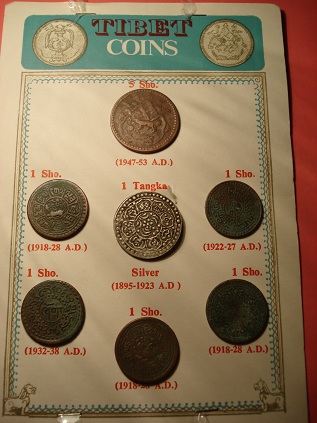
I was wondering about several sets I have that were purchased on the street over the years in different countries. I never spent much time with them because they are in cheap shrink wrapping, labeled with poor grammar, and have a tourist postcard packed with them. However, some of the coins look interesting in some of them.
Is there any reason to leave them in the shrink wrap? What is the chance they are real? I wonder what they are glued to the cardboard with?
Anything anyone knows would be beneficial. I can post pics if that helps.
|
|
|
|
Pillar of the Community
United States
565 Posts |
If it was me I would put them in 2x2 the coins and keep post card with it if the trip was important. That way you can remember the trip and what you did. As far as value of coins we would need pictures. That would be the best way for now. IMHO  |
|
New Member
 United States
28 Posts |
I want to rip them out of the plastic and examine them. I will ruminate overnight then approach them. Pics to follow. Some are either from ancient times or Guido made them in his basement last year.
|
|
Moderator
 Australia
17030 Posts |
The souvenir-makers rarely know or care whether the products they attach coins to or with are "coin-safe". So they very often aren't. If they've been in packaging like that for years, be prepared to discover coins too badly damaged to save. I recently spent several days cleaning/conserving a bunch of Thailand coins that had been glued onto cardboard. They'd been really high-grade (but common) coins when they were attached in the 1970s, but most were unsalvageable; the glue came off in acetone OK but the plasticized cardboard had turned the side of the coins touching the cardboard green and fuzzy everywhere except where the glue blobs had "protected" them from direct contact.  Don't say "infinitely" when you mean "very"; otherwise, you'll have no word left when you want to talk about something really infinite. - C. S. Lewis
|
|
New Member
United States
28 Posts |
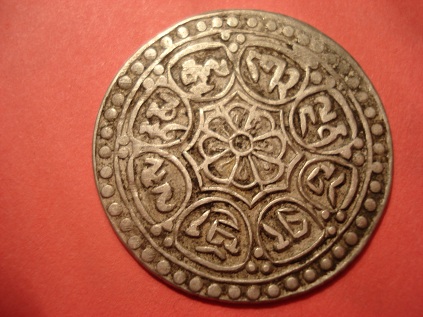
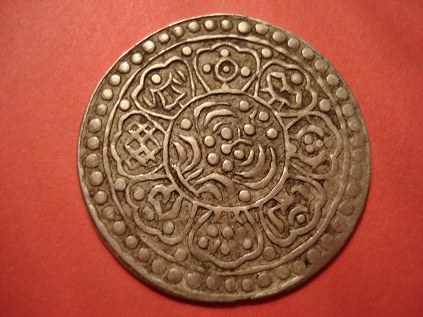
These must not have been glued too long, and it was apparently water based glue. I soaked one and it all came off with no problem to the naked eye. It is a silver Tibetan coin, I will post a pic tomorrow.
|
|
New Member
United States
28 Posts |
Okay, after a delay, here is one...
|
|
New Member
United States
28 Posts |
|
|
Moderator
Australia
17030 Posts |
Yep, looks genuine enough to me. It's a typical "Ga-Den tangka". On the reverse (top pic), the Tibetan script in the eight segments translates to "Ga-Den Palace victorious in all directions". On the obverse are eight "lucky symbols". These coins are categorized into eight major types, based on the symbols placed between the segments at the rim, which are then further subdivided into varieties based on other factors. With three-dots on the reverse and one-dots on the obverse, yours is Type F, the variety is the one listed as KM/Y# F13.4 in Krause. Krause reports this variety was struck in the period 1912-1922. Example on zeno.ru. Don't say "infinitely" when you mean "very"; otherwise, you'll have no word left when you want to talk about something really infinite. - C. S. Lewis
|
|
Pillar of the Community
United Kingdom
2942 Posts |
It's not that long ago that I could buy these in lots at about £3 apiece. Like everything else their value seems to have shot up and they are now about £10 apiece
|
|
New Member
United States
28 Posts |
Thank you all. Now on to the Bhutanese coins.
|
| |
Replies: 9 / Views: 1,812 |
|




 Posted 04/12/2011 11:04 pm