| Author |
 Replies: 10 / Views: 4,650 Replies: 10 / Views: 4,650 |
|
|
New Member
United States
14 Posts |
I recently discovered what I think may be a major die break on a 1923 Mercury dime. The grade of the dime would be about a G06, so it is very well circulated. But the odd thing is that it looks to have a Cud on both sides of the coin, the front Cud being much larger along the rim between the "L" and the "I" on LIBERTY, while on the backside of the coin, the Cud extends from the "U", almost completely covers the "N" and flows to the "I" in UNITED. The rime along this area of the coin is also slightly filled in with some of the die break. I wish I had a good camera (any recommendations on this) to take a picture so that I could show you what it looks like. BUT, my question is HAVE any of you EVER heard of a double sided major die break that produced a Cud on both sides of the coin in the same area? Part of me is saying, THIS cannot be real, while the other part is saying, MAYBE it is real. Any help would be GREAT! Thanks |
|
|
|
Pillar of the Community
United States
2589 Posts |
youd need to post pics in order for us to diagnose and verify it
|
|
New Member
 United States
14 Posts |
I am not asking for a diagnosis of the Cud or verification of the Cud. I am asking if ANYBODY has heard of, or seen a coin with a double sided Cud. And, I mean the true meaning of a Cud against the rim of a coin. The two Cuds are in the exact same area when you flip the coin over. One is more prominent on the one side than the other. The Cud is not flat, but it looks to be as though the die piece may have adhered to the coin on both sides, because you can see where it flowed onto the coin. There is evidence on the side of the rim in the groves on the rim since this is a dime. I will be sending it out for verification, BUT I need to know a possible value. If I can find out if there are any other KNOWN coins with this type of attribute, then I may be able to do a more detailed search on finding its value. I know it is a long shot, but I thought that if anybody had heard of or seen a double sided Cud, you guys would be the ones to ask. Thank you for any help. Once I can place a value on it and send it off for verification, and it is determined to be what I think it is, then I will get pictures and post for everyone to see. I am not anticipating selling this coin, but I will need a value for insurance purposes. Thank You. |
|
New Member
United States
14 Posts |
These are not perfect as my camera is not as good as I would like it to be. 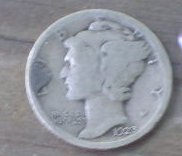 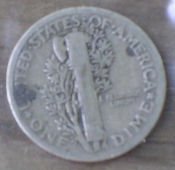 |
|
Bedrock of the Community
United States
12437 Posts |
Those are not Cuds and they are not even part of the coin- notice how the colors do not match. That dark grey color could indicate lead solder. |
|
New Member
United States
14 Posts |
WOW! Thanks for saving me the cost of having it certified. Now I can put it back in my box of coins "to be melted" if necessary.
I was under the impression that if a die broke and adhered to the coin, then it could look like this because the die itself was not made of silver. I guess I was wrong.
Thanks for saving me the expense of sending it off for certification.
|
|
Pillar of the Community
United States
6429 Posts |
It may be you aren't using the term correctly. A Cud is the result of a die losing a piece of its striking surface (face) at a point along the rim. When that die then strikes a coin, some metal from the planchet flows into the void at the point where the die is incomplete. This creates the blob-like patch we call a Cud. The Cud is the same composition as the rest of the coin and does not contain any of the steel from the broken die. By the way, for a coin to have Cuds on both sides both dies would have to be damaged. It seems very unlikely this could happen without some help from a mint employee. Edited by Jaobler
04/15/2011 9:34 pm
|
|
New Member
United States
14 Posts |
That is what I thought too, until my husband said that the planchet is solid when struck. Then I read about the times when a piece of the broken die could adhere to the surface of the coin (retained Cud?). But, also, there would have to be enough heat generated from the striking process to make this possible. Which, I believe could happen, but if what you say is true (and this was my original belief until my husband made his comment), where did the coin material come from to cause the flow? Would all Cuds have a reverse that was concave? Some people have said that they would, which makes sense. In all fairness, when I first discovered these places on the coin, my first thought was that it was solder. It was only after my husband's comment and then I read about pieces of the die adhering to the coins on some breaks that I began wondering. And, since the only way it could be authenticated would be to send it off, that was my intention. But, because ANACS needs a value for insurance, and because I could not find any source for a double sided Cud, I came here with my question. I didn't mean to offend anyone with my comment about it being a Cud. I just knew that if it was a anomaly from the striking of the coin, then it would be a Cud. But thanks to biokemist6, I know it is worth about $2.74 and definitely not worth the cost of having it authenticated. |
|
Moderator
 United States
23522 Posts |
If a piece of a die has ever adhered to a coin that it struck, I've never heard of it. Dies are significantly tougher metal than the planchet itself, and it's hard to imagine a "weld" happening between the two materials. Either way, it would be plainly obvious what happened; there would be no chance of believing it was part of the coin. The difference in metals, as on the coin you picture here, would be too obvious. A Cud, as we're discussing it here, is purely part of the planchet flowing into an area it normally can't. A Retained Cud is when the broken part of the die hasn't completely fallen away - maybe you'll see mushiness and obscured details. Like so: 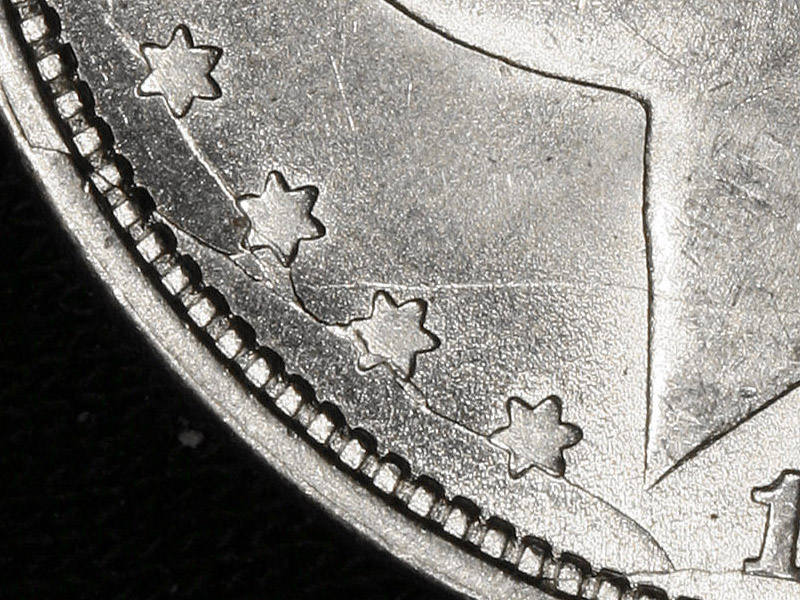 You can see where one part of the die has cracked completely loose, but the details are still there. If you look at it from the right angle (not shown here), you'll be able to see that the two pieces are not on the same level - the broken piece will be "higher" or "lower" than the rest of the coin. A "full" Cud is when the broken piece of the die has vanished, and the area it used to occupy becomes just a blob of metal with no details at all. Like so: 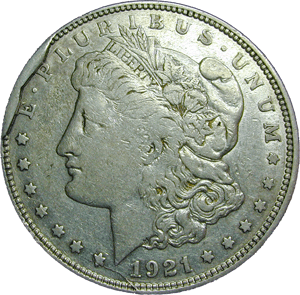 *That* is what a truly full Cud looks like. Normally, a Cud doesn't leave such a big void that the planchet can't successfully expand into it. Broken dies don't necessarily break deep; just a relatively shallow chunk of metal that doesn't leave a huge hole. Some Cuds, though, are serious enough so that the rest of the coin strikes weakly because there's not enough metal left after filling the Cud to become a full strike. The picture above is one of those. Look at the lettering above and right of the Cud; there's not enough metal left to fill all the details. |
|
New Member
United States
14 Posts |
Yes, thank you. I can see where the bottom of the "L" did not fully form. Thank you very much for showing me this example and explaining it to me.
|
|
Pillar of the Community
United States
2764 Posts |
|
| |
Replies: 10 / Views: 4,650 |
|










 Posted 04/14/2011 9:51 pm


