| Author |
 Replies: 13 / Views: 3,294 Replies: 13 / Views: 3,294 |
|
|
Valued Member
United States
117 Posts |
Just curious as how to tell the difference?
|
|
|
|
Bedrock of the Community
United States
62064 Posts |
Usually a worn coin will weigh less. Extra Thickness is a vague term?
|
|
Pillar of the Community
United States
3592 Posts |
Ask, post pics,rinse,repeat...in other words..experience
|
|
Valued Member
 United States
117 Posts |
OK sorry I did not mean to be vague. On some DDO the description will state extra thickness on date, liberty, etc... Now to me, even using pictures at chucks site, it is very hard to tell the difference between extra thick letters and just normal flattening that occurs during the life of the coin. I was just wondering if there were any tips to distinguish the two. Edited by ebm
04/20/2011 10:11 pm
|
|
Pillar of the Community
United States
3640 Posts |
I'm glad this was brought up. I even have trouble when seeing listed DDO's etc. with attribute pics. of extra thickness. I can stare at the pics. for an hour and see no doubling whatsoever. I'm sure it will have to do with die state/stages and metal flow etc. But still tough to distinquish. |
|
Bedrock of the Community
United States
62064 Posts |
Most circulated coins tend to flatten from the abuse they get during circulation. The more it is out there the more the flattening happens. But in the case of a a flattened coin, you would need to compare how the other devices have flattened and see if any are wider/notched. So a side by side comparision helps. here is an AU example with another coin to compare it with: 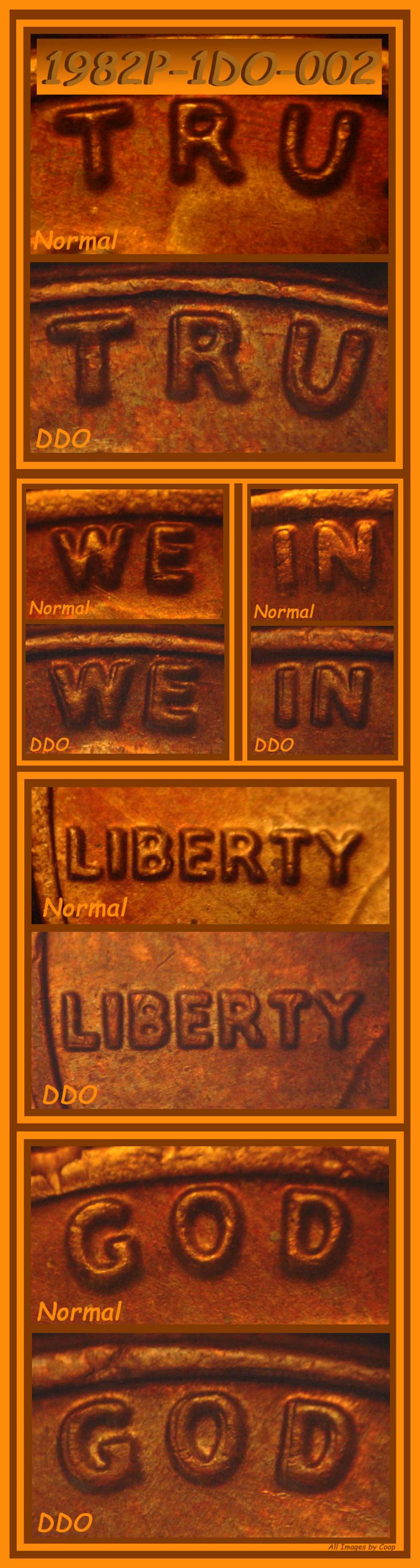 So in the case of a flattened coin compare it to the other devices. If it is questionable, likely if you were to sell it it would probably not sell. The more obvious a doubled die is, the more desireable they become. Hope this helps. |
|
Valued Member
United States
117 Posts |
Thank coop. I appreciate the pics. Specifically I was referring to a DD that shows no separation or notching. Take the 1940-P (Daughtrey 1940P-1DO-001 CONECA 2-O-VI) for example. The description is extra thickness on the date and LIBERTY. I don't want to link to Chuck's photo without his permission, but if you look it up, you can see no notching just extra width. This is just one example, there are many that seem to have a similar description of "extra thickness". My problem seems to be differentiating this extra thickness from the normal spread as the coin is abused..... when there are no notches or "spread".... just thickness.
|
|
Bedrock of the Community
United States
17884 Posts |
Linking to one of Chuck's pictures should be fine (Because you are going to HIS site where it is available), or copying and posting the picture here, especially with credit, should be fine because it falls under fair use in the copyright laws.
The problem is that at least one class of doubled die does not show separation or doubling of the features, just a thickening of the lettering. (I believe it is distorted hub doubling.) On high grade coins it is identifiable, but I'm not so sure on worn coins where the wear tends to broaden the features. It might only be identifiable there through die markers noted from higher grade coins.
|
|
Bedrock of the Community
United States
62064 Posts |
http://www.coppercoins.com/lincoln/...ie_state=mdsOn the devices, they should all be the same width/height as the ones pictured in order to be from that die. The 9 on the date is a good place to start as well as the doubled die on the reverse. If they are not the same, then it wouldn't be that die number.
|
|
Valued Member
United States
117 Posts |
|
|
Pillar of the Community
United States
7629 Posts |
Generally in all cases, the following will be true:
1. On a class 6 doubled die the doubling will be stronger closer to the rim - so the extra thickness will show more on the L of LIBERTY than the R, for instance. On beaten down coins, the thickness will be more or less uniform all over the coin.
2. On a class 6 doubled die, the outer edges of the thickened devices that parallel the rim will often have a concave "pulled" effect near the corners. Pounding on a coin until the devices are thick never produces this effect.
3. Class 6 doubled dies ALWAYS show better thickness on device areas that are parallel with the rim. Usually the parts of the devices that are perpendicular with the rim are normal. So, for instance, the you of TRUST will have more or less normal uprights where the bottom will be extra thick. This effect is never repeated with pounding on a coin to thicken the devices.
4. VERY often, pounded coins show the wear in other ways to give you a hint that's what you are looking at. Pitting from hits, missing details because of the hits...something.
5. Class 6 doubled dies are generally the lesser valuable of all classes of hub doubling - primarily because they don't show separation and many people don't really understand what they are. This makes them less popular, thus less valuable over all. There are exceptions to this rule...BUT...given that class 6 doubled dies are generally not worth very much unless in higher grades, I would simply toss all the coins that are difficult to tell class 6 from pounding back in the reject pile. Even if they are class 6 doubled dies, they are going to be difficult to impossible to round down to a specific die number, thus are just too much trouble to bother with.
I normally pass over coins that are even obviously class 6 doubled dies unless they are at least a nice EF or better. If this is the case, you generally don't ever have to worry about thickened devices due to wear.
|
|
Pillar of the Community
United States
7629 Posts |
Two more things...
1. I don't understand why Coop used a class 5 doubled die to help with understanding class 6 doubling. As far as I'm concerned, this muddies the waters more than it helps. Class 5 and class 6 doubled dies are completely different from one another.
2. It doesn't matter to me who uses images from coppercoins.com as long as they are used for educational purposes. My big issue with people using my images is when they steal the images for personal gain - like to use them to sell coins in online auctions. There's a clear distinction between the two, and the former is anyone's game. Feel free.
|
|
Valued Member
United States
117 Posts |
Chuck,
This was the exact info I was looking for, thanks. I had kinda given up looking for those class 6 because it IS just too difficult, at least for me to tell the difference.
BTW thanks for clearing up the picture thing, I just didn't want to cost you bandwidth without asking.
|
|
Bedrock of the Community
United States
62064 Posts |
I was trying to show how side by side comparisions could help one to see if it was normal or not. A bad choice on using the wrong class number, but comparision to another from the same year might help to see if a coin is normal or it has some doubling on it.
|
| |
Replies: 13 / Views: 3,294 |
|







 Posted 04/20/2011 9:59 pm





