| Author |
 Replies: 17 / Views: 7,371 Replies: 17 / Views: 7,371 |
|
Pillar of the Community
United States
2250 Posts |
I've posted question this in many coin forums and no one has been able to answer it. Why is it that only the lettering and the date of the 1955 Lincoln are doubled? Why isn't the portrait doubled as well? One person answered that the portrait is in fact doubled, but that simply is not true. 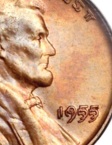 As you can see the date and words are heavily doubled, while the portrait is clean and precise. Edited by jpsned
04/21/2011 10:32 pm
|
|
|
|
Pillar of the Community
United States
7629 Posts |
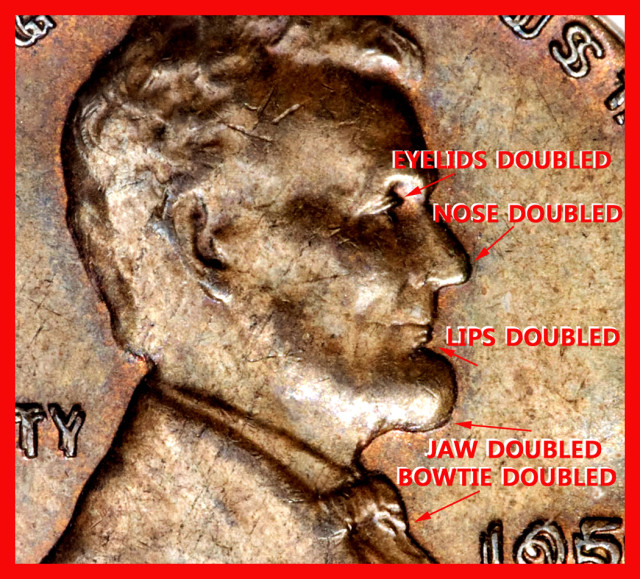
I'm not sure what to tell you except that the people in the other forums were correct. The portrait is doubled.
|
|
Bedrock of the Community
United States
62064 Posts |
|
|
Pillar of the Community
967 Posts |
|
|
Pillar of the Community
United States
7629 Posts |
The lapel and hair are also strongly doubled.
|
|
Pillar of the Community
United States
7629 Posts |
Basically it's like this. You need to know what you're looking for before you go professing something to a number of different message boards that may be (and is in this case) incorrect. Here's how this doubled die works:
The 1955 Doubled die is a class 1 rotated hub doubled die. What this means is that the entire design is doubled rotated on an axis near the center of the design. Like the spokes of a wheel, the doubling gets stronger (farther apart) as you get closer to the edge of the design, just as the spokes get farther apart. Areas near the center of the design will show no apparent doubling, then the farther you get from the center of the design the stronger the doubling will be.
You see...very basic to the die making process is the FACT that the entire design is placed into the die using a positive image of the coin's design - called a "hub". It is simply impossible to place part of a design into the die, then place another part in a different fashion at different time. So, to that effect, if any part of a die's design is doubled, the entire design is actually doubled to some effect, regardless of whether it is enough to be visible. There are only two exceptions to this that I will not get into in this post, but suffice to say that over 90% of doubled dies are doubled all over the design.
So...whether you care to believe it, and whether you go to yet another message board professing there's no doubling on the portrait - there is, and that's a fact.
|
|
Pillar of the Community
United States
3640 Posts |
Any links to more info on the exceptions ?
Was it discussed on here at one time ?
Thanks
|
|
Pillar of the Community
United States
7629 Posts |
I didn't want to muddy the waters here with a detailed description - but since you asked... Dies start out with a conical shape to the coining surface. As the hubbing happens, the design elements impress into the center of the die first, then work toward the outside edge of the die. During the multiple hubbing days, it was very common for dies to go into the oven for their first post-hubbing annealing with only the center 10-20% of the design hubbed into the die. If that hubbing is off, then all the other hubbings are on, we end up with a coin that shows doubling only in the center of the design and nowhere else. The 1984 doubled ear is one of the best examples of this. Class 8 hub doubling, or 'tilted' hub doubling describes doubling that takes effect because the hub is not plumb with the die when it impresses design into the die. This catches just one edge of the die doubling some feature around the edge of the design only. The 1963D doubled die with the doubled 3 of the date is one of the best examples of this class of doubling, as is the first piece discovered with this class, the 1964 doubled die on which only the L of LIBERTY and the word IN are doubled. This die at one time was referred to as 1964 1c 22-O-VIII. I'm not sure what the current die numbers are...but this was the first die classified as a class 8 tilted hub doubled die. Another exception is in the newer class 9 'shifted hub doubling' doubled dies where the hub and die start out slightly out of alignment, and with the pressure of the hubbing the die snaps into place, and the hubbing continues. This class of doubling generally only shows in the very center of the design, and is basically limited to the single squeeze die production technique known to have been used at least from 1997 to present. All of the doubled column Lincoln cents and all of the Statehood Quarter doubled dies are class 9 doubled dies. Those are your exceptions. |
|
Pillar of the Community
United States
7629 Posts |
The 1955 doubled die is a class 1, rotated hub doubled die. It occurred when the set key wore off or was removed from the edge of the die before it was complete. When the die was set into the hubbing press for one of its last hubbings, it was rotated a dozen or more degrees off of the alignment of the rest of the hubbings. When the hubbing press came down on the die, the entire design was off...meaning that by definition the entire design is doubled. When you rotate a wheel from its axis if you rotate a point near the center of a spoke one inch around the center of the wheel, a fixed point near the outside of the wheel will naturally move farther, and a point closer to the center of the wheel will move less. Simple physics. In fact, if the wheel is much larger, the outside points move farther. So, with that to wit, if a Morgan dollar were hubbed with the same rotational offset as the 1955 cent doubled die, the effect on "E PLURIBUS UNUM" at the top of the obverse would be massive. The letters wouldn't even touch their doubled counterparts. The doubled stars wouldn't even touch each other. Take the same degree of rotation out to the size of a dinner plate with design elements as small as those on the Lincoln Cent - and LIBERTY would be doubled a full inch or more off of its doubled counterpart. They wouldn't come close to touching. BUT... with any of these examples, the design elements very close to the center of the design would remain nearly unaffected because if you put your finger on the axis of a wheel and spin the wheel - your finger doesn't move. Same theory. |
|
Valued Member
United States
134 Posts |
And now I almost fully understand doubled die. Thanks coppercoins.
|
|
Pillar of the Community
United States
1547 Posts |
Quote:
And now I almost fully understand doubled die. Thanks coppercoins. You're not the only one. Chuck, the more I read the things you say, the smarter I think you seem to get.  |
|
Pillar of the Community
United States
4000 Posts |
Quote:
...almost... Help me with something. I'm having a hard time visualizing how the final hubbing does not obliterate previous hubbings. Is it because the field of the working hub never actually reaches the field of the working die? |
|
Pillar of the Community
United States
7629 Posts |
Umm, no. Remember that a hubbing resembles pushing a coin into modeling clay. In that process you are creating a negative from a positive. Pushing a design into clay, moving it, then pushing it into the clay again would cause cavities in the clay in the general shape of two designs next to one another that are very closely spread apart. In other words, they don't affect one another. This is why the devices of a doubled die are wider than normal with a separation between the two different sets of devices. You are thinking about double striking a coin with a die, which causes the opposite effect. The die has cavities that allow the planchet to strike up into them causing raised relief on the coin. If a coin is struck, moved, then struck again, the field will flatten all the raised areas, and because the areas that were already flat are not thick enough to strike up into the moved cavities, they usually remain flat. This difference is the very basic fundamental difference in how to tell doubled dies from Machine Doubling. |
|
Pillar of the Community
 United States
2250 Posts |
Coppercoins--thank you for the explanation. I do understand now how and why the portrait can appear to be not doubled when in fact it is, and at the same time the letters and numbers appear severely doubled. I get how the outer part of the rotation would appear more drastic than the inner.
Edited by jpsned
04/24/2011 11:17 pm
|
|
Pillar of the Community
United States
3552 Posts |
Hi,
Could anyone post a URL link or two demonstrating this entire process via illustrative video(s) essentially guiding the viewer from womb to tomb: or at least from the raw materials stage up to and including the final product just before it hits the banks en route to becoming known as a circulated coin...?
I sure would appreciate it.
gracias,
mdpmedia
|
|
Valued Member
United States
388 Posts |
Very cool info coppercoins. I've read this same info on a few different sites. I like this condensed version of your. Straight and to the points. Especially about the double strikes. Thank you.
|
| |
Replies: 17 / Views: 7,371 |







 Posted 04/22/2011 01:49 am