| Author |
 Replies: 8 / Views: 2,447 Replies: 8 / Views: 2,447 |
|
|
Pillar of the Community
Norway
510 Posts |
I found this coin for sale and jumped on the chance, as I have a collection of different denominations. 6 1/4 is definitely not the most common variety. I also liked the shape. Now I will have to try to learn more of the history behind the coin. If anyone already know why this unusual shape was chosen I would be grateful if they would share the information with me. The coin is onesided. 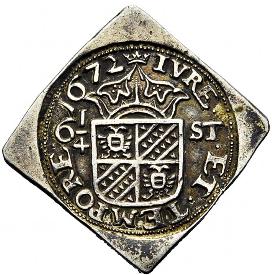 |
|
|
|
Pillar of the Community
Germany
1238 Posts |
The denomination may look odd but makes some sense. :) Back then, the rijksdaalder was (roughly) equal to 50 stuivers. So 25 stuiver would be half a rijksdaalder, 12 1/2 stuiver = 1/4 rijksd. and 6 1/4 = 1/8 rijksdaalder. Such "klippe" coins were easier to make especially in difficult times. 1672 was such a "difficult" year for Groningen, see http://en.wikipedia.org/wiki/Siege_of_Groningen (click on "Nederlands" on the left to get a more detailed article in Dutch). Problem is, the siege did not really last very long, and AFAIK Groningen did not have a regular mint. :) Those pieces were also (in fact, mostly) made after the siege was over, because people apparently liked them. Here are two similar pieces - a 25 stuiver and a 50 stuiver coin: http://www.ma-shops.de/mpo/item.php5?id=3275http://www.ma-shops.de/mpo/item.php5?id=119(Edit) This is a "background" article in English about such siege issues: http://www.coinlibrary.com/wpns/clu..._siege2.htmlChristian Edited by chrisild
04/22/2011 04:48 am
|
|
Pillar of the Community
France
1591 Posts |
Beautiful klippe coin indeed :)
I like their style very much - it's on my search list (for a mexico klipe though - I don't collect for the same region)
|
|
Pillar of the Community
 Norway
510 Posts |
Thank you for the info Christian!  Very interesting to read. I guess 1/8th of 50 is not that strange, still it is not something one sees every day. I wonder a little about the information that Groningen did not have a regular mint  In my 1600s Krause you can read: "The Groningen Mint was closed in 1692. The following coins were struck at the Harderwy Mint of Gelderland". Appears to me, then, they had a mint up until then. But that mint might very well have been out of reach during the siege. Another thing I noticed in Krause. These coins are placed in the "City" subsection of the "Groningen and Ommeland" category, as opposed to the "Republic" subsection. But the shield has the same design as the coins of the Republic, not the City. As an OFEC-collector this gives me a little dilemma as to where to put this....especially as I already have an old coin from Groningen (without the Ommeland) and would welcome an addition. I regularly follow Krauses partition, unless I have strong motivation for doing otherwise, so I guess I will make these into two different places. If this offends any OFEC-collecting readers please feel free to argue against my decision. |
|
Pillar of the Community
Germany
1238 Posts |
Well, what do I know ... ;) The city of Groningen had and has the eagle in its CoA, and the "Frisian style" hearts represent the surrounding area (Ommelanden). So I would guess that a coin that shows a combination of both is a Groningen and Ommelanden (city of G. and surroundings) issue. Problem is, my knowledge when it comes to those times is spotty at best. As for when the mint was closed, this article http://www.grunn.nl/historie/uitgeb...n=view&pid=6 says that the city's own coin production ultimately ended in 1692 ("wordt de eigen muntslag - die dateert uit plm. 1370 - definitief beëindigd en wordt ook het provinciaal munthuis gesloten"). That sounds as if the mint had had its ups and downs before ... and if you look here http://www.duiten.nl/ommelanden.htm they talk about how the mint was closed, because of the "bad" coins made there, in the late 16th century for example. That page even mentions your new acquisition: "de eenzijdig geslagen munten van 50, 25, 12 1/2 en 6 1/4 stuiver nog tijdens het beleg geslagen kunnen zijn of anders in de tijd kort na het beleg". So the pieces were made during or shortly after the siege. And apparently made in the city of Groningen http://www.duiten.nl/groningen.htm but for the city and the Ommelanden. The duiten.nl pages are all in Dutch, but why not ask the author? On the front page he even invites you to do that: "Ook kunt you vragen stellen of scans sturen ter determinatie van munten." Does not sound deterring to me. ;) Christian |
|
Pillar of the Community
Norway
510 Posts |
Thank you again, I apreciate the info and the links However, If I should somehow have given the impression that I understand Dutch then I must have overstated my abilities  I will try communicating with the author in English. The Dutch generally have good language skills. |
|
Pillar of the Community
Germany
1238 Posts |
Dutch is not exactly my primary language either, hehe, but NL is almost around the corner from here (NW, DE). Was just trying to say that his pages are quite comprehensive and that, according to the home page, comments and questions seem to be welcome. And I agree, English should not be a problem. ;) While I don't collect such coins myself, it would be interesting to learn about the background of the piece. So if you get a reply, please let me/us know!
Christian
|
|
Pillar of the Community
Norway
510 Posts |
Here is the reply I got when I asked about the mints of Groningen. I found it very interesting:
"The city mint of Groningen was situated in the city of Groningen. It was the early mint of the Groninger Ommelanden who did not mint in the city of Groningen. They minted their First coins in Appingendam because the city Groningen was against their plans to open a provincial mint. In the beginning of the 80 year war against Spain the city of Groningen was Spanish and it was difficult for the Ommelanden to keep minting in the neighbourhood of Groningen. They had to move their mint to the city of Gorinchem (in the province of Holland) but the mintmaster over there was very frauduleus so it was closed. After that they moved the mint to Culemborg, a small town in the provence of Utrecht wich was ruled by a count. The mintmaster over there was also a frauduleus person and this mint was also closed. After that they did not reopen the provincial mint untill 1672. This time the mint was situated in Groningen but the city mint of Groningen also stayed open and struck coins from time to time."
This means that Groningen and Ommelanden were on different sides in the conflict with Spain. History really is fascinating!
|
|
Pillar of the Community
Germany
1238 Posts |
Quite complicated ;) and very interesting indeed. Thanks for letting us know!
Christian
|
| |
Replies: 8 / Views: 2,447 |
|







 Posted 04/22/2011 05:13 am


