| Author |
 Replies: 9 / Views: 8,611 Replies: 9 / Views: 8,611 |
|
|
New Member
Canada
4 Posts |
Hello everyone. I have an item that I really don't know what it is to do the research on. There are approximately 100 Chinese coins that are strung together. I have been able to determine that the coins are from the Qing Dynasty - 1821-1851 but I don't know what the item is that they are made into. I wondered if anyone here might have seen something like this to set me on the right path of research. Any help is greatly appreciated. 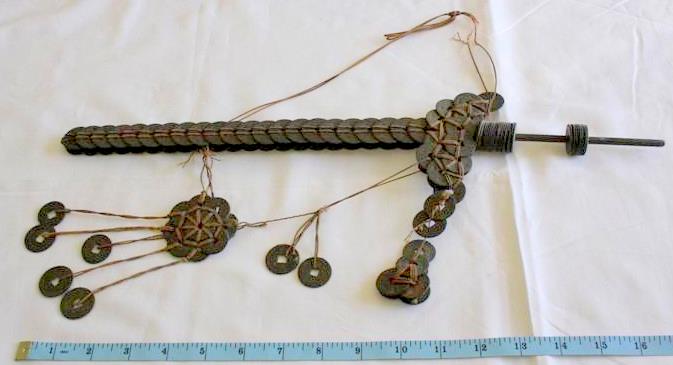 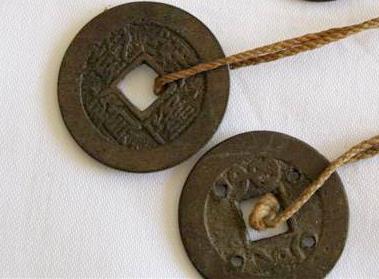 |
|
|
|
Rest in Peace
United States
9104 Posts |
Interesting looking piece, but no clue from this section of the peanut gallery.
|
|
Pillar of the Community
Canada
1166 Posts |
|
|
Moderator
 Australia
16982 Posts |
Yep, it's a "coin sword". Googling that exact phrase should find you more than enough Feng Shui websites that'll sell you one, and explain what they're for. Apparently, there's nothing better at scaring away evil spirits.
Yours seems to be older, and seems to have been made from real coins; at least, the closeup you've shown looks like a real coin of the Chinese Qian Long emperor (ruled 1736-1796). I assume the handle has had a few coins pilfered from off the end of it. The long reign of this emperor makes his coins extremely cheap and plentiful, but there's still probably about $50 worth of coins in a typical-sized sword. You can also find swords made from fake coins; apparently, the spirits can't tell the difference.
Don't say "infinitely" when you mean "very"; otherwise, you'll have no word left when you want to talk about something really infinite. - C. S. Lewis
|
|
New Member
 Canada
4 Posts |
Thanks so much for your help. I will certainly search the "sword" aspect of it all.
All the best.
|
|
New Member
Canada
4 Posts |
Actually... upon closer inspection I've noticed there is more than one era represented on the cross. Not that it makes a difference I'm sure but here is a picture of one of the other coins on it. 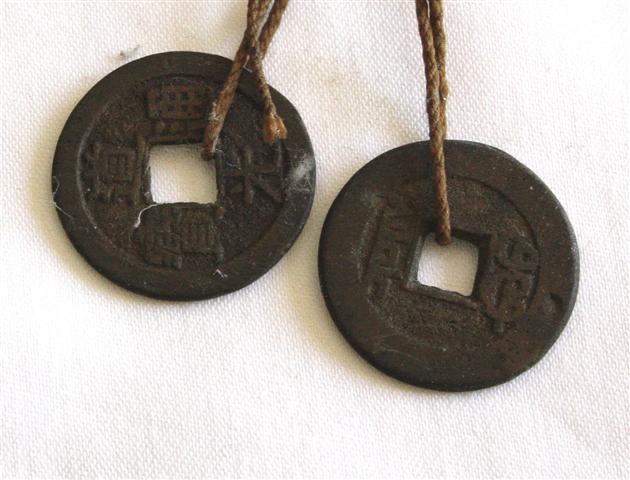 |
|
Moderator
Australia
16982 Posts |
Correct; that one's a coin of the Dao Guang emperor (1820-1850). You can use the characters given in the "reign name" column of the Wikipedia list of Qing Emperors to identify the rest of your coins. Cash coins from most of these emperors are common, but for the makers of the sword the important thing is to make sure all the coins are more or less the same size. In general, later cash coins tend to be smaller, while earlier cash coins tend to be larger. Don't say "infinitely" when you mean "very"; otherwise, you'll have no word left when you want to talk about something really infinite. - C. S. Lewis
|
|
New Member
Canada
4 Posts |
Thank you Sap. I appreciate your help. I'm trying to value the sword for my father who is looking to sell it. Unfortunately it's appearing it's not quite of the value that he may have thought.
Again, I thank you for your help.
|
|
Valued Member
Canada
480 Posts |
To repeat the conversations so far- this is an older coin sword- the cords are typical of earlier types- modern types often have silk-type threads. The coins would have been the typical pieces that could have appeared in circulation until the mid 1930's- coins were circulated by the weight of the coin. The coins look good- right period, right writing. These were used to ward off evil spirits, especially for babies. I worked with several of these in the late 70's and 80's. The "medallion" effect of the hanging ornament is quite nice, and more elaborate than the ones that I saw. A nice piece.
|
|
Pillar of the Community
United Kingdom
2928 Posts |
They are interesting objects but not particually rare. I bought a couple of them about 15 years ago for £30 - the one pictured and another one that was only half there.  |
| |
Replies: 9 / Views: 8,611 |
|










 Posted 04/25/2011 10:56 pm


