











 Posted 05/13/2011 1:28 pm


I read your link, Dale.
Thoughts:
1) Don't worry about filling the sensor. Worry about a final product of 650px in diameter which meets your desires, and back the camera off to buy room for lighting.
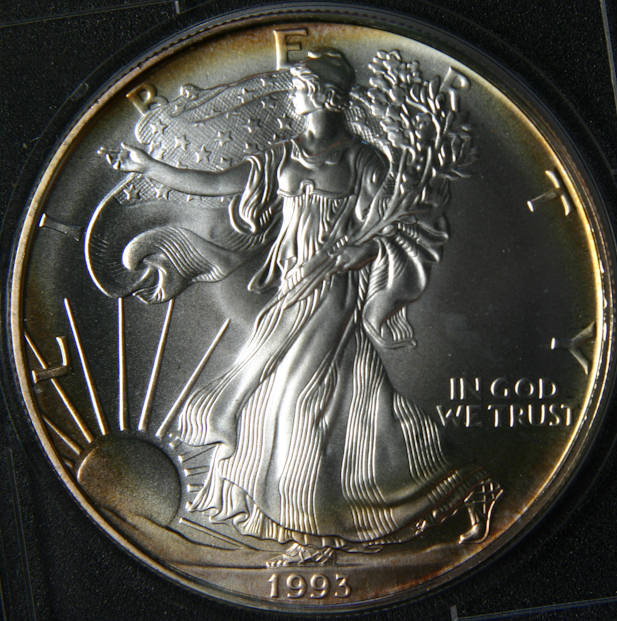
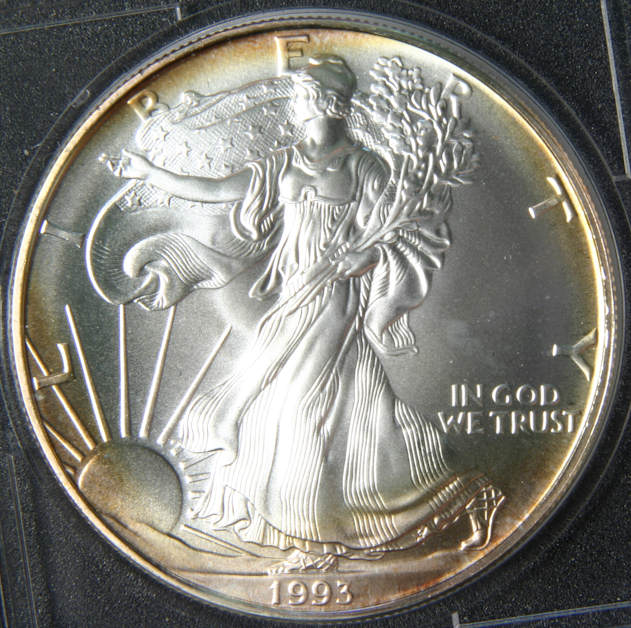
2) Digital cameras do not see coins the way our eyes do. That's a fact of life, and a rather "niche" secret of coin photography. Your first image is well on the road to being a great coin shot as those knowledgeable of digital coin photography will see it. I wouldn't go tighter than f/8 with that lens; you're probably reaching the diffraction limit at f/13. That'll buy you a faster exposure and/or lower ISO; you can get nice shots at ISO400 but if you can use ISO100 you'll improve contrast.
3) Concentrate on accuracy, not color. Sharp focus. Proving the lack of marks on the surface of the coin. An ASE buyer knows what color the coin will be; they want to see a pristine surface.
4) Don't be afraid to color-correct in postprocessing. I shoot Canon, too; I know how difficult they are with white balance. Use 18% grey for Custom white balance over white; the result works well for me, filtered through what I know the camera is going to make the coin look like. See the first sentence of 2) above.
5) You're going to probably find narrow-beam spots better than diffusion and reflection. Those take away from the representation of luster which, for a coin, involves showing a contrast between the bright areas in direct light and the darker areas outside the direct beam.
With your combination, shoot for exposures faster than 1/100, ISO 200@f/8. ISO100 if you can. I'm guessing that'll be near the sweet spot. And use a lens hood if you have one, because incident light reflected back into the lens kills contrast with coins.
Headed for work right now; I'll be checking back about Midnight Eastern tonight.
Thoughts:
1) Don't worry about filling the sensor. Worry about a final product of 650px in diameter which meets your desires, and back the camera off to buy room for lighting.
2) Digital cameras do not see coins the way our eyes do. That's a fact of life, and a rather "niche" secret of coin photography. Your first image is well on the road to being a great coin shot as those knowledgeable of digital coin photography will see it. I wouldn't go tighter than f/8 with that lens; you're probably reaching the diffraction limit at f/13. That'll buy you a faster exposure and/or lower ISO; you can get nice shots at ISO400 but if you can use ISO100 you'll improve contrast.
3) Concentrate on accuracy, not color. Sharp focus. Proving the lack of marks on the surface of the coin. An ASE buyer knows what color the coin will be; they want to see a pristine surface.
4) Don't be afraid to color-correct in postprocessing. I shoot Canon, too; I know how difficult they are with white balance. Use 18% grey for Custom white balance over white; the result works well for me, filtered through what I know the camera is going to make the coin look like. See the first sentence of 2) above.
5) You're going to probably find narrow-beam spots better than diffusion and reflection. Those take away from the representation of luster which, for a coin, involves showing a contrast between the bright areas in direct light and the darker areas outside the direct beam.
With your combination, shoot for exposures faster than 1/100, ISO 200@f/8. ISO100 if you can. I'm guessing that'll be near the sweet spot. And use a lens hood if you have one, because incident light reflected back into the lens kills contrast with coins.
Headed for work right now; I'll be checking back about Midnight Eastern tonight.


