












 Posted 05/17/2011 8:40 pm


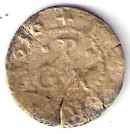
It's not an official coin, but an early English token. Towards the end of the Civil War period, small change was hard to come by and merchants all over the country began issuing their own little brass farthing and halfpenny tokens. The three-letters-in-a-triangle is very distinctive of this series of tokens, appearing on many of them; the letters usually form the abbreviation of the name of the shop or the proprietor.
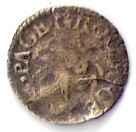
In this case, what the initials stand for appears to be spelled out in full on the other side: I can read PAGE GROC... - the K, I suspect, stands for the name of the city or county in which Mr. Page was a grocer. I don't have a good reference book for this series yet, so I can't confirm the ID on it, but here's a similar token with "VIR" in a triangle.
They are quite collectable; dealers here in Australia usually charge over $10 each for them.
In this case, what the initials stand for appears to be spelled out in full on the other side: I can read PAGE GROC... - the K, I suspect, stands for the name of the city or county in which Mr. Page was a grocer. I don't have a good reference book for this series yet, so I can't confirm the ID on it, but here's a similar token with "VIR" in a triangle.
They are quite collectable; dealers here in Australia usually charge over $10 each for them.
Don't say "infinitely" when you mean "very"; otherwise, you'll have no word left when you want to talk about something really infinite. - C. S. Lewis


