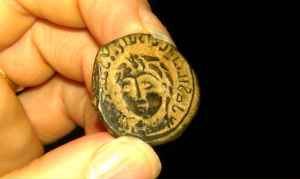
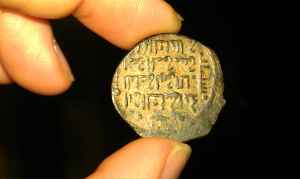
This is from a series of very un-Islamic bronze coins issued by the Artuqids and Zengids, dynasties of Islamic warlords who lived in what is now northern Iraq, eastern Iran and western Turkey. The bottom pic is upside-down; the language is Arabic.
I say "un-Islamic" because the Islamic law prohibiting the making of graven images was traditionally extended to include portraits on coins; most early Islamic coins are text-only. The rulers of Crusader-period Iraq were, for reasons unknown to us now, an exception. The variety of coin designs and quality of the artistry on them had not been seen in the Middle East since Roman times.
Having pictures makes them much easier to identify to a particular time period, just by matching the picture; much easier that trying to read mediaeval Arabic. This style of portrait, turned three-quarters facing in similar fashion to ancient Greek coins like my avatar, was used by the several branches of the Zengids and Artuqids. Your coin was, I believe, struck by Nasir al-Din Artuq Arslan, the Artuqid ruler in Mardin from 1201 to 1239 AD.
Here's an example of a similar coin on zeno.ru. This coin is apparently dated Islamic year 611 (= 1214 AD).
Judging value is tricky, especially for these pieces; with all the American interest and presence in Iraq in the past decade, a lot more of these coins are turning up in the West than there used to be, so the old catalogues may be out of date with regards to rarity and value. But this coin is rated even in my 1998 edition catalogue as "extremely common". Formerly selling in the $50 range, it would probably be more like $10 to $30 range today.
Don't say "infinitely" when you mean "very"; otherwise, you'll have no word left when you want to talk about something really infinite. - C. S. Lewis










 Posted 05/18/2011 5:37 pm