| Author |
 Replies: 28 / Views: 31,765 Replies: 28 / Views: 31,765 |
|
Valued Member
63 Posts |
Are these coins fake?   |
|
|
|
Pillar of the Community
Mexico
1304 Posts |
I can comment on "el caballito" having being faked, depending on the year. I'd have a good close look at that one for sure. Without better photos, hard to say. The 1951 5 pesos is fairly common and I wouldn't imagine it was fake unless it's REALLY missing details. I'll wait for SwamperBob to chime in on the 8 real, though I wouldn't mind owning it my self. (once proven that it isn't a fake) Can't comment on the Bolivia & Guatemala pieces...though they do look interesting. The blast white on four of them make me wonder about their origins, they look like they were cleaned...is that correct? What's the history? (please don't say you received them china off ebay) |
|
Pillar of the Community
United States
570 Posts |
Unfortunately, I have seen fakes for all these before. There is some guy in the US that is selling the fakes on ebay and probably elsewhere. Easiest way to tell if they are fake is first see if they are magnetic. If they are then they are fake. The next thing is to check out the weights. I don't have my Krause with me to check on the weights of each, but maybe somebody will be able to chime in before I get of off work. |
|
Pillar of the Community
United States
1146 Posts |
My question to you is why do you think they are fake?
|
|
Valued Member
 63 Posts |
Got them off ebay from a Nebraska Seller. They are non magnetic, but I have no scales to weight them. All 5 were 67$ |
|
Valued Member
United States
426 Posts |
Hello TheDepreso,
The Cap & Rays Mexican Peso is definitely a fake. It is a common modern chinese counterfeit often found in flea markets and such across the US.
It has the wrong eagle design and wrong edge for starters and I'm willing to bet that the weight is going to be way off too.
As someone else mentioned, the caballito is fake also and I will add that the 1951 peso is also a modern chinese counterfeit. Why did they choose to counterfeit a common Mexican silver coin? I have no idea but I have seen them sell like hotcakes in predominantly hispanic areas to unsuspecting people wanting a keepsake of their home country.
I don't collect the Guatemalan Peso or Bolivian 8 Sucres but the fact that they're paired with the other fakes would make them highly suspect.
As others mentioned the weight would be very informative clues for these.
Edited by RealPeso
06/01/2011 2:42 pm
|
|
Pillar of the Community
Canada
3692 Posts |
What's with the grey fading on each one? Makes it look like they all shared the same clothes-dryer ride. Or they all aged equally somehow from the same owner. Strange. The 1951 coin has the same colour as the 8 Reales despite a difference in purities.
That 1951 Cinco Pesos should read Comercio - Agricultura - Industria on its edge and yours does not. They are all approximately the same size coin, as well. In fact, all your coins appear to have the same edges throughout.
Usually on Mexican coins all you have to do is look at the edges since most were decorated or engraved in some way. Examples are seen on 8 Reales, but on other coins reading Independencia Y Libertad. Not only did these serve to track people who shaved their coins, but it discourages counterfeiting.
I wouldn't be surprised if they were silver plated or .1000 or less, as they resemble the same texture from the Peso circa 1957-1967.
Edited by Libertad
06/02/2011 7:34 pm
|
|
Pillar of the Community
United States
1146 Posts |
Try an edge test on one to see if its solid silver or silver wash.
|
|
Valued Member
63 Posts |
Yep, they're silver plated and the seller is offering a refund, thank god.
|
|
Pillar of the Community
United States
1146 Posts |
At least you found out now and not years from now.
|
|
Valued Member
63 Posts |
This forum is really helpful, thank you guys :)
|
|
Pillar of the Community
United States
5362 Posts |
TheDepreso The answers provided are correct - the coins are modern fakes - Chinese imports that are seen at hundreds of flea markets, But they do provide a good teaching opportunity. 1. The edge designs - you need to know what the original coin used for an edge - several coins here have the wrong edge. You should also be aware of what reeds applied with a ring die look like - before you return the coins TAKE a close look at them and you will know what to avoid. 2. RealPeso was right when he said the design of the 8R was WRONG. The best thing you can do before buying a coin is knowing EXACTLY what it looks like and how much variation is possible. An 1882 8R has almost no tolerance for variation while an 1825 would have a wider range. YOU HAVE TO KNOW what you are looking for. 3. Libertad was exactly right to point out the very suspicious color here. Coins that come from different eras of circulation and are made of DIFFERENT alloys should NOT look alike. 4. The coins that look most like originals in this group were all made with transferred images. The features are soft and rounded with a pebbly texture - not sharp like struck coins. 5. YOU NEED A SCALE - weight is critical. You can not afford to waste money on fakes - invest in a scale a ruler and a world coin book BEFORE you gamble on ebay. 6. Just because a seller is in Nebraska does not mean he is selling real coins. Perhaps he was duped like you were or perhaps he uses that address as part of a con-game. All of the coins in this group are BAD copies. Stick around and you should learn enough to spot all of them as bad - even if they appear one at a time. Learn as much from these coins as possible before you return them. They have a lot to tell you that I can't ever explain in writing. Study real and fake coins until you can tell the difference IMMEDIATELY.
|
|
Pillar of the Community
United States
5362 Posts |
The coins you posted usually show up in groups - they are harder to spot individually but if you get used to which ones usually come together and check a sellers past auctions you often get clues. Here are some completed auctions by a seller from San Jose, California who is, in my opinion, an outright fraud. The coins are bad copies but he sells them with NO RETURNS permitted. These are the guys giving ebay a bad name. But ebay will not cancel these auctions based on the Buyer Beware issue. The firt picture shows the same eagle from your coin in the upper right corner but this one is mated with a more proper 8 Reale die. Your coin was never actually made - it combines a Peso die and an 8R die. The "winner" gets three quarters of an ounce of copper nickel for only $26.92. He should know better he has over 1200 feedbacks. I want to see if he gives a negative feedback to the seller.  The second coin is an Olympic 25 Peso from 1968 - it is a common bullion coin but note the reeded edge. Also note how the color matches that of the 8R. Strange since they are different alloys. This sale was completed long enough ago so that feedback was exchanged. The seller got a POSITIVE?  He must like paying $15.50 for a piece of worthless junk. He too should have known better - his feedback of 629 means he has been here a while. The final coin already sold with feedback is a bit more believable until you place it along side the other 2. This 1947 Peso is usually seen in groups of similar fakes and has the same poor color and a reeded edge. Here the novice winner with 55 feedbacks wasted $33 for nothing. I hope he will learn a lesson but his positive feedback says "Very fast, Very good." I wonder exactly what was VERY GOOD about getting a worthless hunk of junk? 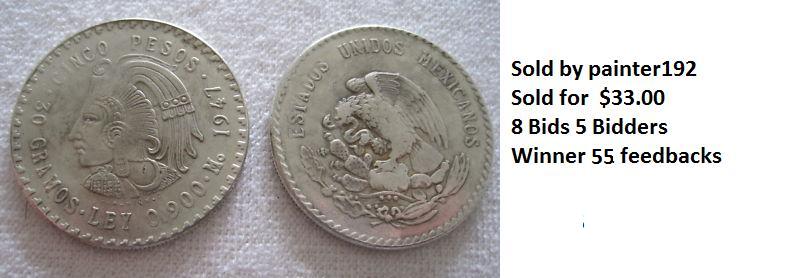 There are a couple lessons to learn - do not trust feedback as truthful - the buyer may be a dumb klutz and always look at the other items a seller is handling. Look for known groups of counterfeit coins that appear together. Also check the REPLICA section of ebay periodically for what is out there - all of the coins in this posting appear regularly in the Replica section. They often APPEAR to have the word COPY stamped on them but in reality they arrive without copy being applied. Edited by swamperbob
06/05/2011 12:59 pm
|
|
Valued Member
United States
296 Posts |
Good info in this thread. I really like Mexican silver coinage, but have always stayed away for these very reasons. I have bought a few of the later coins localy, but I didn't realize they were also faking the Olympic 25 Peso...  I have a few of these... Now I gotta go check them. |
|
Pillar of the Community
United States
5362 Posts |
Bowfin While you are checking you should also look at: 1. 1947 and 1948 5 Peso with Cuauhtemoc KM #465; 2. 1950 5 Peso Railroad KM # 466 3. 1951-1954 5 Peso Hidalgo KM # 467 4. 1953 5 Peso Hidalgo Bicentennial KM # 468 5. 1955-1957 5 Peso KM # 469 6. 1957 5 Peso Centennial of Constitution KM # 740 7. 1959 5 Peso Carranza KM # 471 8. 1955-1956 10 Peso Hidalgo KM # 474 9. 1957 10 Peso Constitution KM # 475 10. 1960 10 Peso Independence KM # 476 11. 1972 25 Peso Juarez KM #480 12. 1977-1979 100 Peso Morelos KM # 483 I own counterfeit versions - Modern Chinese - of EVERY ONE of these common silver coins. Check the Chinese forgers inventories (follow the replica section) - and after about 6 months you will see just how extensive it actually is. Remember you can avoid the first tier sale by avoiding Chinese offerings - but once the coins are here they appear in flea markets, on ebay and even at some coin shows where they fool novice buyers all the time.
|
|
Pillar of the Community
Canada
3692 Posts |
They're probably faked for bullion investor purposes. None of these are rare by any means. They're just perfectly sized for cheap stacking. Eventually, after seeing bunches of these you get used to just knowing which coins seem "off". Mexico during the 20th century had so many different styles of coins that it's hard for anyone to keep up. Even half-way through series there would be a minor design change like on the 20 Centavos of 1940s-1970s. That's why they're so easily mistaken for real coinage. Buy the books, they help out SO much - imagine never seeing a coin in person but you already have lots of information about them.
|
| |
Replies: 28 / Views: 31,765 |










 Posted 05/31/2011 11:57 am


