| Author |
 Replies: 11 / Views: 3,724 Replies: 11 / Views: 3,724 |
|
|
New Member
United States
18 Posts |
Ah, yes, the uncleaned ancient Roman coin, $2.00 on ebay with free shipping. Who can turn down a bargin like that? So I just bought one. It shipped fast,and was well packaged, kind of a crusty grey round blob with only a vague hint of detail. I picked at it under the microscope, using a dental pick and an Exacto knife. The scrappings looked like lava ash, but the coating was rock hard. I hit it with the sand blaster, using glass beads. I can see some of you wince, but there actually was a coin under there. Couple more days in the tumbler, and it should be fit to post a picture. |
|
|
|
Pillar of the Community
United States
597 Posts |
i hear baking soda is safer for antique stuff that needs to be blasted
|
|
Pillar of the Community
United States
2661 Posts |
I have soaked these for months, even years. I have several that are in olive oil I acquired nearly 3 years ago. I change the oil about every 4 or 5 months and they are starting to look fairly good. I don't have a tumbler and I would be scared t use a glass bead peening method. Good luck with those.
|
|
New Member
 United States
18 Posts |
Here are the results. I should have taken some "before" pix, too. I figured fer $2, so what if I ruined it? I'll bet now that I got the crud off, maybe someone can please tell me what it is? The diameter is 18mm. It weighs 2.29g I'm working on modifying the sand blaster to make a sort of micro blaster to pinpoint where I clean. So far, it still puts out too much. I'll cut down on the pressure to see if that helps. 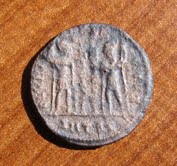 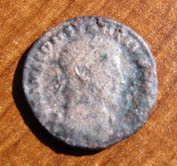 Edited by cyberfish2
06/27/2011 12:01 am
|
|
Moderator
 United States
23731 Posts |
IMO olive oil is the best method, followed by distilled water. The object is to remove the caked on dirt but not hurt the coin or remove the patina. It's not as simple as it sounds, every coin is different depending on what type of soil it was burried in and it's exposure to the minerals in that soil. A long soaking in olive oil softens the dirt and allows it to be picked off without removing the patina. It takes practice and you will probably overclean some coins before you get the hang of it.
|
|
New Member
United States
2 Posts |
What you have there is a bronze coin probably of Constantious II with a Gloria Exercites reverse, 2 soldiers with standard. Probably around 330-360AD. Hard to see in the pic but I think probably Thessalonika mint.
Ben
|
|
New Member
United States
18 Posts |
Thank you, Bensgemz. I know zip about ancient coins, but I did find that (almost) same image in Google Images, and I think you nailed it exactly. I just bought ten more of these. There are times when olive oil and acetone just won't hack it. Some coins are so covered with ages of crud the details are obscured until they are "restored". I have an 1823 large cent that I got for a dollar at a flea market many years ago. It languished in a box of "unknowns", until I retired. A coating of hard tar-like, but insoluable, substance hid nearly all detail until I cleaned it last month. It came out with a readable date, and almost all lettering visible on the reverse. However, before I get flamed, let me be clear that I'm not advocating EVER using a sand blaster on ANY coin. What I am doing here is just a personal experiment on coins so badly damaged as to have only their intristic metal value. I poke around with a metal detector, mostly for the exercise value, and most of the clad coins I find can not even be spent; they look that bad. After one or two sessions in the tumbler, even IHOP will take them. Thus, I get a "free" breakfast a couple times a year.  Edited by cyberfish2
06/27/2011 12:04 am
|
|
Pillar of the Community
United States
4778 Posts |
yea that looks like Thessalonika mint to me also.
Edited to correct spelling
Edited by VisigothKing
06/26/2011 11:51 pm
|
|
Moderator
Australia
17006 Posts |
There is one key diference between a modern detector find and an ancient uncleaned coin: the nature of the surrounding "dirt", because not all of it's really "dirt". The problem with using any harsh-but-quick cleaning method on an uncleaned ancient coin - be it acids, electrolysis, a rock polisher or a sandblaster - is stripping away too much patina, because on many surviving bronze coins it's in the patina rather than the metal itself that has most of the fine detail preserved. A bronze coin that's been in the ground for 2000 years has begun to fossilize, with the copper slowly trying to turn back into the copper ore from which it was made. So the cross-section of an uncleaned bronze coin typically has three layers: 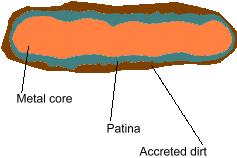 The goal with cleaning ancient bronzes is to remove the brown "dirt" layer while disturbing the green "patina" later as little as possible, because it's the outermost surface of this green layer that marks the original surface of the coin, and that's where the fine details are going to be preserved. Stripping both the brown and green layers away leaving just the orange metal core will result in a coin that's been "overcleaned", and typically looks pitted and fuzzy. Judging from the colour and appearance of the coin in your pic, I suspect that's what's happened to your coin. Unfortunately, not all uncleaneds have a nice, sharp boundary between the "brown" and "green" layers. The "brown" layer can look quite greenish as copper leaches out into the surrounding soil, and minerals leach into the patina layer to replace it. Don't say "infinitely" when you mean "very"; otherwise, you'll have no word left when you want to talk about something really infinite. - C. S. Lewis
|
|
New Member
United States
2 Posts |
Ahhh, cleaning. Such a controversial topic. I'm one of those who hold that any ancient coin has been cleaned at some point. Myself, I generally take a long view and soak them in distilled water. I have some soaking since 2004. Every year I take them out and inspect them, a few will be clean or nearly so and the rest go back in fresh DW.
I have used electrolysis, chemicals (Kaboom!), dremel engravers, sharpened silver wires in a pin vise, fiberglass scratch brushes, soft brass and silver brushes, dental picks, etc. and find each to have their own uses. I use mechanical tools under a stereo microscope so I can see where and what I am doing.
All told though I find cleaning more effort than it is worth and tend to buy them already clean now, saving my cleaning efforts for the occasional coin that really catches my eye. Once in a while I offer some of my stash of uncleaned coins, usually on the AP Sunday auction.
Ben
|
|
New Member
United States
18 Posts |
Thanks to all of you for all the information, and excellent tips and advice. At my somewhat advanced age(In my youth, I could still find the occasional Indian Head cent in circulation, all the hint yer gonna get), I have neither time, nor patience to let the olive oil and DW to work their magic. I'm a retired tool & die maker. I worked nearly forty years for an excellent computer company before retiring over 13 years ago. I still dabble in the black arts, alchemy, trying to make gold from lead(Just kidding. Never take me too seriously). I do have a semi well equipted shop in the garage. My current brain storm is to redesign my sand blaster into something more useful for cleaning coins; something more like the cosmetic surgeons use for dermabrasion, but without the $10K price tag. A small, ceramic nozzle, very fine grit(baking soda?), lower air pressure, and an adjustable grit feeding system. One of my friends used to cut heart stents for a living, using a laser, so there may be some merit to using that method as well. Like Benzgemz, I use a stereo microscope to pick away at the coatings with a dental pick. It is a technique which now seems primative, tedious, and nearly fruitless, given the techno world I (we) now live in. I 'spect I rambled on way too long for this thread to be relavent, but I would love to know what you think about the ideas. Edited by cyberfish2
06/27/2011 5:55 pm
|
|
Pillar of the Community
United States
2589 Posts |
Quote:
I still dabble in the black arts, alchemy, trying to make gold from lead Thats not a profitable venture anyway, its actually possible with nuclear transmutation but not cost effective. Now changing tungsten to osmium, thats where the real money is (so long as you dont mind the radiation). Anyway I think you have not only improved the coins appearence but value as well. I'm sure that someone would be willing to pay more for the coin now than they would if it was just a $2 hunk of crud. -XoG |
| |
Replies: 11 / Views: 3,724 |
|








 Posted 06/26/2011 11:58 am


