









 Posted 06/29/2011 8:07 pm


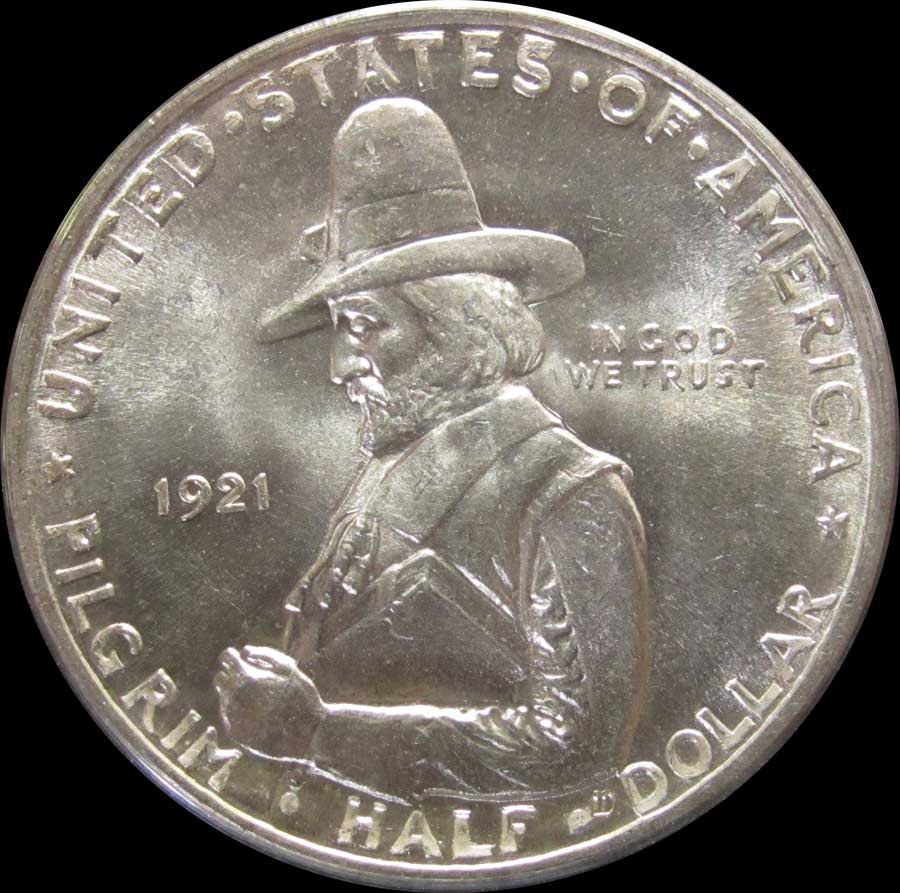
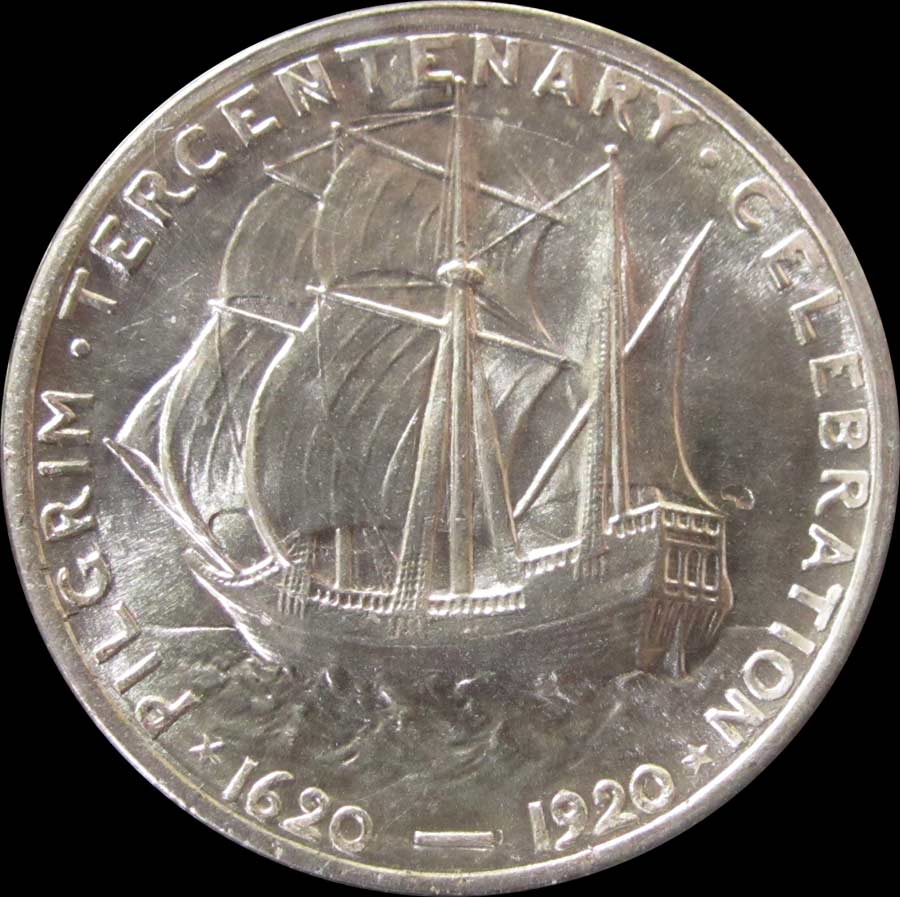
Interesting coin Bill ... presents some challenges for me to understand what is going on with the legends? Lacking any other evidence I suspect this coin has been somehow damaged. 
I'll postulate that the coin is MS-something ... see no signs of circulation wear ... but the unusual appearance of the rim legends as you point out is troubling to me ...
Suspect the 'cannon plume' is perhaps a lamination error ... does not appear from the photos to be PMD.
My view is this coin is best submitted to ANACS who would take a friendlier 'details' approach if needed.
Sooo ... all that said ... a few fun facts about your coin that I suspect you already know.
The coin was designed by Cyrus E. Dallin ... and what is unusual about this coin is the designer initials are shown incuse (not raised) on the obverse at 5:30 below the elbow of Gov. William Bradford. You can see the incuse "D" clearly on your coin just beyond the "D" of "Dollar".
Rumor has it that the coin was supposed to contain the designer initials as CED ... but that was somehow forgotten ... and someone used a Denver mint mark punch to place the now interesting "D" on the original hub ... resulting in all subsequent strikes (for both years) with an incuse initial.
Anyways ... this incuse "D" is a great marker to separate a counterfeit Pilgrim if the Chinese were to ever make these ... tough to replicate incuse features.
These were struck in both 1920 and 1921 at the Philly Mint. Your 1921 is the least common with a net mintage of 20,053 coins ... compared to the 1920 net mintage of 152,112 coins.
From the standpoint of a commemorative collector ... this coin with dual year mintages represents the very first specimen where multiple coins were issued with the unstated objective of milking money from the collectors of the time.
B. Max Mehl addressed this topic in his 1937 pamphlet "The Commemorative Coins of the United States" of which I have an original copy.
Mehl wrote in 1937 ...
"Apparently the Committee in charge thought they could do as well with another issue. And in 1921 proceeded to strike 100,053 more of the coins, but they soon found that some things can be done successfully only once and the Committee returned 80,000 of the coins to be remelted, therefore only 20,023 were sold at $1.00
Naturally this makes the 1921 a very scarce commemorative half-dollar, and incidentally this was the beginning of the hot idea of trying to "get" the collector at least twice. "
This greed to maximize collectors dollars was continued at the end of 1921 with the issuance of the Alabama 2x2 coin ... and repeated many time over through the commemorative explosion of 1936.
Anyways ... your 1921 Pilgrim is special because it was the first coin in the series that started all the chaos that led to an eventual congressional "STOP" in 1936.
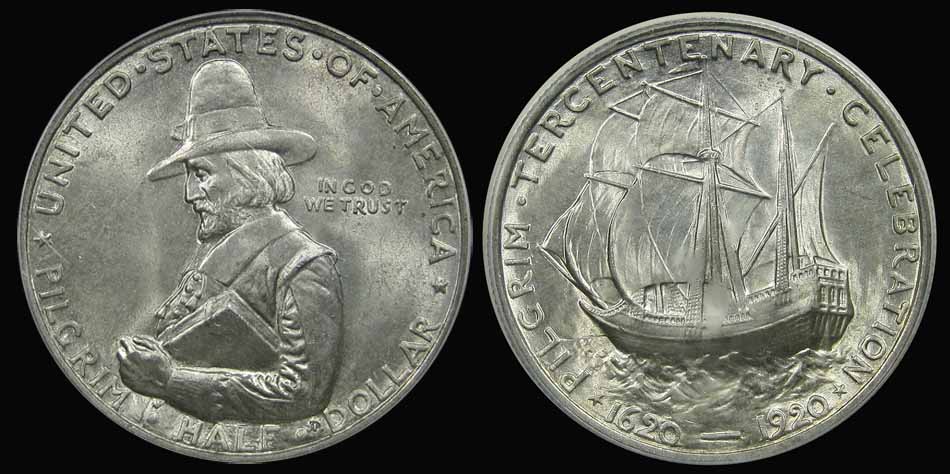
For grading .... compare yours to my PCGS MS66 1920 example ...
Hopeful that my meandering replies are of some use to someone.
David
I'll postulate that the coin is MS-something ... see no signs of circulation wear ... but the unusual appearance of the rim legends as you point out is troubling to me ...
Suspect the 'cannon plume' is perhaps a lamination error ... does not appear from the photos to be PMD.
My view is this coin is best submitted to ANACS who would take a friendlier 'details' approach if needed.
Sooo ... all that said ... a few fun facts about your coin that I suspect you already know.
The coin was designed by Cyrus E. Dallin ... and what is unusual about this coin is the designer initials are shown incuse (not raised) on the obverse at 5:30 below the elbow of Gov. William Bradford. You can see the incuse "D" clearly on your coin just beyond the "D" of "Dollar".
Rumor has it that the coin was supposed to contain the designer initials as CED ... but that was somehow forgotten ... and someone used a Denver mint mark punch to place the now interesting "D" on the original hub ... resulting in all subsequent strikes (for both years) with an incuse initial.
Anyways ... this incuse "D" is a great marker to separate a counterfeit Pilgrim if the Chinese were to ever make these ... tough to replicate incuse features.
These were struck in both 1920 and 1921 at the Philly Mint. Your 1921 is the least common with a net mintage of 20,053 coins ... compared to the 1920 net mintage of 152,112 coins.
From the standpoint of a commemorative collector ... this coin with dual year mintages represents the very first specimen where multiple coins were issued with the unstated objective of milking money from the collectors of the time.
B. Max Mehl addressed this topic in his 1937 pamphlet "The Commemorative Coins of the United States" of which I have an original copy.
Mehl wrote in 1937 ...
"Apparently the Committee in charge thought they could do as well with another issue. And in 1921 proceeded to strike 100,053 more of the coins, but they soon found that some things can be done successfully only once and the Committee returned 80,000 of the coins to be remelted, therefore only 20,023 were sold at $1.00
Naturally this makes the 1921 a very scarce commemorative half-dollar, and incidentally this was the beginning of the hot idea of trying to "get" the collector at least twice. "
This greed to maximize collectors dollars was continued at the end of 1921 with the issuance of the Alabama 2x2 coin ... and repeated many time over through the commemorative explosion of 1936.
Anyways ... your 1921 Pilgrim is special because it was the first coin in the series that started all the chaos that led to an eventual congressional "STOP" in 1936.
For grading .... compare yours to my PCGS MS66 1920 example ...
Hopeful that my meandering replies are of some use to someone.
David
Take a look at my other hobby ... http://www.jk-dk.art


