| Author |
 Replies: 12 / Views: 1,556 Replies: 12 / Views: 1,556 |
|
|
Valued Member
United States
210 Posts |
All of the apparent staining, especially noticeable above the beaver tail and "e pluribus" is not on the coin, but on the case. The ding on Peter Schuyler's coat is on the coin. This is perhaps the smallest rendition of the word "Liberty" on any US coin (it's just above the eagle). Thanks for the opportunity to share these  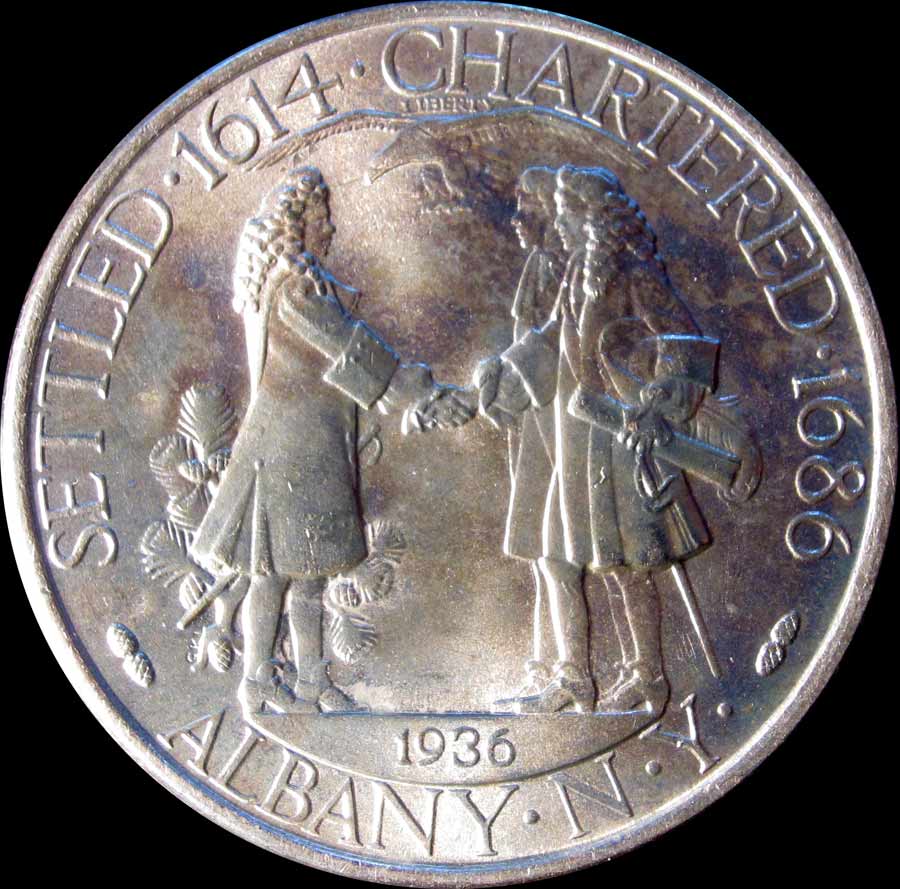  |
|
|
|
Pillar of the Community
United States
7331 Posts |
Another nice example, how far along is your set?
|
|
Valued Member
 United States
210 Posts |
Only 9 in the collection with two more to show here. I've been focused more on modern commemoratives the last few years.
|
|
Moderator
 United States
15952 Posts |
Great fun ... great coin! Yours compares well to my PCGS MS65 example ... photo in a bit ... This is truly one of the Classic US Silver Commemorative that has a great story ... including your 'Small Liberty' observation ... c'mon ... a Beaver on a USA coin?  Appreciate your understanding Bill of my reluctance to re-type my prior comments ... so quoted below from a prior thread on this coin ... Let's discuss the Albany Half Dollar ...
Minted in 1936 to commemorate of the granting of Albany, NY city charter. Albany is (was?) the 2nd oldest city in the country .... but this was still an event of local interest and not national significance.
Total mintage including assay coins was 25,013 ... eventually 7,342 were returned to the mint for melting ... leaving a total net mintage of 17,671 examples. Compare that total to the 1909-S VDB and let's discuss true rarity.
This has always been a collector favorite due to the excellent design work of Ms. Gertrude Lathrop. She followed on the next year with the design of the New Rochell Half Dollar.
The obverse of the coin features a beaver eating a maple branch. C'mon ... how many other USA coins can you point to that feature a beaver on the obverse? Historical records suggest that Ms. Lathrop actually kept a live beaver in her studio, courtesy of the NY State Conservation Dept, while working on the coin.
The reverse of the coin contains what I think is one of the best 'quiz' questions in US coinage history .... "Which USA coin has the smallest size LIBERTY?"
Look real close above the three figures on the reverse ... there is an eagle flying above them. Look extra real close above the eagle ... and below the CH of "CHARTERED" .... there is the minuscule LIBERTY that Ms. Lathrop was required by law to place on the coin. Yours appears to be another well-struck and clean MS example ... compare for grading help to my PCGS MS65 Albany ... 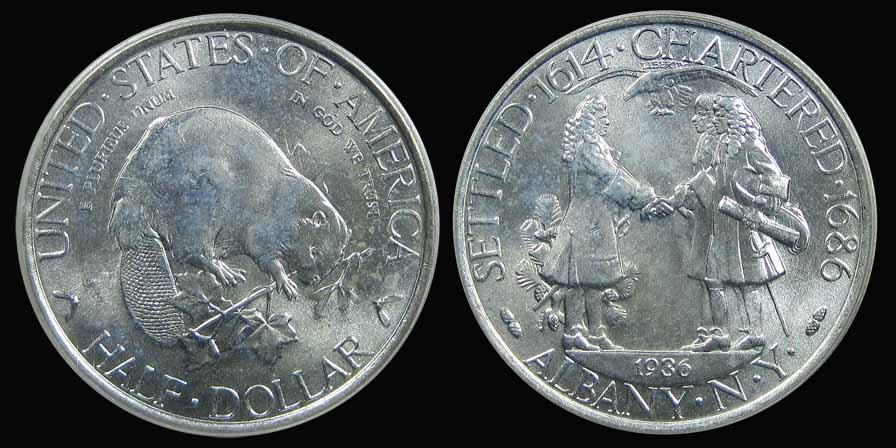 Thanks for sharing your coins! David |
|
Valued Member
United States
210 Posts |
Upon closer examination of the pictures and the actual coins, the staining I blamed on the casing is in fact on the coin. It is not evident to the naked eye (at least my untrained eye) and barely perceptible under magnification. Perhaps it's something about the light I'm using. Time to bring out the soft box!
David, care to share any detail as to how your photographs were taken? It appears as though a professional may have been involved. They really capture the luster and detail one would see if holding in hand (a difficult feat, I've discovered). If need be, I can ask this question in the photo forum.
Thanks for re-posting your earlier comments.
|
|
Valued Member
United States
287 Posts |
Cool!
That tiny "liberty" is really great
|
|
Moderator
United States
15952 Posts |
Quote:
David, care to share any detail as to how your photographs were taken? It appears as though a professional may have been involved LOL ... all my mediocre quality CCF 'click-and-show' photos were made and processed by me ... professional photoguy not! If you post a photo in the photography forum with a description of your equipment and set-up then you will get expert advise ... not my newbie photo guidance below. In the spirit of a quick description for how I shoot my images ... all the commemorative you have seen have been taken through the darn PCGS holder plastic (adds another dimension) ... I will share the following: I place the coin on a hard surface in my woodworking shop (check out my WW link in my signature line) ... mount my Canon pocket sized 10 mega pixel point-and-shoot camera in a tripod ... and turn off all the lights in the room. I keep the coin appx 6" to 8" beyond the camera lens ... knowing that my post-processing will enable a large enough image to work with ... and this space allows the light to flow into the coin. I do turn on two 30W daylight balanced compact fluorescent bulbs that are housed in adjustable holders ... no other light in the room but the CCF. Turn off the flash ... set the camera mode to 'macro' .... set the auto-timer to 2 seconds delay beyond shutter click release. Then ... I move the CCF lighting here and there ... hither and yonder ... observing the results through the viewfinder ... when satisfied that I have 'captured the coin with light' ... then I take the shot. Post-photo processing for me is done with Photoshop Elements 6 ... where I am mainly cropping, combining and re-sizing for CCF photo standards. My favorite shot ... done just as I described above ... recall that you did give me permission Bill to post photos in your threads. 1937 Antietam Half Dollar ... PCGS MS67 CAC ... stunning coin ... accurately captured IMHO by me using the crude methods I described above: 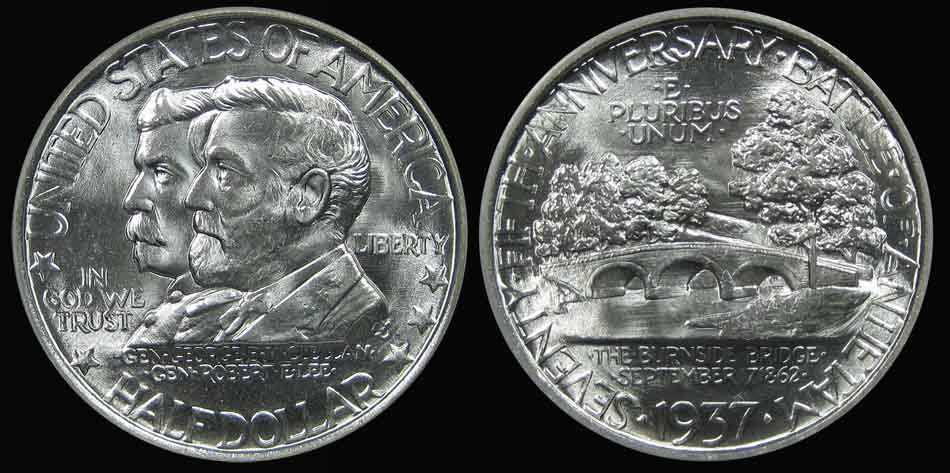 Hope that helps. David Take a look at my other hobby ... http://www.jk-dk.art |
|
Valued Member
United States
158 Posts |
That's an amazing coin, i'll have to work my way up to that one  The strike and the detail are beautiful. |
|
Pillar of the Community
United States
7331 Posts |
nicklesearcher your Antietam is beyond gorgeous. The design, along with the Gettysburg, are in my top five favorites. What a true gem it is.
|
|
Valued Member
United States
210 Posts |
Oh, that's a beauty. Excellent photography and your technique looks solid. I especially like the idea of keeping the camera 6-8 inches away from the coin, allowing the light to be placed at a higher angle, giving it room to breathe. I read somewhere that fluorescent lighting was not recommended for coin photography (does this mean I can't believe everything I read on the internet? ;-)
Another myth busted!
|
|
Pillar of the Community
United States
2424 Posts |
nickelsearcher, what sort of lighting device (lamps) do your 30w bulbs house in? I have seen the smaller ikea lights on the coin photo thread, but am curious as to SEE a picture of your setup
shoot me an email
|
|
Moderator
United States
15952 Posts |
Quote:
Upon closer examination of the pictures and the actual coins, the staining I blamed on the casing is in fact on the coin. Digital photography often brings this out ... and I feel for you on this one. I have a Robinson (Arkansas) Half Dollar that is stunning in hand ... but every photo I have ever taken shows a huge dark smear on the obverse ... I have to do pirouettes in the lighting to even get a glimpse with my eye ... maybe it's there ... maybe not ... but the camera sees it every time. Truly ... I am a newbie at coin photography so please consider my comments above as a starting point for your own growth on the subject. David |
|
Moderator
United States
15952 Posts |
Quote:
. I read somewhere that fluorescent lighting was not recommended for coin photography Keep in mind I am not using Home Depot fluorescent lights ... these are daylight-balanced bulbs that throw a lighting spectrum stated to be equivalent to what the camera would see if shooting in the outdoors (ie the sun). This choice of lighting keeps me from having to set my camera to the light source ... something I do not know how to tinker with and would prefer to avoid. Truly ... post a thread in the Photography forum and the pros that hang out there can give much better advise than I can. David Take a look at my other hobby ... http://www.jk-dk.art |
| |
Replies: 12 / Views: 1,556 |
|





 Posted 06/28/2011 7:34 pm





