GTALLEN I do not see anything that JUMPS out at me saying Counterfeit. The coin looks real.
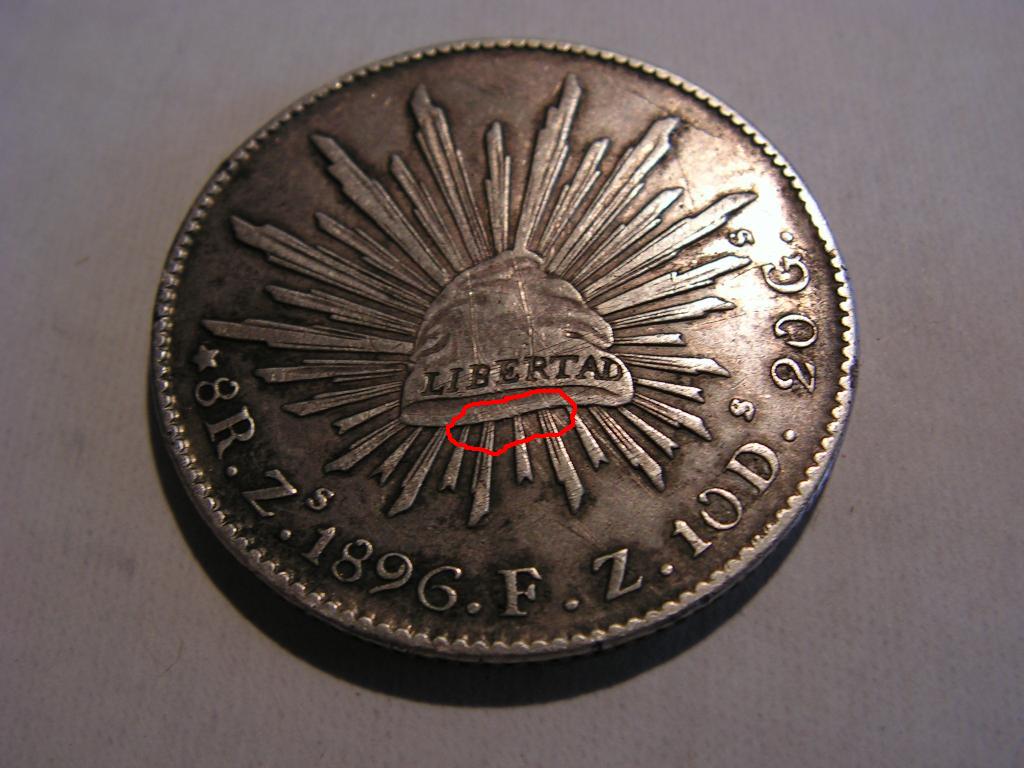
However, I would like to see the same blow up that jfransch is asking for. He is obviously interested in the Dragon's teeth" the anti-forgery device added to the die hubs produced in Mexico City after 1887. I think they are present but the tooth to the right seems particularly weak.
One caution - the teeth are a very low relief feature and die abbraision can remove them in part or entirely. It is not often seen but periodic cleaning and re-surfacing of the die (also called lapping) can remove the feature. I did notice that one ray on the side of the cap above the L in LIBERTAD appears to show die lapping near the connection to the cap.
This is clearly a strike made from a OLD die. Fatigue cracks around the perimeter which you were concerned about are indicative of die age. They also point to an older press (open sided) where perimeter fracturing and displacemnet occurred routinely.
The late Republican era 8Rs were bullion coins made in hige numbers for the express purposes of the export trade. They were not routinely used as money per see in Mexico.
To meet a high output requirement, striking pressures and speeds were increased. This was assisted by the advent of steam presses. Worn cracked and over polished dies were not uncommon during this time period.
The edges of the coin are correct. Unlike earlier dates made on hand operated edgers - these coins were made in powered edgers which edged up to 10 blanks at once. Indistinct overlaps and multiple edge impressions are far more common in this era as a reult. At times it appears that one blank may have rolled all 5 rotations before ejecting because the edge can look like a series of MANY indistinct overlapped impressions. But here I see one impression of the late standardized design.
Even the edge design was streamlined to a point where there is little character.

Nice to have a new collector taking an interest in earlier Mexican coins - watch out it gets addictive.







 Posted 07/09/2011 11:26 pm





 and bienvenidos to the CCF Amigo. I'm glad you enjoy collecting Mexican.


