











 Posted 07/19/2011 09:54 am


Ah, the perils of Internet translators. 
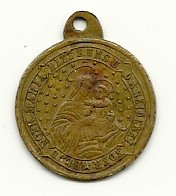
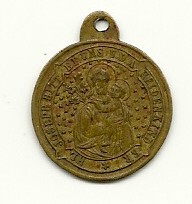
Heiden can indeed mean "heath", or "heather", as in moorlands, purple flowers, etc. But in English, there is another meaning of the word "heath", that is, "heathen", "pagan" or "unbeliever"; so it is the same in German, with Heiden. HL is correctly translatable as "saint" in most cases, deriving from the German word for "holy", Heilige. And Jungfer, in this religious context with reference to Mary, clearly denotes the Virgin Mary. And uns is "us" (as in the plural of "me"), not the United States (which in German begins with a V). Bitte these days normally means "please" or "I beg your pardon", but this usage derives from the verb, "to pray". The F can reasonably be interpolated as für - "for" - thus giving us a translation of bitt f. uns to be "pray for us".
Ramming what we now can translate from the Mary side into Google, it wasn't hard to find some Catholic websites which quote the invocation, "Holy Virgin Mary, pray for us and for the poor pagan children". The medal presumably abbreviates this same prayer, in German. Ramming this back through Google we can deduce U.D.A. is abbreviation for und die Armen - "and the poor".
So, what is it, then? A Catholic religious medal, featuring the Holy Family: Mary with Jesus on one side, Joseph with Jesus on the other. Something clearly with a missionary leaning, given the reference to "pagans". This website mentions that a certain Catholic missionary society requires their members to add this prayer to their daily recitation. It seems reasonable to assume this medal might be intended as a kind of membership badge for such an association.
Heiden can indeed mean "heath", or "heather", as in moorlands, purple flowers, etc. But in English, there is another meaning of the word "heath", that is, "heathen", "pagan" or "unbeliever"; so it is the same in German, with Heiden. HL is correctly translatable as "saint" in most cases, deriving from the German word for "holy", Heilige. And Jungfer, in this religious context with reference to Mary, clearly denotes the Virgin Mary. And uns is "us" (as in the plural of "me"), not the United States (which in German begins with a V). Bitte these days normally means "please" or "I beg your pardon", but this usage derives from the verb, "to pray". The F can reasonably be interpolated as für - "for" - thus giving us a translation of bitt f. uns to be "pray for us".
Ramming what we now can translate from the Mary side into Google, it wasn't hard to find some Catholic websites which quote the invocation, "Holy Virgin Mary, pray for us and for the poor pagan children". The medal presumably abbreviates this same prayer, in German. Ramming this back through Google we can deduce U.D.A. is abbreviation for und die Armen - "and the poor".
So, what is it, then? A Catholic religious medal, featuring the Holy Family: Mary with Jesus on one side, Joseph with Jesus on the other. Something clearly with a missionary leaning, given the reference to "pagans". This website mentions that a certain Catholic missionary society requires their members to add this prayer to their daily recitation. It seems reasonable to assume this medal might be intended as a kind of membership badge for such an association.
Don't say "infinitely" when you mean "very"; otherwise, you'll have no word left when you want to talk about something really infinite. - C. S. Lewis


