











 Posted 07/25/2011 05:09 am


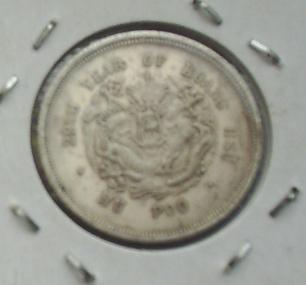
I would have to classify it as "very fake". The "hu poo" mint-name never appeared on a circulating silver coin, only on coppers.
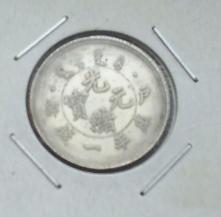
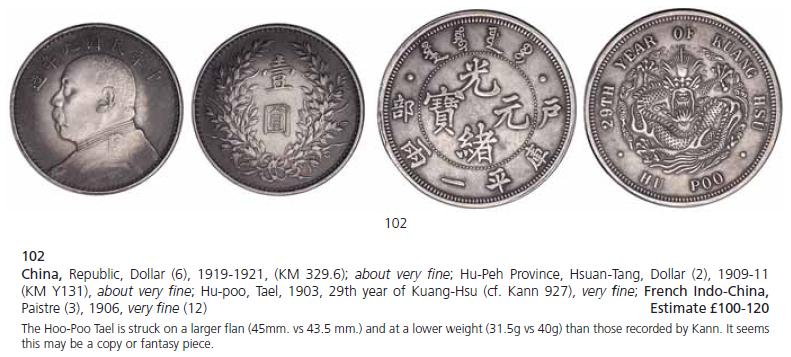
The denomination mark, at the bottom of your bottom pic, reads "1 mace". The mace was a unit of weight, 1/10th of a tael; the dollar-sized piece from Spink (which is absolutely 100% fake) is a 1 tael, so your coin should be 1/10th the weight of a genuine tael: about 4 grams.
These "tael" and "mace" denominated coins are listed in Krause in the Patterns section, under "Peking Tael Series". The 1 mace (called "1 ch'ien" in Krause) is valued at $500 in my 2006 edition. It's my understanding that few if any of these patterns ever actually made it to China: they were made in European mints (such as Birmingham) who were lobbying the Chinese government for new coinage contracts, but the Chinese government elected to make dollar-based coins instead.
The denomination mark, at the bottom of your bottom pic, reads "1 mace". The mace was a unit of weight, 1/10th of a tael; the dollar-sized piece from Spink (which is absolutely 100% fake) is a 1 tael, so your coin should be 1/10th the weight of a genuine tael: about 4 grams.
These "tael" and "mace" denominated coins are listed in Krause in the Patterns section, under "Peking Tael Series". The 1 mace (called "1 ch'ien" in Krause) is valued at $500 in my 2006 edition. It's my understanding that few if any of these patterns ever actually made it to China: they were made in European mints (such as Birmingham) who were lobbying the Chinese government for new coinage contracts, but the Chinese government elected to make dollar-based coins instead.
Don't say "infinitely" when you mean "very"; otherwise, you'll have no word left when you want to talk about something really infinite. - C. S. Lewis


