| Author |
 Replies: 12 / Views: 1,534 Replies: 12 / Views: 1,534 |
|
|
Valued Member
Germany
194 Posts |
This is an 1881 8 Reales from Zacatecas with assayer "A" and "inverted A". It has two holes and so many chopmarks that it is dish-shaped, which is why the scan doesn't bring it up well. Obviously, it is a contemporary conterfeit. The weight is 25.04g, which is to be expected from a 27g coin with holes, and both the edge reeding and the little that's left of the design look good. So - why would anyone have wanted to produce a counterfeit in good silver, where everything is close to perfection except the assayer's initials? Any explanations? The coin must have been produced in quantities - has anybody ever seen another one? 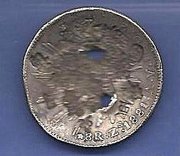 |
|
|
|
Valued Member
 Germany
194 Posts |
Nobody any thoughts on this?
|
|
Pillar of the Community
Czech Republic
803 Posts |
Picture is way to small to see anything. At least on my pc.
|
|
Pillar of the Community
United States
1801 Posts |
Can't see anything to make a comment on.
|
|
Pillar of the Community
United States
1674 Posts |
Are you sure it's fake? From what I've learned on this forum, seems like contemporary counterfeits that actually were silver were made of debased silver causing them to be underweight. Maybe a later bullion counterfeit? Hopefully Swamperbob will chime in on this one.
|
|
Pillar of the Community
United States
819 Posts |
I know that at some of the Mexican mints, the standards were not as good as those at the Mexico City mint. An inverted assayer's initial is not impossible at all.
I would love to see this coin in much closer detail. I am interested in chopmarks, and have a small collection. I really wish I could see this coin in hand, as that really is the only way to see all the marks, or what is left of the marks, in detail. Dished coins are very hard to photograph well. :(
|
|
Pillar of the Community
United States
5362 Posts |
From the looks of the coin - you have a concho. There were many uses for a dollar (like a sheriff badge) and one common use was as a decoration on a gun belt or a saddle - hence the concho. The two holes and the dish shape are very typical. But the primary reason I am commenting is the obvious issue of a "silver" counterfeit. Anyone who has read my posts understands that I am a proponent of the theory that millions of 8R forgeries were produced in full weight silver when silver value was below that of the face value. HOWEVER, that being said, I have proof ONLY with regards to the Bustman types. It is possible but only conjectural that full weight Cap and Ray coins were actually produced. By 1881 especially in Mexico these coins were Trade dollars valued based in their weight in silver and not having a real "face value. So the VAST MAJORITY of forgeries produced late in the 1800's were off metal containing virtually NO silver at all. The Cap and Ray coin was NOT treated in the same way as the Bustman dollar - there was no market demand in China for the C&R as opposed to the Bustman which was preferred and commanded a PREMIUM. So is this coin a forgery based on the inverted A used for a V? That is a good question and the answer comes from understanding how dies were cut in 1881 in Zacatecas. Zacatecas was one of the later mints to adopt new full hub technology. Why? Who knows but it is clear that until 1882 multiple punches were still used to make working dies and minor variations are observed. So it is possible that an inverted A could be used in making a die - but I am not familiar with any such coin. I too would love to see much larger and clearer pictures of the coin to make a positive ID. But from what I see I do suspect a debased counterfeit. |
|
Valued Member
Germany
194 Posts |
Okay, I have finally gotten to take some pictures. Unfortunately, I haven't been able to do a specific gravity test, because I don't have access to a apothecary scale. But I am positive I'll get one soon. 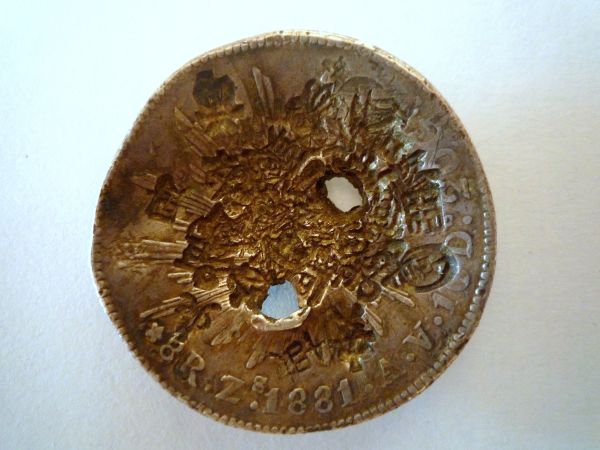 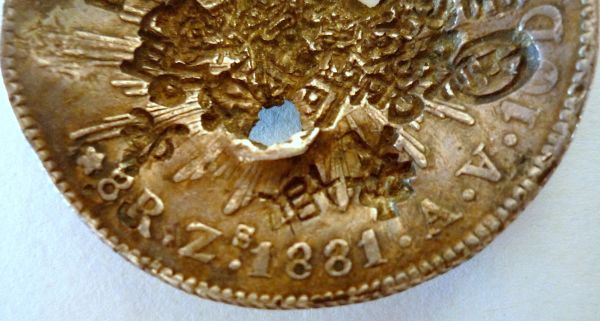 Here we can see the Assayer - A and inverted A. The assayer's initials were JS, no A, so it can't be an error. There are no Js and no Ss in the legend, so the producer of the die may simply not have had the J and S punches and had to invent something else. Not all chopmarks are legible, but there are some pretty clear ones, there is no doubt the coin was chopped in Asia. Somebody must have accepted it as good. 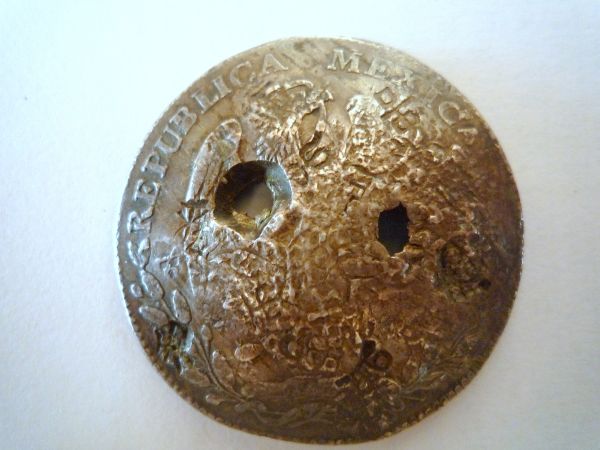 |
|
Valued Member
Germany
194 Posts |
It didn't take the edge picture the first time, so here it is! 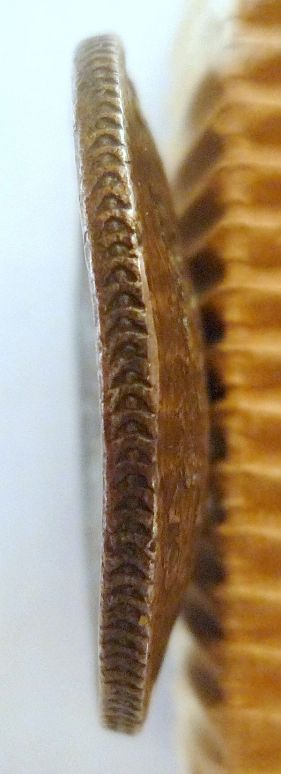 |
|
Pillar of the Community
United States
1674 Posts |
Wow, chopmarked to hell, but it looks good from the close-up pics.
|
|
Pillar of the Community
United States
1801 Posts |
The host coin looks like a fake, the font on the numerals is all wrong.
|
|
Pillar of the Community
United States
1674 Posts |
I see what you mean, the 1's are too thick and the point on the 1's is not as pronounced or horizontal. Could that perhaps be a variation for this year between the AV and JS assayers?
The material doesn't look like that off typical modern counterfeits though, it looks like actual silver.
|
|
Pillar of the Community
United States
5362 Posts |
Based on the larger photos there is absolutely no doubt that the coin is a forgery. That is an absolute. The letters used are simply incorrect for that period of time as is the edge design. The edge is a few years TOO OLD for the date.
But it leaves the open question of the metal used. A silver (full assay) 1881 is unknown as a forgery.
But I do think it may still have been used as a riveted concho.
|
| |
Replies: 12 / Views: 1,534 |
|







 Posted 09/23/2011 7:13 pm





