| Author |
 Replies: 18 / Views: 7,439 Replies: 18 / Views: 7,439 |
|
Valued Member
Canada
235 Posts |
So I am going through my late Uncle's coins and come across a Whitman Canadian 5 cent coin folder (the cardboard ones that you pop the coin into and can only see the front-stupidest thing I ever saw), and am trying to carefully pop them out. Some of these coins are absolutely gorgeous, for instance we have what is probably an AU-50 1938 coin among others. Only problem? The edges of practically every coin are "rusted" with a fairly thick red corrosion-they haven't damaged the coins per se but it looks pretty brutal.
Salvagable or junk bin? I really don't have that much experience with restoring coins. Any suggestions?
|
|
|
|
Valued Member
United States
466 Posts |
hmmm interesting. I have heard stories about the whitman albums causing damage and have seen it first hand on canadian cents actually.
I was given an album with many cents in it that had been placed in the album a long time ago. The cents got like striations on them, and became discolored.
I would say to of course pull the coins out and place them in flips so no more damage can be done. Are the backs of the coins messed up too?
Post a picture of some of the coins if you can. Hey if they aren't good enough for your collection you can always save them up until you get enough posts and trade them off to somebody like...IDK little old me.
I know Bad Thad has that stuff you soak coins in called verdigone or something, maybe send him a private message and see if his solution would help
|
|
Bedrock of the Community
Australia
21789 Posts |
I have actually seen a corroded gold coin.
I certain rare circumstances, gold will form into compounds called 'double salts'. The mineral telluride is an example of this.
In the case of the aforementioned gold coin, it was found buried in a very rusty steel box. It seems that where contact was made against the inside of the steel box in acid soil conditions, a complex gold double salt was formed in association the the iron. The length of time of burial was about 100 years.
Edited by sel_69l
09/01/2011 05:36 am
|
|
Valued Member
 Canada
235 Posts |
In this case I am concerned about any kind of cleaning at all, since some of these coins are possibly MS. I will try to get some pictures up tonight if I have time and maybe there will be some ideas. One thing I do know is that I strongly dislike coin "albums" of any kind where a coin is squeezed into a hole.
|
|
Valued Member
Canada
235 Posts |
I am not sure verdigone will help here. This appears to actually be red rust, but only on the outside edge rims. It is barely visible, if at all, on the face of most of the coins. Any help with dealing with this type of problem would be appreciated.
|
|
Bedrock of the Community
United States
20038 Posts |
Verdigone can't help....because there's no such product anymore. LOL
Show us some pictures. It's highly unusual that the problem is red in color. A simple soak in distilled water should always be tried first.
|
|
Valued Member
Canada
235 Posts |
|
|
Valued Member
Canada
235 Posts |
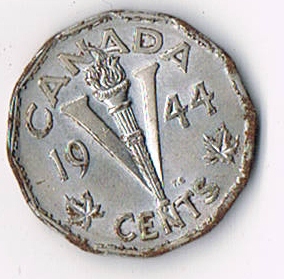
This is the best I can do with my current scanner....the red "rust" mostly covers the edges and spills over a bit on the rims, and as you can see around some parts of the field. The coin, like the rest, is otherwise in beautiful condition, literally some of them are AU.....such a shame
|
|
Bedrock of the Community
United States
12437 Posts |
It looks like rust because it is rust, 1944 and 1945 Canadian Five Cent coins are composed of steel plated with nickel and chromium. Tombac, an 88/12 alloy of copper and zinc, was used 1942-44.
|
|
Valued Member
Canada
235 Posts |
yes, thank you biokemist, I am aware of that however I have pennies dated 1938-1956 with the same substance. So the question is can nickel rust?
|
|
Valued Member
United States
466 Posts |
oops badthads stuff is verdicare
I was going to say the same thing about the coin being plated steel
hmm if the coins that are nickel mostly are also rusted like that I am confused
Could there be some kind of gunk on the coins? or do you really thing it is something in the metal?
interesting, I have a 44 that has a very similar look, but my older canadians I found in circulation, even back to a 1937 are nice and silver in color
|
|
Bedrock of the Community
United States
20753 Posts |
Quote:
hmmm interesting. I have heard stories about the whitman albums causing damage and have seen it first hand on canadian cents actually.
I was given an album with many cents in it that had been placed in the album a long time ago. The cents got like striations on them, and became discolored. Please note it was stated Folders, not Albums. I've mentioned this many times in the past. Almost all Folders are made with the same system. Sheets of paper are layed out and a glue machine is dragged accross them. Then the cardboard pages with prepuched out holes are layed out on top of thoes. Now if you look at the back of those slots in any Folder, you would see a sort of shinnyness. This is the glue from the manufacturing process. NORMALLY, it does not effect coins. HOWEVER, if any type of humidity gets to that glue, it is sort of reactivated and adhears to the coins. The really older Folders were made with glues that were rather on the Acidic side and as reunited with moisture, becomes something not good for coins. If you see coins with a sort of stripping on the reverse, it was caused by that glue in the Folders. Kids famorite trick for well worn coins was to spit on the reverse and this activates the glue so the coins will not fall out. Folders are OK for chaep, fun type of collections. Also, OK in really dry climates. Quote:
I have actually seen a corroded gold coin.
I certain rare circumstances, gold will form into compounds called 'double salts'. The mineral telluride is an example of this. Of course. Most people think Gold is Inert but it does combine with Chlorine. AuCl3 and HAuCl4. It also combines with Fluorine, Cyanide and dissolves in Mercury. Au2S is the normal BR/BK discoloration on Gold coins. |
|
Valued Member
Canada
235 Posts |
Just carl I think you nailed it. Upon closer inspection this substance appears to be some kind of chemical reaction that is similiar to rust, caused by glue. I thought only ferrous metals could rust but this one is really strange. Its such a shame I didnt know my uncle had these coins, they are gorgeous......is there anything I can do to "conserve" these coins at this point?
|
|
Bedrock of the Community
United States
20038 Posts |
OK, now it makes sense because the coins are plated steel. Unfortunately, iron oxide (rust) is a VERY difficult problem for coins, one that cannot be addressed without ruining the coin. The best course of action is to arrest further development by dehydrating the coins with acetone and putting them into an air tight environment. I suspect these are not of huge value, so coins with this condition should probably be replaced if you're a serious collector.
|
|
Bedrock of the Community
United States
20753 Posts |
Mostly as Thad said but there is one thing you could try. If the so called Rust is from the glue, try soaking the coins in distilled water for a while. Will not return the coin to originality but may take off some of the so called Rust by disolving. Also, any glue left on the coins too should be disolved. Then follow what Thad mentioned about Acetone.
Do whatever you can in the future to not use those Folders. There are so many bad features about them I sometimes really wonder why people use them at all. You can't see the backs of coins. People push the coins in with fingers. Every time a Folder is opened, people breath, sneeze, cough on thoes coins.
|
|
Valued Member
Canada
235 Posts |
Yes, I hate coin folder and wish they did not exist. 2x2's are OK, if I had my druthers every coin I owned would be in a capsule, but that gets a bit expensive.
|
| |
Replies: 18 / Views: 7,439 |










 Posted 09/01/2011 02:40 am