| Author |
 Replies: 16 / Views: 16,281 Replies: 16 / Views: 16,281 |
|
Pillar of the Community
United States
3345 Posts |
When were these made and how do you tell if one is made of shell casing or not?
|
|
|
|
Valued Member
United States
407 Posts |
SHELL-CASE BRONZE PLANCHETS (1944-1945)
1944 1,435,000,000
1944-D 430,578,000
1944-S 282,760,000
1945 1,040,515,000
1945-D 266,268,000
1945-S 181,770,000
COPPER PLANCHETS RESUMED (1946-1958)
|
|
Valued Member
United States
407 Posts |
|
|
Pillar of the Community
 United States
3345 Posts |
|
|
Valued Member
United States
466 Posts |
never heard of this...interesting
|
|
Bedrock of the Community
United States
10045 Posts |
For years, I've read in various books how 1944-45 LWCs were struck from shell cases. A few sources even paraphrase a Treasury report, saying the casings came from small-caliber weapons--really? Using the mintages posted above, that calculates to nearly 25 million pounds of bronzeI can only guess the brunt of small-caliber casings were spent on the battlefield, but who collected 25 million pounds worth? Small arms normally eject casings; were there soldier details to collect casings--amidst unexploded ordnance and other hazards? Perhaps it's more likely that larger guns, used on tanks, planes, and ships would recycle their (unejected) casings? --just wondering here.  |
|
Pillar of the Community
United States
1007 Posts |
According to Whitman's Red Book the recycled brass was used 1944 through 1946. The color is slightly darker on some coins. While many of the shell casings recycled could and probably did come from combat zones, a large portion of them could also have been recovered from domestic sources, such as firing ranges and training centers for artillery personnel. |
|
Valued Member
United States
397 Posts |
Ranges and most training exercises turn up alot of left over brass. I don't think the army allows reloading at all for brass, so it gets sold off to someone to use in recycling. Someone always gets the job of sweeping brass of of the firing line, and each soldier might fire a few thousand rounds of ammo in training in the us. Don't forget tank and artillery training as well, as both at that time would have produced brass shell casings.
|
|
Bedrock of the Community
United States
17884 Posts |
My understanding was that most if not all of the recycled brass came from training. (Although I have heard stories from navy sailors who claim that they were detailed to recover the shell casings used in the smaller guns during action. They hated it because before the orders the casings would be jettisoned over the side but now they had to be gathered and kept out of the way during action lest they get underfoot.) Also the cents for these years used recycled shell cases, but they were not made exclusively from shell cases.
|
|
Bedrock of the Community
United States
10045 Posts |
What you guys wrote makes a whole lot of sense  |
|
New Member
United States
6 Posts |
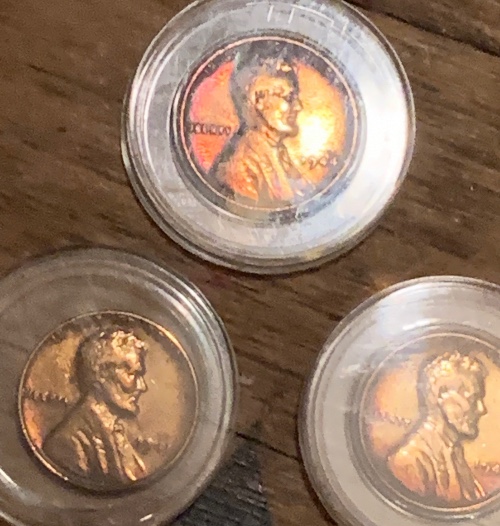  I been looking for more information on this..I have these Pennie's and I am thinking that these r the shell Pennie's. I am not for sure..if they r would a coin authentication business except them to grade? Or better question are these not worth much and not collectable? Any information will help me. Thanks |
|
Bedrock of the Community
 United States
27514 Posts |
Scroll up a few posts - Whytlash listed the mintages of 1944-1945 Lincoln Wheat Cents. They are not rare in the least. Worth their copper content plus maybe another cent in circulated condition, so definitely not worth sending off to be graded. Inordinately fascinated by bits of metal with strange markings and figures
|
|
Moderator
Australia
17031 Posts |
To clarify the information from this twelve year old thread: all 1944 and 1945 pennies are classifiable as "shell case pennies", due to the alloy being used by the mints at the time including (but not entirely made of) recycled shell casing. So it's not a case of there being some 1944 pennies that are, and some that aren't - they're all the same. There's no way to look at a specific penny and say "this one was once a shell case"; the recycled metal got mixed in with metal from other sources, where it all got melted together before being turned into coins. And as noted, the mintages are in the hundreds of millions, so they are by no means scarce.
Further, your specific pennies appear to have been cleaned and polished. So no grading company will grade them, and few collectors will want them, even for face value. Sorry.
Don't say "infinitely" when you mean "very"; otherwise, you'll have no word left when you want to talk about something really infinite. - C. S. Lewis
|
|
New Member
United States
6 Posts |
 Respectively I have to disagree with the polishing of these coins..thanks for the reply.. |
|
Moderator
United States
110117 Posts |
you polished the coins?   |
|
Pillar of the Community
 United States
4623 Posts |
Well... you can use an XRF gun to check the composition.
If it's 95% copper, and 5% tin/zinc then you have one made from virgin material.
If it's any other composition, then at least some of the metal likely came from shell casings.
-----Burton 50+ year / Life / Emeritus ANA member (joined 12/1/1973) Life member: Numismatics International, CONECA Member: TNA, FtWCC, NETCC, EveryCountry (online) coin club Owned by three cats and a wife of 40+ years (joined 1983) Author: 3rd Edition of the Sample Slabs book, https://www.sampleslabs.info/ |
| |
Replies: 16 / Views: 16,281 |




 Posted 09/05/2011 12:14 pm





