| Author |
 Replies: 5 / Views: 1,826 Replies: 5 / Views: 1,826 |
|
|
Pillar of the Community
United States
842 Posts |
Hey guys I have three Asian coins that I am unfamiliar with. Could someone please give me some info on them such as date minted, what country, etc. Thanks! Obverse? 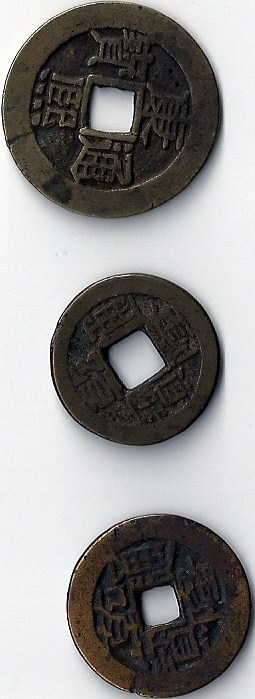 Reverse? 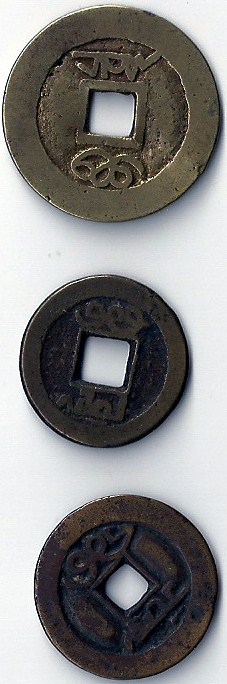 |
|
|
|
Moderator
 Australia
16994 Posts |
They are all Qing Dynasty Chinese.
#1: the Kang Xi emperor (1661-1722), Revenue mint. To make it "right way up", rotate the top pic 90 degrees anticlockwise.
#2 and #3 are essentially the same: the Qian Long emperor (1735-1796), Works mint. Rotate them both about 90 degrees clockwise.
Don't say "infinitely" when you mean "very"; otherwise, you'll have no word left when you want to talk about something really infinite. - C. S. Lewis
|
|
Pillar of the Community
 United States
842 Posts |
Holy....! I had no idea they were that old! Thanks once again Sap for your help. This amazes me.....they were in the .20 bin at my local coin shop. I know there are several more in the bin like these but I never picked them out and bought them. I am assuming I should though; value often accompanies age!
|
|
Moderator
Australia
16994 Posts |
Quote:
I know there are several more in the bin like these but I never picked them out and bought them. I am assuming I should though; value often accompanies age! Not for Chinese cash it doesn't. Look how long those two emperors in particular reigned for - sixty years apiece! That's a long time of continuous, low-denomination coinage issue. Combine that with China's huge population, and you end up with what are probably among the two most common coin types on the planet, ever. These are very commonly encountered in the "Chinese Cash Coins" scratchtrays. The challenge with these coins is trying to find a full set of mintmarks. Kang Xi in particular issued cash coins from 21 mints, with the Taiwan mint being scarcest and most keenly sought after (though even those shouldn't cost more than $30 or so). A full set of 20 provincial Kang Xi coins bound up in a red cord has been a lucky talisman in China ever since these coins were first issued. Of course, replicas are just as "lucky" as the genuine articles, so caution is always advised when buying the pricier varieties. It's even possible to find 1,000 year old Song Dynasty cash coins in dealers scratchtrays, mixed up among the Qing Dynasty coins and the replicas; they too can be surprisingly cheap and plentiful. Don't say "infinitely" when you mean "very"; otherwise, you'll have no word left when you want to talk about something really infinite. - C. S. Lewis
|
|
Pillar of the Community
United States
842 Posts |
Ahh thank you for that explanation. If not for value (or lack thereof), I will get them just because of their age. Old coins facinate many friends that see my collection and these sure fit the bill of 'old'!
|
|
Valued Member
Canada
480 Posts |
Number 3 is Chuan mint- Chengtu, Szechuan Province. Cruder writing on the obverse, typical reddish copper, rather than the yellowish brass commonly used by most Chinese mints. The top and bottom coins are definately less commn than the middle one, but not really valuable- less than $1, 5 cents, less than $1.
|
| |
Replies: 5 / Views: 1,826 |
|










 Posted 09/08/2011 9:19 pm


