Coin Community Family of Web Sites Join Thousands of Coin, Bullion, & Money Collectors
Vancouvers #1 Coin and Paper Money Dealer Royal Estate Auctions - $1 Coin AuctionsCoin, Banknote and Medal Collectors's Online Mall Join Thousands of Coin, Bullion, & Money Collectors Royal Canadian Mint products, Canadian, Polish, American, and world coins and banknotes. 300,000 items to help build your collection! Specializing in Modern Numismatics


Username:
Password:
Save Password
Forgot your Password?


This page may contain links that result in small commissions to keep this free site up and running.

Welcome Guest! Registering and/or logging in will remove the anchor (bottom) ads. It's Free!

1802 Mexico City 8 Reales - Counterfeit?

To participate in the forum you must log in or register.
Author Previous TopicReplies: 22 / Views: 6,024Next Topic
Page: of 2
Pillar of the Community
jfransch's Avatar
United States
1801 Posts
 Posted 09/26/2011  6:11 pm  Show Profile   Bookmark this reply Add jfransch to your friends list Get a Link to this Reply
Or the NGC coin was also a Boston Style counterfeit. Remember, not everyone in the "Spanish Colonial" Coin World agrees with Swamperbobs carefully researched conclusions. I believe many of these coins that were high grade may have been encapsulated as real and accepted by the TGP services.
Valued Member
United States
115 Posts
 Posted 09/26/2011  7:04 pm  Show Profile   Bookmark this reply Add rexvictor to your friends list Get a Link to this Reply
I must admit that I when I purchased the coin, I did not feel 100% confident about its authenticity as its patination and strike would be highly unusual for an example "typically" identified as genuine.

I continue to have admiration for the remarkable technical quality of many Spanish colonial coins and the degree to which they represented highly advanced technology of the 18th century. These coins must have had a very high degree of security against contemporary fraud. In the 19th century as technology trickled down and silver bullion declined in value, the balances turned toward the counterfeiters. I eagerly await the opportunity to see a collected (and augmented) presentation of the information Swamperbob has presented here. Hope it may happen soon!
Edited by rexvictor
09/26/2011 7:10 pm
Valued Member
RealPeso's Avatar
United States
426 Posts
 Posted 09/26/2011  8:02 pm  Show Profile   Bookmark this reply Add RealPeso to your friends list Get a Link to this Reply
Good luck with whatever you decide to do.

I purchased a 1797 8 Reales earlier this year which might also be a "Boston Style Counterfeit".

I personally decided to keep mine because it is not a counterfeit in the traditional sense of the word. These were struck for trade just as the originals were and they have the proper weight and finesse not to mention the correct design.

The only difference being "when" they were struck.

I consider them similar to the Maria Therese dollars.

Pillar of the Community
swamperbob's Avatar
United States
5362 Posts
 Posted 09/26/2011  8:22 pm  Show Profile   Bookmark this reply Add swamperbob to your friends list Get a Link to this Reply
A master forger is of course a possibility but so is an encapsulated forgery.

I know that when I personally spoke with the head grader at ANACS, I was told they "do not routinely look at the edges of the coins they are grading".

Therefore, since the graders do not actually look at the edges of coins they are grading, how would they be able to detect a forgery that is ONLY detected because of an edge application error?

I suspect that a GREAT NUMBER of "Boston Type" 8 Reales have already been encapsulated and that one of the biggest roadblocks I will face is an unwillingness on the part of the "experts" to admit that they can be fooled.
Pillar of the Community
swamperbob's Avatar
United States
5362 Posts
 Posted 09/26/2011  8:32 pm  Show Profile   Bookmark this reply Add swamperbob to your friends list Get a Link to this Reply
I Just did my own side by side comparison.

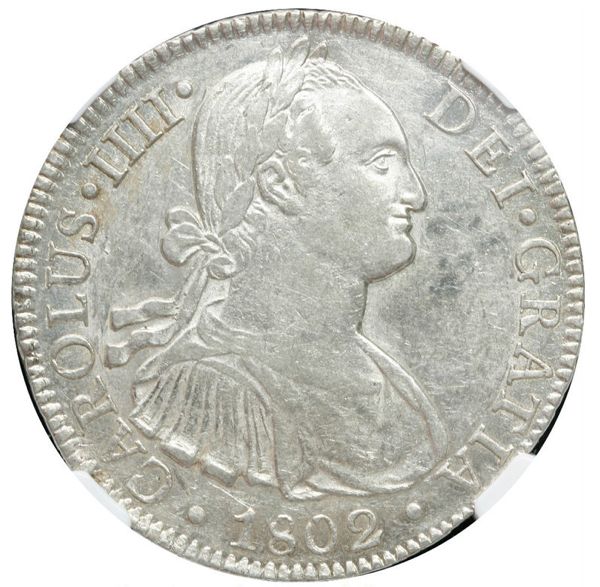
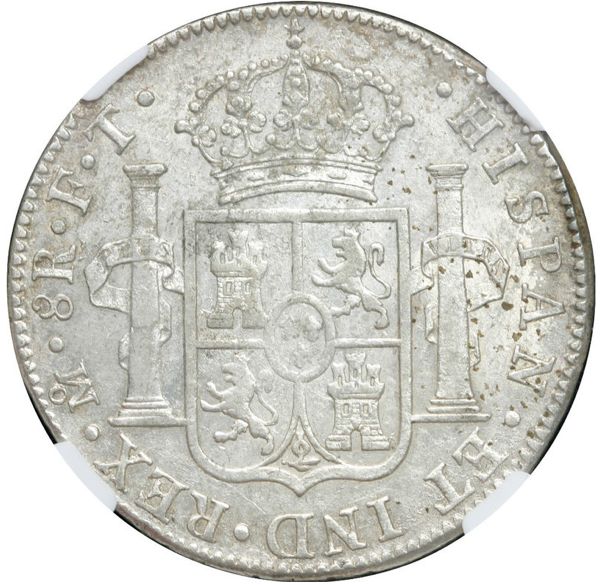
Did anyone notice that the Damage on both coins includes some IDENTICAL DAMAGE?

For instance place both portraits together and look at the odd shaped dent (J) in the field in front of the Kings face. Also the scrape along the jaw line is the same, as is the damage behind the head of the King and the ding on his armour.

NGC has clearly encapsulated a forgery. Great discovery.

Do you know who owns the encapsulated version. It would make a simply fantastic pair coupled with your coin.

Valued Member
United States
115 Posts
 Posted 09/26/2011  10:16 pm  Show Profile   Bookmark this reply Add rexvictor to your friends list Get a Link to this Reply
Hi Swamperbob,

I'm glad you liked the overlays. They were done at 50% opacity, however the dark toning on the "Boston" coin and the bright surfaces on the NGC may have led to a misleading final image. I'm posting the original pics of the NGC coin. Unfortunately I was unable to locate the URL.

1802-Mexico-City-8-Reales---Counterfeit?

1802-Mexico-City-8-Reales---Counterfeit?
Pillar of the Community
swamperbob's Avatar
United States
5362 Posts
 Posted 09/27/2011  1:09 pm  Show Profile   Bookmark this reply Add swamperbob to your friends list Get a Link to this Reply
I was not aware you could do such an overlay - shows how OLD I am. I was not raised with computers. I graduated from college about the time the first hand held calculators from Texas Instruments came out. We had one kid in 4th semester Structural design that had one (the rich kid in class) and the professor went nuts when he brought it to the finals. Now I understand they are mandatory in the same situation because no one does the calculations by hand anymore.

Looking again at the overlay picture - I now see that the punch elements are the same - but the spacing varies just a bit proving that two dies are involved. So I now see what you mean. You can ignore my earlier comments.

But one caution, you need to know more about the story behind die production that I was told about years ago. The Boston dies were at one time produced EXACTLY like the originals with a King punch and die arrangement. They made multiple dies with the same punches so there would be die variation as expected and also because they were operating like a mint and dies wore out. The dies were shipped in from somewhere (that is one element I have not been able to discover is the die maker). Period (1890's) letters that have recently come to my attention lead me to believe the US Government was involved (or at least viewed the undertaking with a blind eye) - so it is not a long stretch to postulate that the US mint iteslf could have been involved. That is speculation based on a statement in one letter from a US Senator to a lawyer - but it fits the pattern that this was a quasi official but "secret" production facility.

It has been proved beyond any doubt that the US mint did attempt to open an "official" mint in California to make restrike Portrait Dollars using US silver in the early 1870 era. This was only abandoned when the Mexican government demanded a 15% royalty. But the need to trade with China and the preference on the part of the Chinese for "Bustman" dollars did not go away.

In any event - I have also been told in correspondence with another researcher that the dies were produced from punches copied from real coins. This technique is documented elsewhere and is a well documented procedure used by forgers for a century or longer. It involves copying each element (letter, portrait etc.) on the coin separately and making a punch set. The process used is virtually identical to using a punch block similar to what the real mints used. It makes complete sense to do so before newer technologies came into being.

The other story which I heard from the old forger that started all of this research back in 1960 - was that they also used a 1 to 1 pantographic lathe to duplicate dies. This story conflicts with his other statements about punched the dies. But they could have had two die sources - over time. This theory makes more sense to me since it uses technology that is known to have existed at the time he was involved (1920's and 1930's). The apparatus (lathe) used would be similar to the machine that Francis Henning built ON HIS OWN in the late 1940's or early 1950's to make his famous nickel counterfeits. To me it makes complete sense to think that in the 1880's dies would have been punched but that by the 1920's a die could be lathed quicker and less expensively. The Boston type forgery did occur over a period of about 50 years so advances in technology would have been employed.

My real wish is that someone at the time had documented exactly what was being done and that I could find that document. But that is very wishful thinking since the enterprise was not 100% on the "up and up". But I keep searching archives for clues. It is a very interesting detective story.
  Previous TopicReplies: 22 / Views: 6,024Next Topic
Page: of 2

To participate in the forum you must log in or register.


Disclaimer: While a tremendous amount of effort goes into ensuring the accuracy of the information contained in this site, Coin Community assumes no liability for errors. Copyright 2005 - 2026 Coin Community Family- all rights reserved worldwide. Use of any images or content on this website without prior written permission of Coin Community or the original lender is strictly prohibited.
Contact Us  |  Advertise Here  |  Privacy Policy / Terms of Use

Coin Community Forum © 2005 - 2026 Coin Community Forums
It took 0.26 seconds to rattle this change. Forums