| Author |
 Replies: 16 / Views: 4,828 Replies: 16 / Views: 4,828 |
|
New Member
Canada
5 Posts |
Hey all, I have a few bills that I was wondering if someone could help me get an idea of what they are worth... here they are... 9 consecutive 1979 20$ Bills (Mint) 4 consecutive 1979 20$ Bills (Mint) 2 consecutive 1979 20$ Bills (Mint) 4 consecutive 1973 1$ Bills (Mint) 2 consecutive 1973 1$ Bills (Mint) 1 1937 100$ bill (poor) 1 1954 1,000$ bill (Mint) uploaded/lkorexia/20110929_20_opt.jpg uploaded/lkorexia/20110929_1000_opt.jpg 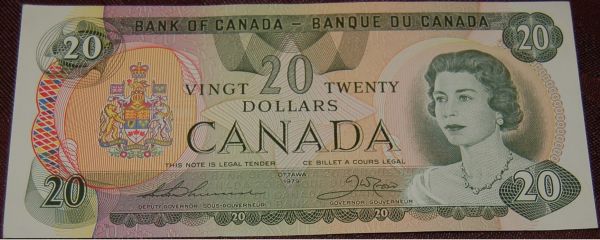 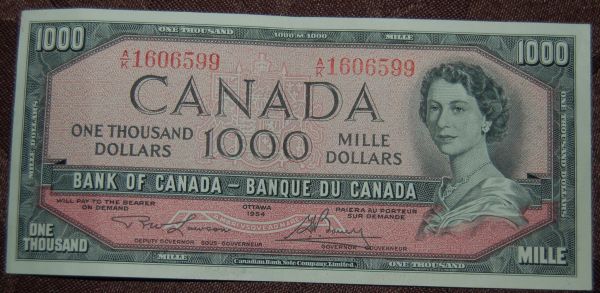 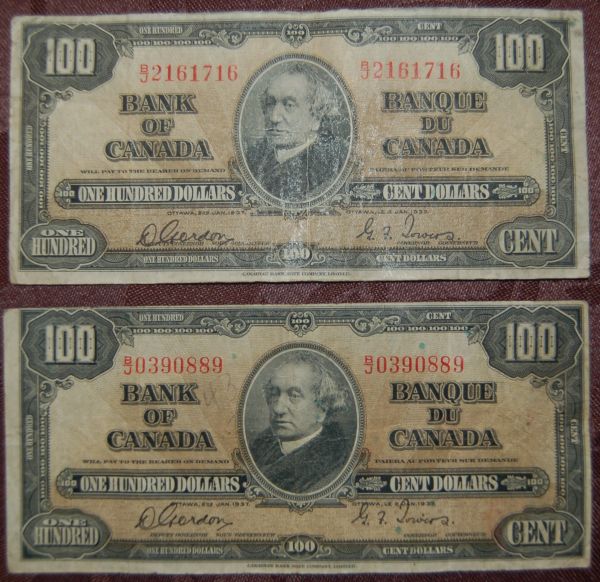 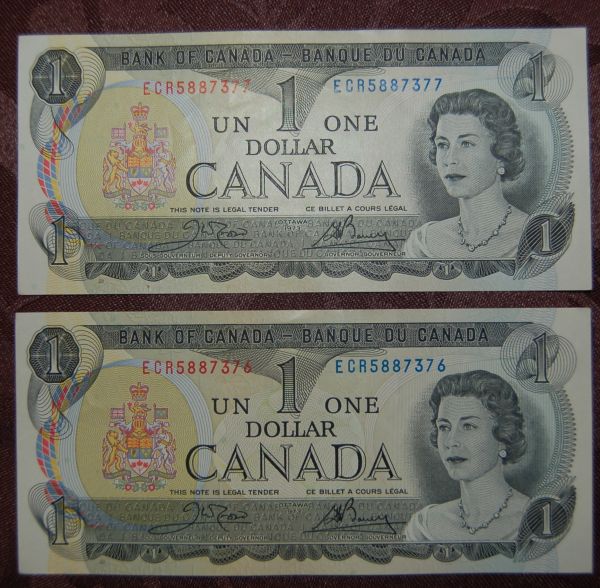 Edited by lkorexia
09/28/2011 10:14 pm
|
|
|
|
Pillar of the Community
Canada
834 Posts |
If my math is correct
$1406
|
|
New Member
 Canada
5 Posts |
very smart... I was looking for a value based on the notes that I have in sequence... I know nothing about old currency and would like to begin with a little help from people who are not *** Edited by Staff | The bad word filter is in place for a reason. Bypassing the filter and making the intended word obvious anyway is completely unacceptable. ***
|
|
Valued Member
Canada
272 Posts |
To give an accurate value of your bills one needs an accurate grade of your notes.
I know you said they are mint, but that means nothing to me as there is 4 grades of mint.
Perhaps a better description would help eh?..
|
|
New Member
Canada
5 Posts |
okay I posted pics... hope this helps..
|
|
Pillar of the Community
 Canada
9904 Posts |
Swrbxx wasn't being smart,unless you have a sought after variety among them,all the bills you list are face value items
|
|
New Member
Canada
5 Posts |
hmm so what why are people posting them so high on ebay? |
|
Valued Member
Australia
278 Posts |
|
|
Valued Member
Canada
497 Posts |
Regarding the consecutive $20s, Thiessen Crow were the last signatures in this series and a lot were put away, ie they are very common. The fact that they are consecutive serial #s would interest a buyer only in the fact that maybe they came direct from the bank and therefore less likely to have signs of circulation - counting flicks, edge bumps, soiling from handling , etc. , there is no premium for consecutive #s. Unless they are replacement serial #s beginning with 510 or 516 they're pretty much face value. The $1 bills are common serial #s and were the last signatures for this series, and again pretty much face value.
The 1937 series $100 are in your words 'poor' shape, the first one is well circulated and the second may be trimmed. They book for $125 in VG condition , but that is what a dealer's start price would be if you wanted to buy, he might offer slightly over face.
The $1000 is in nice shape and might book around $1800, but collecting $1000 bills is an expensive hobby and the bill doesn't appreciate in value as quickly as a $1000 investment, just think what $1000 invested in 1970(about the year this was issued) would have returned today, so finding a buyer might be tough, although I've seen them sell not too bad on the 'bay if you want to take that chance.
Also take into account that the paper money market has been very soft for the last few years. Sorry if I burst your bubble but that's my opinion.
|
|
Pillar of the Community
Canada
9904 Posts |
Just because they're not valuable doesn't mean they're not collectible
I have consecutives in every denomination $1-$100,in every series from 1954 to present,I care less that there is no premium,I like 'em
|
|
Valued Member
Canada
497 Posts |
I agree with you DBM, they are great to have and look at, the 54 series is my favorite and the $1000 bill is gorgeous. But Ikorexia did ask for opinions on the value of the collection and was wondering about the consecutive bills, I bet you didn't pay much of a premium for the consecutives in your collection unless they were tough notes or possibly some in the '54s.
|
|
New Member
Canada
5 Posts |
thanks everyone for your feedback, although these were passed down to be and I thought it would be a great idea to make some extra money for school.... they are beautiful notes and maybe its time to pick up this hobby? haha I dont know... are they worth keeping?
|
|
Bedrock of the Community
Canada
10743 Posts |
Quote:
....are they worth keeping? For sure, if your a collector.  |
|
Moderator
 Canada
10477 Posts |
Quote:
...although these were passed down to me... are they worth keeping? Only you can answer that question. If the person who passed the notes to you was someone important in your life, then you can't put a price on sentimental value... "Discovery follows discovery, each both raising and answering questions, each ending a long search, and each providing the new instruments for a new search." -- J. Robert OppenheimerContent of this post is licensed under a Creative Commons Attribution-NonCommercial 3.0 Unported License. See: http://creativecommons.org/licenses...0/deed.en_USMy eBay store
|
|
Pillar of the Community
United States
781 Posts |
The best way to determine if they're worth keeping is to ask yourself: if these were suddenly gone 1 day, would I care? Would I even notice? If the answer is yes, then you have your answer.
|
|
Pillar of the Community
United States
1002 Posts |
My estimate is that you may get anywhere from $1,100 - $1,800 for the 1954 $1,000. $25-$45 for the 1979 20's, $105 - $135 for the 1937 $100 and $2-$3 for the uncirculated 1973 $1 bills. That is based on my observations of ebay sales. From those prices you would have to back off listing fees, selling fees and paypal fees. Personally, I think you are better off to sell than as singles than consecutive numbers as there are more people that are willing to buy single bills than groups. If you were going to sell them on ebay you might want to list the individual consecutives at the same time which would give someone who wanted to buy consecutive #'s a chance to get them but not shut yourself out from bidders who want only single bills. |
| |
Replies: 16 / Views: 4,828 |










 Posted 09/28/2011 7:03 pm


