Here is a bit of information I found concerning another coin with the same design. I COMPLETELY stole this from someone else, so thanks to that aficionado on another website.
Quote:
You will find few castles and palaces in the Netherlands. Wealth was not held by the nobility, but by the merchant class from the 17th century. Rich merchants did build their stately homes, but they are more modest than those found in more feudal countries. This gave the Netherlands a unique, but temporary economic advantage between 1650 and 1750 and the result was a trading empire around the world, including trading stations in India, such as Paliakate (Pulicat), Negapatnam, Masulipatan, Pondicherry, Cochin and Tuticorin, each of which had their own coins.
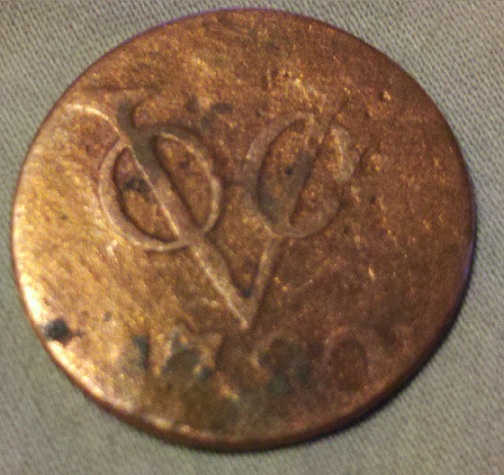
In order to head off the competition (mostly English), the Dutch established the counterpart of the United East India Company, the VOC, which received a (Dutch) monopoly on te trading route via Africa. The VOC got sovereign rights, such as the right to raise an army, negotiate with foreign potentates, conclude treaties with foreign states and strike coins. Its mandate stipulated that coins would be struck in the various mints of the Netherlands, so that each of them would receive part of the business and that the coins would have the bale mark (logo) of the VOC, so that they couldn't circulate in the Netherlands. Various measures were taken to separate VOC coins from Dutch coins, such as tariffing them differently. To a large degree, this only encouraged smuggling and re-melting. This explains why VOC copper is plentiful, while silver is scarce.
VOC coins were also struck in the trading stations, but the bulk of the coins came from the Netherlands and were transported by ship. They are generic coins, for all the VOC stations. whether in South Africa, India, Ceylon, Malaysia, Taiwan or the East Indies. In that sense, you may consider this an Indian coin. Saran Singh, in his catalogue of Malaysian coins lists them as Malaysian.
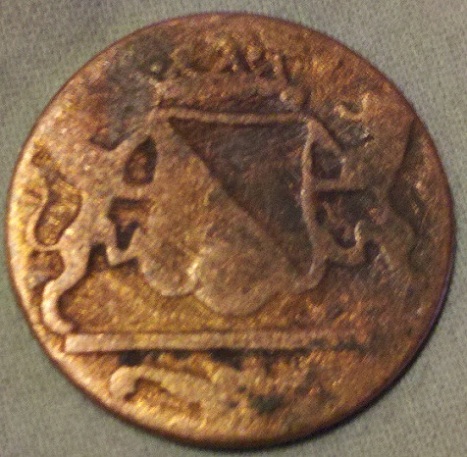
The coins were screwed without a collar, a process halfway between hammering and machine pressing. The screws were driven by people power. The dies are mounted in the device in the centre. By turning the weighted handles on top, the upper die is screwed down towards the lower die. The ropes are for the elegant minters in the picture to pull on. The coin is 100% copper, its denomination is 1 duit, catalogue number depends on catalogue: Scholten 745, KM 111.4.












 Posted 10/04/2011 9:50 pm


 The Dutch West India Company operated around New York but their peak power was in the 1600s and it was rapidly declining by the early 1700s with English governance and trade on the rise.
 The VOC mark is one of the earliest corporate logos, and that company did not operate in N.America...AFAIK.


