| Author |
 Replies: 22 / Views: 7,581 Replies: 22 / Views: 7,581 |
Page 2 of 2
|
|
|
|
Pillar of the Community
United States
7375 Posts |
Also keep in mind that you can have two of the exact same coin in slabs with the same grade, let's say XF Details for both, and one could be in much better shape that the other. Although both would be XF (and equal) if there were no damage....the details damage can be different on both coins. So to sum it up, each coin has to be evaluated carefully on it's own to determine the exact value. Older US Large Cents come to mind. You can have two 1794 VF details, and one can be worth $200, and the other could be worth $600. |
|
Pillar of the Community
United States
4963 Posts |
cdngmt- I am a bit hesitant to agree with you. Coin grading is and always has been extremely subjective. TPGs have, like you said, attempted to regulate it more and have been fairly successful. However, it still varies significantly. You can get a coin in a PCGS MS-63 slab, crack it and send it back, and get MS-65. By 'buying the coin, not the slab', you can consider if it is over- or undergraded (hence affecting value) and weigh other factors like eye appeal. This concept applies as much or more to details coins than problem-free ones.
|
|
Bedrock of the Community
United States
11951 Posts |
Interesting discussion. I look at getting a Details grade is saying the surface of the coin is not original. By assigning a grade the TPGis just stating what level of wear the coin is in. 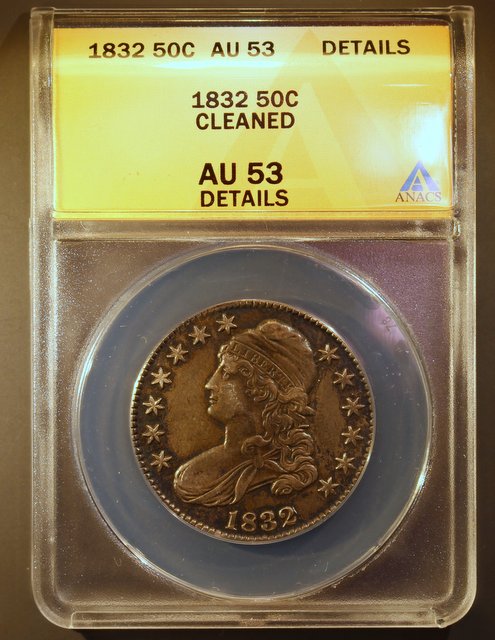 On this coin the TPG is saying the coin has been cleaned. but the coin has the same level of wear as a AU53 coin. |
|
Valued Member
 Canada
405 Posts |
Hi
Again I do appreciate the opinions expressed. I can understand GR58 explanation ...as far as his example goes(ie with cleaned coins. BUT when I saw corroded I really can't see/accept it. To me its double talk akin to its perfect except where its not.
I think the other to commentators are both on the point I'm having such difficulty with. Unless grading is more standardized and will generate the same (or narrow range of )valuation wherever it is evaluated, there is no justification for pricing.
We are in effect buying tulip bulbs, prices and values have no floor, they are fad and whimsy (which is true of course to some degree). If the value is all puffery...why not just catalogue pictures? {we can't really handle the coins with "impairing their value and worth"}
|
|
Bedrock of the Community
United States
11951 Posts |
I am not exactly sure where your going with this idea. Here is another shot at hoping to be more clear. If you have two coins same date and grade, both TPG slabbed. But one has a "Details" on the label. The coin with out the "Details" on the label will sell for more. When "Details" is added to the label, the TPG's are saying there is a problem with the coin. Problems could be Corroded Cleaned Damaged Environmental damage Artificial toned and many other problems. The TPG's will still give a grade, based on the amount of wear on the coin. Because you could for example have two Lincoln Cent. One has full rims, but other main devices of the coin are gone. No wheat lines, Lincoln head is smooth. But the surfaces are corroded. Then you have a Lincoln that has all the wheat lines, Lincoln has hair lines, bow tie and defined coat lines. But is also corroded. Both coins are corroded but one still looks better than the other, the TPG's try to state that. |
|
Pillar of the Community
 United States
4616 Posts |
Details BAD
It means that the coin was messed with. Altered. Cleaned. Something like that.
Not original.
Now, if your choice (for an exceptionally rare or pricy - given YOUR budget) is between a hole and a details coin, and you know you aren't going to turn around next week or next month or even next year and want to upgrade... a details coin can "fill the hole".
Sometimes that is ALL you are going to get - there simply aren't any original coins in existence. S'be'it.
Net Grading. OK, the coin has been messed with. If it HADN'T been, it would be an XF40.
One school says no net grading, just XF details.
The other school says, "we can approximate how messed with". XF Details, Net VF35 - means just a little. XF Details, Net AG3 - means a lot.
-----Burton 50+ year / Life / Emeritus ANA member (joined 12/1/1973) Life member: Numismatics International, CONECA Member: TNA, FtWCC, NETCC, EveryCountry (online) coin club Owned by three cats and a wife of 40+ years (joined 1983) Author: 3rd Edition of the Sample Slabs book, https://www.sampleslabs.info/ |
|
Bedrock of the Community
United States
94367 Posts |
IMO, "net grading" is essentially meaningless. I mean, as if the original grade wasn't subjective enough in the first place! The term might have validity in the structured EAC system, perhaps, but it is a useless distraction otherwise.
|
|
Pillar of the Community
United States
4085 Posts |
Also sometimes you look at a Details coin and you might think "I don't see it". Remember, the TPG's are still just some guys sitting in a room giving an opinion. They have lots of experience of course but they aren't necessarily perfect. |
|
Pillar of the Community
United States
4963 Posts |
Quote:
One school says no net grading, just XF details... ...and that's the school I'm in. In most cases, I'd rather have a VF-35 coin than a damaged EF-40, or at least I would rather know which I was buying. |
|
Bedrock of the Community
United States
17884 Posts |
If you are going to net grade you need to also state the sharpness or details grade and preferably what the problems are that resulted in the net grade.
|
|
Valued Member
Canada
405 Posts |
Sorry I've been/am still away {I'm old and only log on with a computer}. In answer to goldrush58 (& with a nod to BStrauss3 and coinfrog)I really didn't understand where/what the "details" referred to. My point was (I guess) is that TPG should make the evaluation and hence the values of the coins clearer and more standardized so as to reduce confusion. The use of "details" was like those 'famous' telegrams lacking punctuation that enabled contradictory meanings depending where the missing comas, periods etc went. That is was the coin downgraded to its current level because of the "details" or were they a sign of possible future problems...(would hairlines mean that some corrosion/rust marks starting to develop that may in the future possibly downgrade the coin). { I guess I still don't understand what surface porousity would mean}. The way I understand it currently it would have been an XYZ grade if not for the damage is meaningless. Any coin is perfect except where its not. I will treat it as a no go. Thanks again for taking the time to explain and help me clear my thinking |
|
Pillar of the Community
United States
4616 Posts |
Unfortunately there's very little incentive for the TPGs to standardize on ANYTHING. In some sense we're lucky the 70 point scale was established long ago or ...
-----Burton 50+ year / Life / Emeritus ANA member (joined 12/1/1973) Life member: Numismatics International, CONECA Member: TNA, FtWCC, NETCC, EveryCountry (online) coin club Owned by three cats and a wife of 40+ years (joined 1983) Author: 3rd Edition of the Sample Slabs book, https://www.sampleslabs.info/ |
|
CCF Advertiser
United States
1533 Posts |
I've seen artificial toning that I do not agree with. I've also seen repaired that I cannot see. TPGs have tried to create a sight unseen market for coins. With the common stuff, they have largely succeeded. You can buy 63-65 Walkers and Morgans, Saints and Franklin halves sight unseen in a very narrow price range. It just doesn't work for the rare stuff. |
|
New Member
5 Posts |
Quote:
Sorry to ask what is probably a silly question but when the slab says things like
1) AU details ....does this mean the coin is AU or only some features are AU like ?
2) what would a qualifier on a slab like corroded mean ? i.e. if the coin is corroded how can it carry a grade of say EF ?
Any explanation that would clarify how to rate the relative condition of a coin with either of these (or other)qualifiers vis a vis similiar graded coins without would be greatly appreciated. Any one of these posts should have answered your question but now we are on page #2 and it may keep going. Here is the long answer to your original question: During a 1970's ANA Authentication Seminar the instructor explained that a very strict system of identifying coins was used at ANACS. He called it "technical" grading as it explained what a coin actually looked like. We were asked to imagine how we would describe (grade) an uncirculated coin that was chopped in half! His answer was "Uncirculated, chopped in half." It was NOT AU or lower (Net grading as practiced by Large cent collectors). Another example would be Uncirculated, rim filed. When TPGS started. A coin with a rim file was not considered suitable to be put into a slab; and they kept the money. This practice goes against what I was taught: ANY COIN in ANY CONDITION can be described and graded. Finely, the TPGS got the message. At first one service, ANACS described the problem and then Net graded the coin to reflect its lower value. IMO, this is nuts. It can be demonstrated that the grading services actually DO NOT PUT A VALUE ON A COIN is spite of the claim. Today, a details grade reflects the way it was done in the beginning. A coin is graded for its condition and then the problem is noted. XF Details - corroded indicates that there is a XF degree of details remaining yet the coin is corroded. |
|
Pillar of the Community
United States
992 Posts |
I would prefer it, instead of saying 'Details' or 'Net', the specific words such as 'Cleaned', 'Corroded', 'Mounting Damage', 'Residue', 'Repaired', 'Artificial Toning', and such clear expressions were used.
|
|
Page 2 of 2
|
Replies: 22 / Views: 7,581 |
Page 2 of 2
|






 First Page


 Posted 02/23/2016 02:26 am


