| Author |
 Replies: 26 / Views: 5,405 Replies: 26 / Views: 5,405 |
Page 2 of 2
|
|
|
|
Pillar of the Community
United States
2289 Posts |
Quote:
I did say it is what I like to say. I tend to like avoiding any ambiguity. I'm not sure I remember why I responded at all now.  Obviously "copper nickel clad" is in no way ambiguous. I suppose it's because I still hear people calling silver clad "clad" that I brought it up at all. It can be confusing for newbies. Time don't fly, it bounds and leaps.
Edited by cladking
09/14/2016 09:51 am
|
|
Moderator
 United States
196572 Posts |
Quote:I'm not sure I remember why I responded at all now. It was probably my choice of saying Cu-Ni instead of copper-nickel.  To be clear, my point is that I do not like to say clad alone, specially since nearly a third of the Eisenhower dollar set is silver clad.  |
|
Pillar of the Community
United States
2289 Posts |
Quote:To be clear, my point is that I do not like to say clad alone, specially since nearly a third of the Eisenhower dollar set is silver clad. I see... ...makes sense. From my perspective I'm almost always referring to cu/ ni clad since most modern quarter proofs and all of the uncs are either 90% or cu/ ni clad. If I were primarily an Ike collector I'd probably say cu/ ni clad as well. Time don't fly, it bounds and leaps.
|
|
Pillar of the Community
United States
1119 Posts |
Jbuck when you say Cu-Ni clad do you pronounce it like "q knee" or say copper nickel in full? this is my curiosity.
|
|
Pillar of the Community
United States
947 Posts |
Just for the heck of it, I Googled it: Full Definition of clad 1 : being covered or clothed <ivy-clad buildings> 2 of a coin : consisting of outer layers of one metal bonded to a core of a different metal I vaguely recall seeing the rolling process of the sheets at the Philadelphia mint when I was very young. As I recall, it was for copper pennies. Ingots about 10" thick rolled into sheets the thickness of a penny. Later in life, I worked as a contractor at a few copper plants and it was a similar process, although for different end uses. I don't have any idea where the coils are made today. Some info can be had here https://www.treasury.gov/about/educ...cturing.aspx As previously stated, clad coins are made of specifically "sandwiched" metal sheets. The stock is actually a metal coil from which blanks are punched. Generally, for US Silver Clad coins the inner core was/is copper with the outer material being silver. This holds the illusion that the coin has the intrinsic value of a more pure silver 90% homogenized coin since the "jacket" gives the illusion that the coin is as silver as the older 90% US silver coins. When the coin is "struck" the relatively soft silver tends to draw to cover the edge of the coin which completes the illusion. Copper/Nickel coins furthered the debasement of intrinsic value by substituting nickel cladding which has the illusion of being silver. However, Nickel is much harder than silver and does not draw as easily over the sides and the Nickel content is only 8.33% so the copper core is more visible on the edge of the coin. The process of making "clad" stock is a bit more complicated than making a homogenous metal alloy sheet because the bright metals have to be on the outsides of the metal sheet when it is made. Silver was bonded to copper sheets using a coating/annealing process as nickel is bonded to copper sheets now for CU/Ni stock. The processes were/are regulated to maintain 40% silver cladding on Silver clad stock and 8.33 nickel cladding on CU/Ni stock. The outlier is the Nickel which is 25% Nickel and balance copper, homogenized stock. A different process is used for copper "plated" zinc coins - a further debasement of intrinsic value. The exotic composition of the modern "gold" dollars is, generally, a coating process as previously discussed in this thread. |
|
Moderator
United States
196572 Posts |
Quote:
Jbuck when you say Cu-Ni clad do you pronounce it like "q knee" or say copper nickel in full? this is my curiosity. I read it as cupro-nickel, which is closer to saying copper nickel than it is q-knee. Quote:
Generally, for US Silver Clad coins the inner core was/is copper with the outer material being silver. Gernally-ish, but not quite precise. The core is 79.1% copper and 20.9% silver. The cladding is 80% silver and 20% copper. The overall composition balances out to 60% copper and 40% silver. So the illusion, ignoring the core, is that they are 80% silver coins (since that is what is immediately observable). However, the edge often (but not always due to the bleeding you describe) reveals the core. It is less obvious, being more grey instead of brown or red. |
|
Pillar of the Community
United States
2289 Posts |
Modern cu/ ni strip is made by rolling the copper strip between two rollers and the cu/ ni jacketing at high pressure. Initially back in '65 they were made in sheets that were "explosion bonded". The three sheets were forced together with hydrualic presses and then dynamite was exploded above them to complete the bonding process. The old coins sometimes delaminated even after the strike.
It's in "blanking" that the edges are smeared over. Blanking is cutting out discs (type 1 planchets) using round dies or shears to punch them right out of the strip.
Time don't fly, it bounds and leaps.
|
|
Pillar of the Community
United States
1760 Posts |
That is interesting information, cladking.  |
|
Moderator
United States
196572 Posts |
That is why he is the Clad King. |
|
Pillar of the Community
United States
1007 Posts |
I would have preferred an alloy in place of cladding for halves, dimes and quarters (and large dollars) similar to that of nickles (75% copper, 25% nickel). This would have given a uniform silver-colored appearance and good wear properties with an easier production procedure. It would also allow the same alloy to be used for any of the coins, just made to different sizes for each coin.
What I understand however was that this would not have worked in vending machines properly without major changes and that the clad versions did.
I do admit that the clad coins do wear remarkably well, much better than silver does. Look at a 50 year old clad quarter with a ton of wear, it is still a very functional coin and all the wording and devices are still very readable.
I wonder if using the 75% copper/25% nickel alloy would have saved much money, or been efficient enough to force the vending industry to go along.
|
|
Moderator
United States
196572 Posts |
Quote:
I would have preferred an alloy... similar to that of nickles... I had not thought about this in a long time, but I once assumed that cladding was used to allow easy differentiate from silver (looking at the edge). I am now wondering why again. |
|
Pillar of the Community
United States
1007 Posts |
IIRC it was chosen because it had the same electrical signature as silver coins so vending machines would not need to be adjusted to accept the new clad coins. Apparently the copper-nickel allow must have been different enough not to be practical. I think the same is true for the "Golden Dollar" clad composition, it matches that of the clad SBA's so machines that accept one will accept the other. I remember as a teen being excited about finding "silver" Canadian dimes and quarters in change and how disappointed I was when I learned that were actually not silver but actually nickel. That silver colored edge really threw me for a loop! |
|
Pillar of the Community
United States
947 Posts |
Thanks for the finite corrections jbuck and cladking. Pardon my error for taking significant shortcuts in explanation and forgetting the difference between silver clad and CU Ni Clad core composition as well as the difference between the effect of blank punching and striking.
Seems like I am forgetting a lot lately.
I also agree with n9jig but I have to admit that I did try a Sunoco Car coin in a vending machine circa 1968 once when I was a child just to see if it would work. I was certain it would reject it. I don't remember what type of machine it was but it didn't seem to have an issue with accepting it. I recall I was so scared of being hunted down by the FBI (yes, we kids did have that level of confidence that any bad action had major significant consequences back then - or at least we honorable ones did) that I hit the coin return and never tried it again so I am not sure if it would have worked or not. I only know that it did not immediately reject it like it would a steel slug.
I can only presume that the debasement of quarters and dimes in 1965 with respect to metal composition below that of a nickel was to make the production of change significantly less expensive.
So... Please correct me if I am wrong but I don't believe the vending machines in 1965 were sophisticated enough to determine the electrical difference between silver, nickel, or copper or the percentages of each beyond, possibly, weight through levers or steel through magnets which is what I recall learning as being the major slug rejecter sometime later in life when learning how things worked.
|
|
Moderator
United States
196572 Posts |
Quote:
So... Please correct me if I am wrong but I don't believe the vending machines in 1965 were sophisticated enough to determine the electrical difference between silver, nickel, or copper or the percentages of each beyond, possibly, weight through levers or steel through magnets which is what I recall learning as being the major slug rejecter sometime later in life when learning how things worked. I think you are right. Modern vending machines will reject silver coins, so obviously the electromagnetic signature is different. I think the old machines used diameter, weight (with a large threshold, explaining why clad coins did not have to be exact), and magnets to pull the slugs. Of course, I could be wrong, too. |
|
Pillar of the Community
United States
1007 Posts |
Here is an example of a silver clad 1967 Kennedy half I got at Walgreens today. As I was checking out I saw it and a few golden dollars in the drawer and asked for it. It looks like it was fairly recently pulled from a collection and spent, perhaps from an SMS. The edges are particularly sharp as are the mills. I could not get a clean picture of the milled edge but one can see the layer's differences upon close examination. Without magnification it looks pretty much uniform but edge marks can be seen if you look real close. I will post another picture once it comes out of the rock polisher. 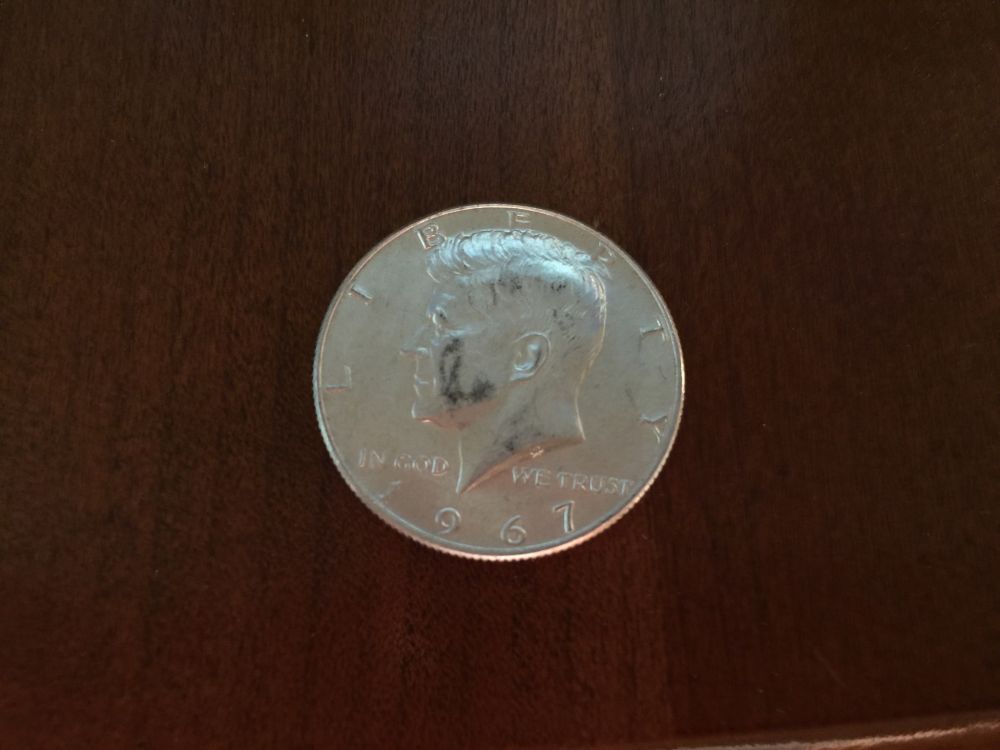 |
|
Page 2 of 2
|
Replies: 26 / Views: 5,405 |
Page 2 of 2
|








 First Page


 Posted 09/14/2016 11:04 am


