| Author |
 Replies: 25 / Views: 1,872 Replies: 25 / Views: 1,872 |
Page 2 of 2
|
|
|
|
Pillar of the Community
United States
3724 Posts |
1941 is a playground for weirdness. At least two hubs had different broken second "T"s of TRUST. Some of the coins are doubled with one broken "T" over another. One of those hubs then acquired a broken first "T" as well. A few coins have both "T"s broken. At least half of the 1941 Philadelphia cents have double die obverses.
At some point, Philadelphia rehubbed a bunch of partially hubbed 1941 dies, using a hub with an intact first "T" and second "T." Where did they get that hub?
One possibility is that Philadelphia used a 1940 hub, grinding off the zero in the date. At least two rehubbed second "T" coins show what may be traces of the Lifesaver-shaped zero hubbed lightly over the last "1" in 1941. Several others show heavy oval-shaped die polishing around the last "1," likely in an attempt to remove traces of a zero. Philadelphia then may have re-ground the 1940 hub, removing all traces of a zero. If so, this would explain the further coins with a somewhat weak second "1" in 1941. Bolstering this idea, the "4" in many 1941 dates is doubled. (The OPs coin here is one of them.)
Interestingly, very few Denver or San Francisco 1941 cents have the broken second "T." To me, that suggests that the early dies had intact "T"s, and Philadelphia shipped the branch mint dies early, and not again in 1941.
If the 1940 hub was used, then many 1941 cents would be reverse-overdate doubled dies, 1940/1941. If that sounds weird, it is what Philadelphia did in 1949, for the extra dies sent to San Francisco, using a ground-down 1948 hub for the rehubbing. That created the three major 1949-S doubled dies. I personally believe that the 1941 experience is what gave them the idea to do it (again) in 1949.
|
|
Pillar of the Community
 United States
2797 Posts |
Fortcollins, this may have relevance to may 1960P posts. https://goccf.com/t/484565I believe some working hub doubling was mostly abraded but shows on my examples. Do you have photos or links to photos of the supposed 1940/1941 examples? "Pride is yoked with callous behavior, as humility is with compassion." St. Gregory Palamas Top Finds - 1969-S 1c FS-101 http://goccf.com/t/477681 1976 D WQ FS-101 http://goccf.com/t/382777 - 1968 D 1c FS-801 http://goccf.com/t/422254Cool clashed dies - 1972 D 1c http://goccf.com/t/429855&SearchTerms=CCLStruck-In Rim Burr - 1969 S 1c http://goccf.com/t/425587&SearchTerms=burrFloating (Type II) Counterclash - 1978 D 1c http://goccf.com/t/434991&SearchTerms=1978 |
|
Pillar of the Community
United States
3724 Posts |
Quote:
Do you have photos or links to photos of the supposed 1940/1941 examples? Yes, but finding the photos will take some time. I have my coin photos on a backup drive, organized by inventory number. I'll have some time this weekend to look. IMHO, all of the rehubbed "T" cents are 1940/1941, although only two that I have seen so far have what looks like the zero also visible. I'll hunt those down. Most of the "4" doubling looks like the 4 of 1940 hubbed over the 4 of 1941. Notice the doubling areas I marked on the date from your obverse photo (below). The rehubbed 4 is larger than and different from the 4 of 1941, and the only possible other year with a 4 as the third digit then would have been 1940. I haven't made an overlay of the two "fours" yet. The 1941 DDOs have the rehubbed 4 in about every orientation to try to minimize the evident doubling. 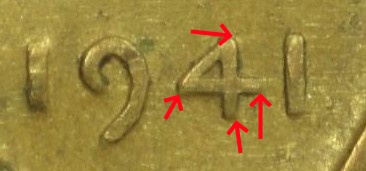 |
|
Pillar of the Community
United States
3724 Posts |
Quote:
Do you have photos or links to photos of the supposed 1940/1941 examples? Here is a set of photos of Die Pair #3 that shows a possible use of a 1940 hub for the second 1941 hubbing. There are four die pair with some suggestion of a zero hubbed over the second "1" in 1941. All four die pair have obverse dies that were polished heavily. Purely conjecture here, but the die polishing is shallower than hubbings, and die wear would tend to expose what was covered by the polishing. I'm still hunting the photos of the other die pairs. I'll post those in separate threads when I finish the 1941 cents. I'm on the prowl for better (and later die state) examples of a couple of those pairings. It seems significant that these appear identically on multiple coins, appear in later die states as the die polishing wears, and are of the right size, shape, and orientation as the last digit on a 1940 cent. This particular die pair shows three, and possibly four, hubbings. The first was a normal first hubbing, but with a broken second "T" in TRUST. The second or third hubbing appears to be directly west of the first hubbing, and is most visible on the second "T" as a light "T" just left of the primary "T." The other of those hubbings isn't for certain. On some of the coins from this die pair, what may be a light hubbing appears to be visible just SE of the primary hubbing. The final hubbing was the intentional DDO, using an intact "T" to rehub over the broken "T." Early die state coins from this and the other die pair are among the most heavily abraded dies I have seen in any modern coin series. The aggressive polishing covered the entire surface of the obverse dies, even reaching some of the deepest parts of the design on the die. My conjecture here is that the intact "T" was a 1940 hub with the final digit ground down. This is known to be the process used in 1949, with a 1948 hub, for the 1949-S DDOs. I believe that 1941 may be similar, and if so, it could be a reason the Mint did that in 1949. The trailing zero (if that is what it is) is very light on all four die pair. If the second "T" was broken on available 1941 hubs, the only possible earlier date that could have been used is 1940. On this coin, like many (most? all?) with the rehubbed second "T" in TRUST, there is doubling on the "4" in 1941. Here are the whole obverse and reverse, date detail, and second "T" in TRUST detail on the third die pair. The inside curve of a possible zero is most clear to the right of the second "1" in the date. The thing closest to the second "1" appears to be a die gouge. What I am seeing is the second object east of the second "1," between the die gouge and the polishing. Note that this hubbing - if that's what it is - isn't oriented correctly, and appears to correspond to what may be a light first "1" and "9" hubbed just NW of the primary "1" and "9." That also would appear to align with a possible second or third hubbing visible left of the "T" in TRUST. Again, this is offered as a possibility that needs a lot more study. 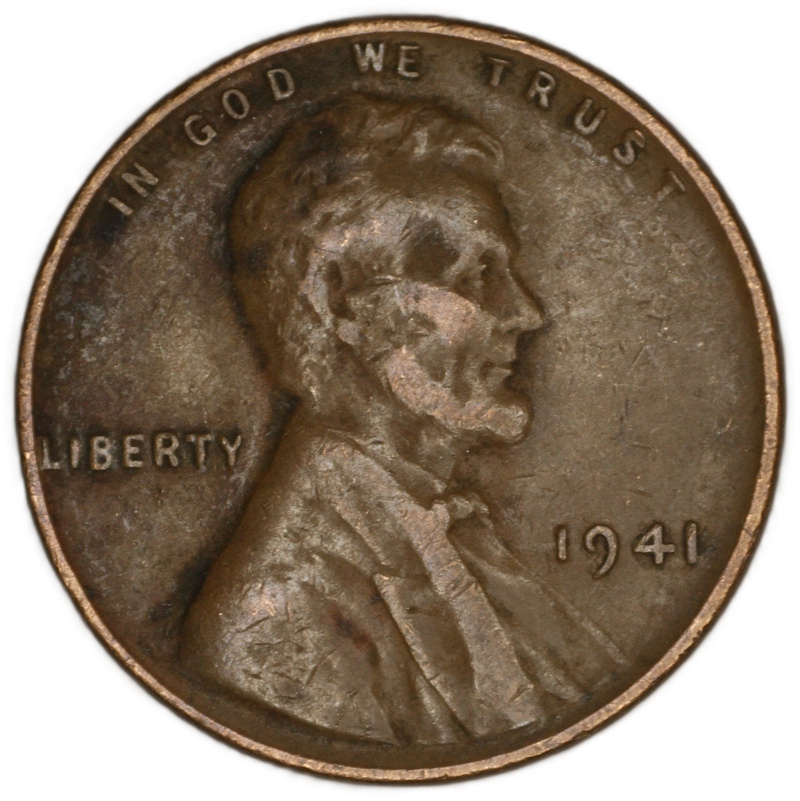 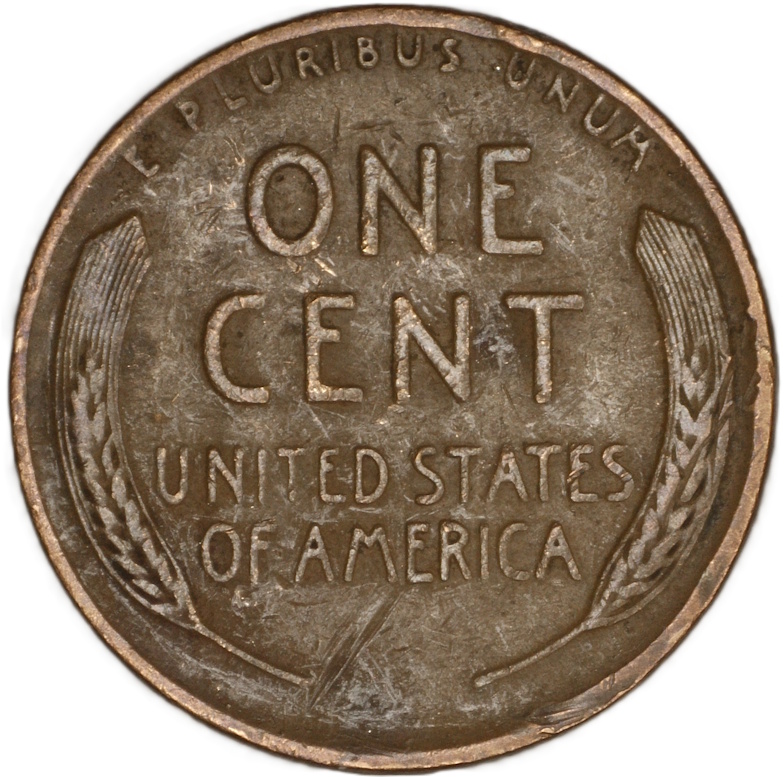 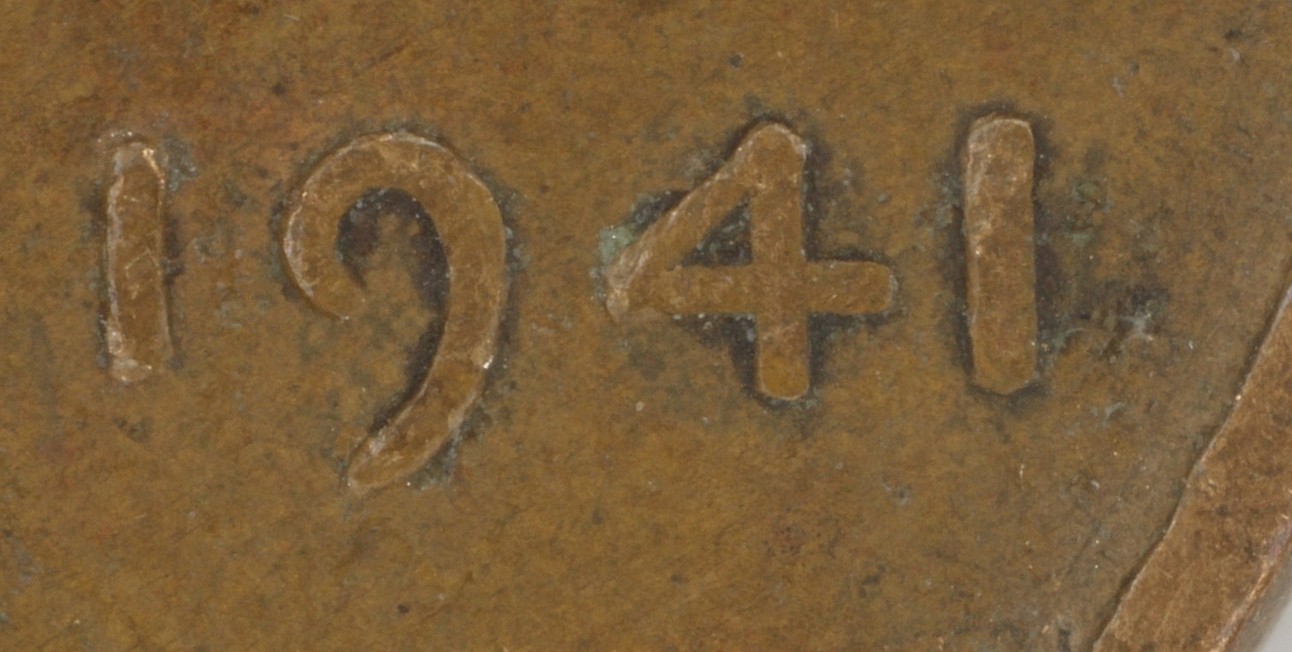 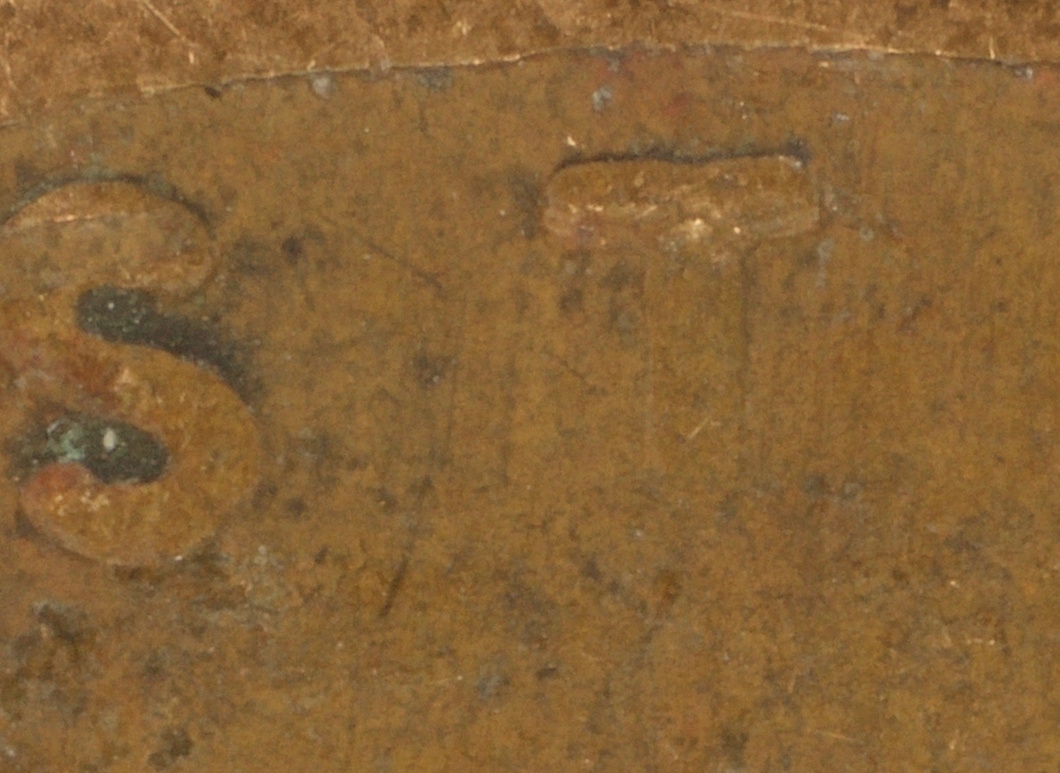 |
|
Pillar of the Community
United States
3724 Posts |
This is a different coin, but it shows the difficulty the Mint had aligning the intact hub "4" with the "4" of 1941 from the first hubbing. This coin has three distinct fours (marked and numbered). The doubling (tripling) is most visible on the point of the primary four, but can be seen east of the foot, at the top point, and on the crosslet, too. 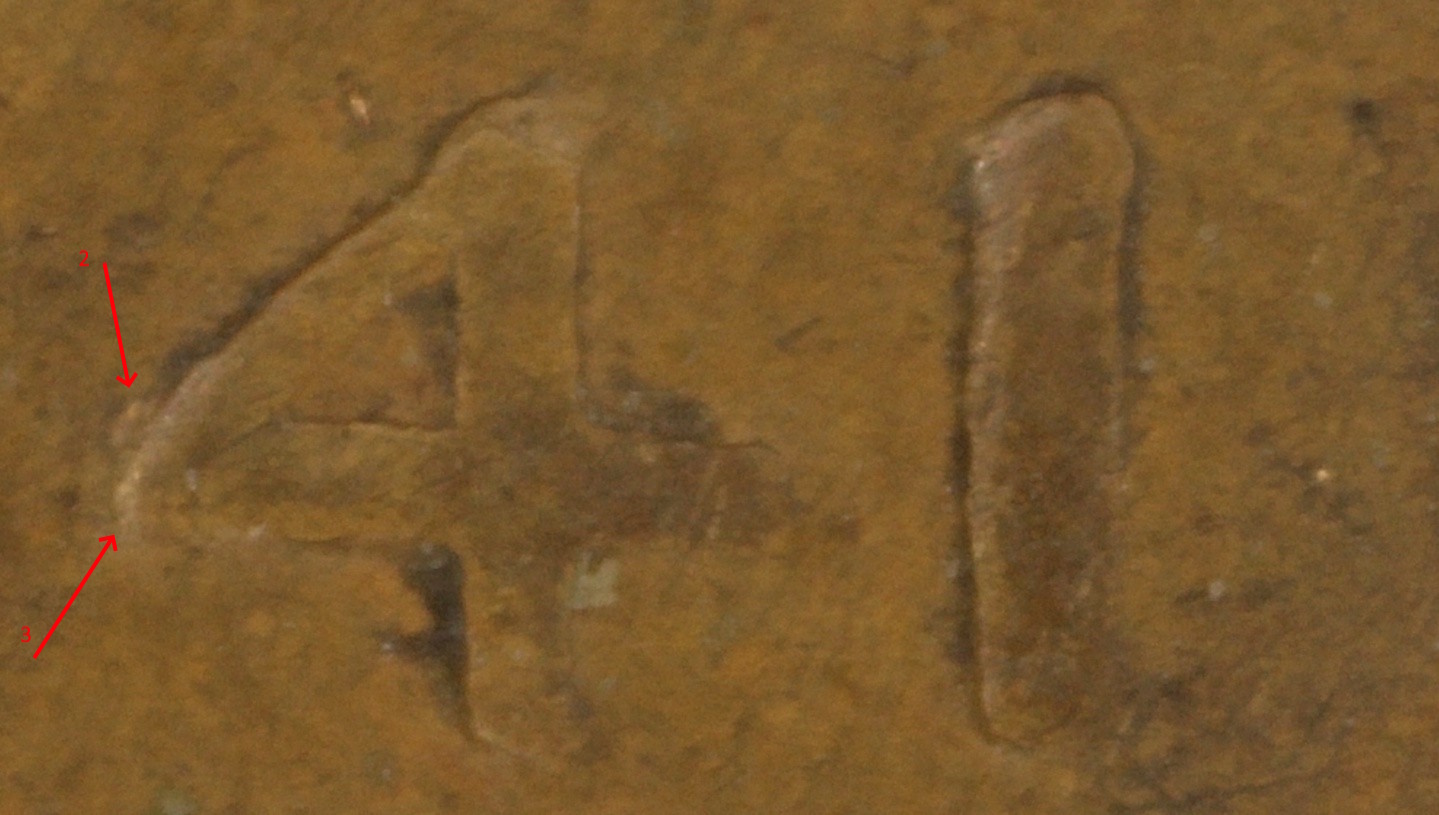 |
|
Moderator
 United States
105622 Posts |
I have a question about this 'broken' T
Seeing how the letters (devices) are incuse on the die, would it be more accurate to call them "incomplete 'T's" rather than broken?
|
|
Pillar of the Community
United States
3724 Posts |
Yes, the first hubbing by a broken "T" hub would be an incomplete first hubbing "T" on the die.
The theory is that the "T"s broke on two of the working hubs, leading to an incomplete first hubbing "T" on many working dies. That is confirmed because there are a couple double dies where the second hubbing was done by a different broken "T" 1941 hub.
The theory is that the Mint then intentionally completed the remaining rehubbings with an intact "T" hub. This process then generated the dozens of intact/incomplete "T" doubled dies. What makes all of this interesting is the distinctly doubled "4" in many dates, with apparent differences in the shape of the second hubbing "4." Unless a 1940 hub was used, the differences in the shape of the "4"s is difficult to explain.
|
|
Moderator
United States
105622 Posts |
Thanks for explaining that @ fortcollins  |
|
Pillar of the Community
United States
2797 Posts |
Thanks for following up fortcollins. I'm going to try and take some better closeups of the 41. I don't see the zero on your example though, I wonder if you've seen some uncirculated examples of what you're talking about?
In general I am trying to figure out if grinding down a digit can produce an incuse ghost image on the hub.
In regards to the coin I posted I don't see two T's, just one broken T. How does that fit in with the other examples?
|
|
Pillar of the Community
United States
3724 Posts |
You actually have three "T"s. The broken "T" was hubbed twice, doubled to the east lightly. I marked it with the red arrows on this copy of your posted picture. The intact "T" was hubbed very lightly, but the top left of the squared crossbar is weakly visible next to and below the broken crossbar of the primary "T." I marked it with the blue arrows. Several of the currently listed rehubbed "T"s are lightly rehubbed. Several of the as-yet-unlisted rehubbed "T"s are very lightly rehubbed. Take a look at:
DDO-009
DDO-012
DDO-015 (which may possibly be a different die state of your coin)
DDO-020/1-DO-036
DDO-027
1-DO-012
1-DO-013
1-DO-014
1-DO-025
1-DO-031 (which is also 1-DR-003)
1-DO-034 (which is also DDR-004/1-DR-005)
Grinding down the digit doesn't leave a ghost image on the hub. If the digit isn't ground all the way down, there may be enough left to impress the remnant lightly into a working die, producing a weak/ghost image on coins. If the digit is fully ground down (as in 1949), nothing of that digit should be transferred to a working die, and obviously nothing would be visible on coins struck from that die.
Again, everything about 1941 is theoretical right now. It's a crazy year for cents, and a lot more study is needed to figure out what was going on in Philadelphia. The large number of 1941 cents I'm going through are all circulated, from bags in estate sales. I wish I had uncirculated coins to look at, but I don't. Again, that's why much more study is needed to figure out this date.
|
|
Pillar of the Community
United States
719 Posts |
Very interesting! Thanks for sharing all this info. |
|
Pillar of the Community
United States
2797 Posts |
I started looking through some high grade examples on PCGS of the 1941's in hopes of seeing something but none of the examples seemed to be with broken T's. I'm curious if you've done this?
Might thoughts about this are primarily in relation to the 60P oddity I've posted. Do you have any thoughts on those coins? There is some sort of weak/ghost image left on a working hub that transferred to multiple working dies that transferred to coins that doesn't fit neatly into known causes.
"Pride is yoked with callous behavior, as humility is with compassion." St. Gregory Palamas Top Finds - 1969-S 1c FS-101 http://goccf.com/t/477681 1976 D WQ FS-101 http://goccf.com/t/382777 - 1968 D 1c FS-801 http://goccf.com/t/422254Cool clashed dies - 1972 D 1c http://goccf.com/t/429855&SearchTerms=CCLStruck-In Rim Burr - 1969 S 1c http://goccf.com/t/425587&SearchTerms=burrFloating (Type II) Counterclash - 1978 D 1c http://goccf.com/t/434991&SearchTerms=1978 |
|
Pillar of the Community
United States
3724 Posts |
One of the lines of thought on the high-grade examples not commonly having broken "T"s is that it is usually the first coins struck in a year that people acquire for collections and by rolls, and the "T"s on the hubs broke later in the year. By the time the 1941 broken "T" coins appeared, coins were probably among the last thing on anybody's mind. There are some higher grade examples out there, and some are photographed on the three sites, but they are scarce. Just from what I'm seeing in the wild, at least half of the Philadelphia 1941 cents are DDOs, the vast majority of them minor: doubled second "T," doubled eyelid, doubled "4" in the date. So many of them are heavily circulated and dinged in ways that make attribution iffy or impossible. I don't have the time (or desire) to spend it trying to attribute an iffy eyelid, so I'm tossing those back into rolls to clear them out. Possibly 10-12% of the total coins are able to be attributed. That's still a lot. The most desired varieties are scarce, and the early stages of those varieties are very scarce in any grade. A few of the varieties are so common that they cause eye rolls when they appear yet again. I'm drowning in DDO-004/1-DO-007s, and they are just getting tossed in a pile so I can pick the nicest looking ones to keep and jettison the rest. There are so many questions about the 1940 and 1941 cents, and the only answer I can give to these questions is, "I don't know." Why are there so many Woodies for 1940 and 1941? Why is the percentage of woodies in Philadelphia cents of 1940 and 1941 so much higher than in Denver and San Francisco cents of those years? Why are there so many Retained Cuds on 1940-S cents, but far fewer on the other date and mint combinations of 1940 and 1941? When the "T"s broke in 1941, why didn't the Philadelphia mint simply scrap the dies, make another working hub, and create new dies? They certainly had the equipment, unlike the branch mints. Did Philadelphia grind down and use a 1940 hub for the second hubbing? If not, why are the "4"s doubled, why does the second "4" look different than the "4" from the first hubbing, and why does the second "4" not fit within the footprint of the first "4"? Why are so many 1941 Philadelphia die pairs abraded almost to oblivion? What is beneath the abrasions? Why did they abrade both the obverse and reverse dies? And most interestingly, as the dies wear and the underlying issues start to emerge in LDS/VLDS, why isn't there evident die clashing on some of those dies? Why are there hints of fairly significant doubling on some of the abraded dies (both obverse and reverse)? Why were these dies used at all? Maybe the answer is simply this. We spend hours looking through microscopes at these coins, but nobody did that in 1941. Held in a hand for commercial purposes, even a coin from a heavily abraded die looks like a coin. The country was trying to recover from the depression, looking at an imminent world war for the second time in 25 years, some goods and food were scarce, jobs were still scarce, and what these coins could buy was far more important than how they looked. And the mint's job was to produce as many circular stamped objects as were needed to keep commerce happening, and saw these cents as that, rather than objects of medallic art. |
|
Pillar of the Community
United States
2797 Posts |
Thanks for the info on this fortcollins. I admire your dedication to this mystery on the 1941 LWC's. Any opinion on whether this is indeed Class VII Modified Hub Doubling? Wexler's describes Class VII as "This class of doubled die varieties may well be a class with no actual known varieties!" CC has these all listed as Class VII. "Pride is yoked with callous behavior, as humility is with compassion." St. Gregory Palamas Top Finds - 1969-S 1c FS-101 http://goccf.com/t/477681 1976 D WQ FS-101 http://goccf.com/t/382777 - 1968 D 1c FS-801 http://goccf.com/t/422254Cool clashed dies - 1972 D 1c http://goccf.com/t/429855&SearchTerms=CCLStruck-In Rim Burr - 1969 S 1c http://goccf.com/t/425587&SearchTerms=burrFloating (Type II) Counterclash - 1978 D 1c http://goccf.com/t/434991&SearchTerms=1978 |
|
Moderator
United States
105622 Posts |
Wow, that is quite a lot of information on this coin! Thank you FortCollins |
|
Page 2 of 2
|
Replies: 25 / Views: 1,872 |
Page 2 of 2
|






 First Page


 Posted 12/03/2025 2:19 pm


