If you haven't already done so, I suggest checking out Part I of the Lincoln Bicentennial cent story.Continuing the story of the 2009 Lincoln Bicentennial Cents...Professional Life in Illinois (1830-1861)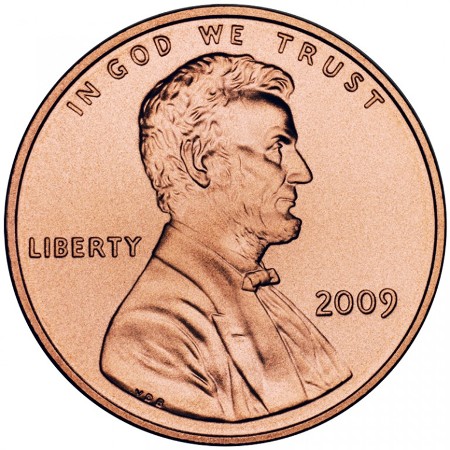
 (Image Credits: US Mint. Media Images.)
Launch Date / Location: August 13, 2009 / Old State Capitol, Springfield, Illinois
The third
Lincoln Bicentennial cent release of 2009 was the "Professional Life in Illinois (1830-1861)" coin.
The Lincoln family moved to Illinois in 1830 and settled west of Decatur, IL. Abraham soon moved to New Salem, He worked odd jobs in New Salem, and eventually opened his own store. He continued to educate himself, including informally studying law with the assistance of John Todd Stuart who had a law practice in Springfield; Lincoln often visited Stuart's office to further his law education/training.
Lincoln launched his political career in Illinois. He began with an unsuccessful run at the Illinois State Legislature, but won election in his second attempt and served multiple terms. Lincoln played an important role in the Legislature voting to move the Illinois capital from Vandalia to Springfield. He moved there and lived in Springfield until moving to Washington, DC after winning the US presidential election of 1860.
While serving in the State Assembly, Lincoln practiced law and opened multiple law practices with various partners. In 1846, Lincoln was elected to the US Congress. After serving one term, Lincoln focused on his law practice and became a noted attorney throughout the state.
When Senator Stephen Douglas (D-IL) introduced the Kansas-Nebraska Act in 1854 - originally the bill was about railway lines to the west, but was revised such that it overturned the 1820 Missouri Compromise and enabled "popular sovereignty" for new states (i.e., a process by which Territories could decide, via their constitution, whether they would enter the Union as a "free state" or a "slave state"). It became law on May 30, 1854.
A Pre-Beard Abraham Lincoln at the Time of the Lincoln-Douglas Debates (1858)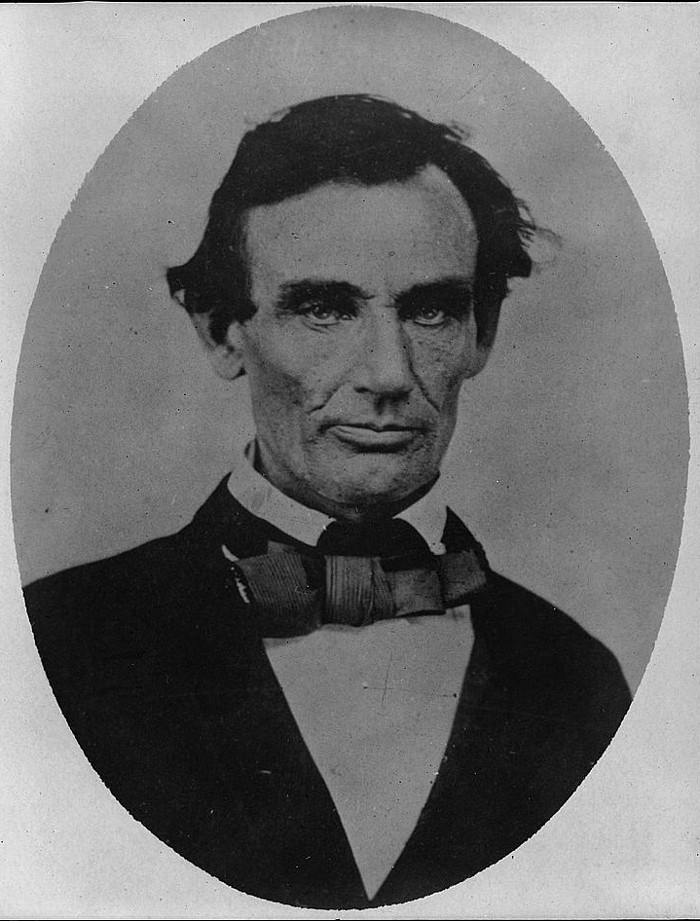 (Image Credit: Library of Congress, Prints and Photographs Division. Public Doman.)
Opposition to the Kansas-Nebraska Act was a major reason why Lincoln returned to the political arena. Though his return was unsuccessful in terms of being elected as a US Senator - he lost in 1858 to Douglas (their campaigns included the seven famous Lincoln-Douglas debates) - he became a major and popular figure in the overall Illinois political organization. Lincoln was later nominated, in 1860, as a Republican for the office of US President.
Lincoln won the election, becoming the 16th US President. He left Springfield for Washington, DC on February 11, 1861 - he would not return.
Lincoln Home - Springfield, IL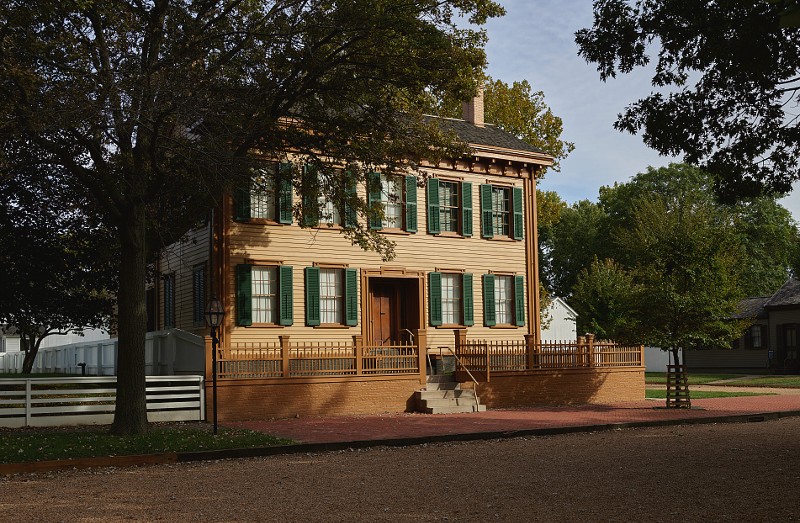 (Image Credit: National Park Service. Public Domain.)
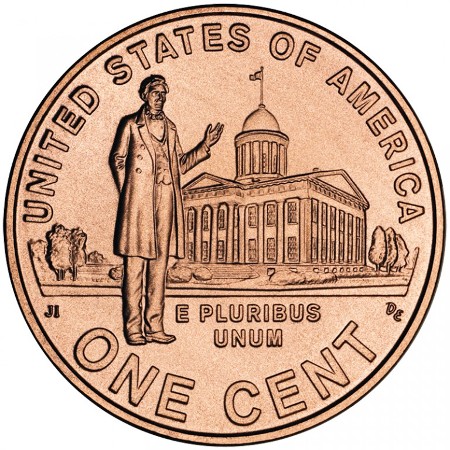
The coin's commemorative reverse was designed by US Mint Artistic Infusion Program Master Designer
Joel Iskowitz and sculpted by US Mint Sculptor-Engraver
Don Everhart. The design presents a standing Abraham Lincoln in the foreground with the Lincoln-era Illinois Capitol, in Springfield, in the background. A larger Capitol was later built and is still in use today, the depicted Capitol is now an Illinois Historic Site..
Lots of great background on Lincoln's time Illinois can be found here:
Abraham Lincoln in Illinois.
Presidency in Washington, D.C. (1861-1865) 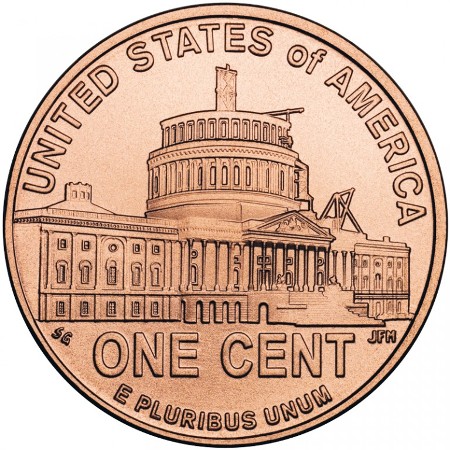 (Image Credits: US Mint. Media Images.)
Launch Date / Location: November 12, 2009 / Ulysses S. Grant Memorial, West Front of the US Capitol, Washington, DC
The final release of the 2009
Lincoln Bicentennial cent Program commemorated Lincoln's "Presidency in Washington, DC (1861-65). The coin's design depicts the Dome of the US Capitol under construction, as it was at the time of Lincoln's first inauguration.
Lincoln's Inauguration in March 1861 with Partially Completed Capitol Dome in Background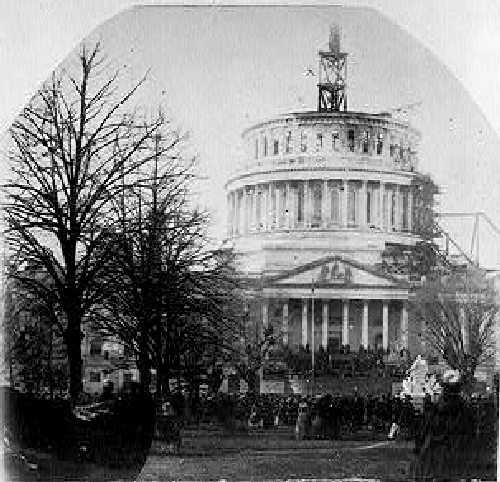 (Image Credit: Library of Congress, Prints and Photographs Division. Public Domain.)
Lincoln arrived in Washington, DC in February 1861 via train from Illinois after winning the 1860 Presidential election; he was inaugurated on March 4, 1861. Lincoln's election - and his anti-slavery stance - were key triggers in the formation of the Confederate States of America with Jefferson Davis selected as its first (and only) president in February 1861.
Little more than a month after Lincoln's inauguration, on April 12, 1861, the Civil War began with the Confederate attack on the Union's Fort Sumter in Charleston Harbor (South Carolina); the fort surrendered two days later. In 1861 and 1862, the Confederate States saw multiple victories on the battlefield, but their fortunes began to turn in September 1862 with the Battle of Antietam stalemate. Union victories at Vicksburg, Mississippi and Gettysburg, Pennsylvania in 1863 marked a clear turning point in the War. 1863 also saw Lincoln issue his Emancipation Proclamation in January and deliver his Gettysburg Address in November.
Lincoln was elected to a second term in November 1864 and was inaugurated on March 4, 1865. Lincoln saw the effective end of the Civil War when Confederate General Robert E. Lee surrendered his Army of Northern Virginia to Union General Ulysses S. Grant at Appomattox, Virginia on April 9. 1865.
Less than a week later, on the evening of April 14, 1865, Lincoln was shot by John Wilkes Booth while attending the play
Our American Cousin at Ford's Theatre; he died the next morning. History remembers him as one of the US' greatest Presidents.
The coin's reverse was designed by United States Mint Artistic Infusion Program Master Designer
Susan Gamble and sculpted by United States Mint Medallic Artist
Joseph Menna.
Lincoln Bicentennial Cent Proof SetOn August 26, 2009, the US Mint began taking orders for the Lincoln Bicentennial One-Cent Proof Set. Notable about the Set is the fact that the cents it includes are of the original 1909
Lincoln Cent composition (i.e., 95% copper, 3% zinc and 2% tin).
One of each
Lincoln Bicentennial cent design is included in the set, with the coins struck at the San Francisco Mint. The standalone, four-coin set had an issue prices of $7.95. It was packaged in a specially-designed lens and inserted into a custom-printed outer box. The Set had a mintage of 200,000.
The Lincoln Bicentennial Cents were also available in the annual Uncirculated, Standard Proof and Silver Proof Sets plus the Lincoln Coin and Chronicles Set. (I plan on discussing the Coin & Chronicles Set in a separate post.)
2009 Lincoln Bicentennail Cent Proof Set - Coin Lens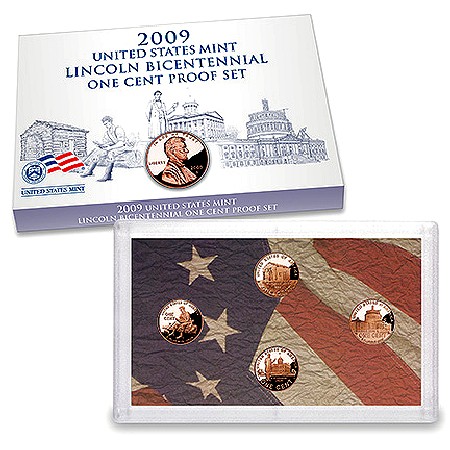 (Image Credit: US Mint. Media image.)Mintage Figures
- Birth and Early Childhood in Kentucky (1809-1816)
>>>> Philadelphia (Circulation): 284,400,000
>>>> Denver: (Circulation) 350,400,000
>>>> San Francisco (Proof): 2,430,958*
>>>> Philadelphia (Mint Set, Satin Finish): 784,614
>>>> Denver (Mint Set, Satin Finish): 784,614
- Formative Years in Indiana (1816-1830)
>>>> Philadelphia (Circulation): 376,000,000
>>>> Denver: (Circulation) 363,600,000
>>>> San Francisco (Proof): 2,430,958*
>>>> Philadelphia (Mint Set, Satin Finish): 784,614
>>>> Denver (Mint Set, Satin Finish): 784,614
Professional Life in Illinois (1830-1861)
>>>> Philadelphia (Circulation): 316,000,000
>>>> Denver: (Circulation) 336,000,000
>>>> San Francisco (Proof): 2,430,958*
>>>> Philadelphia (Mint Set, Satin Finish): 784,614
>>>> Denver (Mint Set, Satin Finish): 784,614
Presidency in Washington, D.C. (1861-1865)
>>>> Philadelphia (Circulation): 129,600,000
>>>> Denver: (Circulation) 198,000,000
>>>> San Francisco (Proof): 2,430,958*
>>>> Philadelphia (Mint Set, Satin Finish): 784,614
>>>> Denver (Mint Set, Satin Finish): 784,614
Note: The Proof Total is comprised of 1,482,502 Regular Proof Sets (18 coins), 697,365 Silver Proof Sets (18 coins), 201,107 of the Lincoln Bicentennial cent Proof Set (4 coins) and 49,984 Coin and Chronicles Sets - a total of 2,430,958 proof sets and, by default, the total number of each design type of the Lincoln Bicentennial cent.
* Many print and on-line references state a total Proof mintage of 2,995,615 which, presumably, came from the Mint. Unfortunately for me, I can't duplicate this figure. When I total up the Proof options for the coin, I come up with 2,430,958 (as detailed above). Am I missing something or is the 2.99 million figure incorrect?The collector wishing to have "one of each" will require the purchase of 20 coins for a complete set (all mints, all finishes): Circulation: 8, Uncirculated-Satin Finish: 8, Proof:4.
For other of my posts about commemorative coins and medals, including more Modern Commemorative stories, see:
Commems Collection.









 Posted 08/07/2023 1:44 pm


