| Author |
 Replies: 8 / Views: 1,346 Replies: 8 / Views: 1,346 |
|
|
Pillar of the Community
United States
551 Posts |
You may know this Roman emperor as Carus (AD 282-283), and his name is usually spelled that way, but on some coins from Ticinum it is spelled KARVS. I just got one found in East Yorkshire. 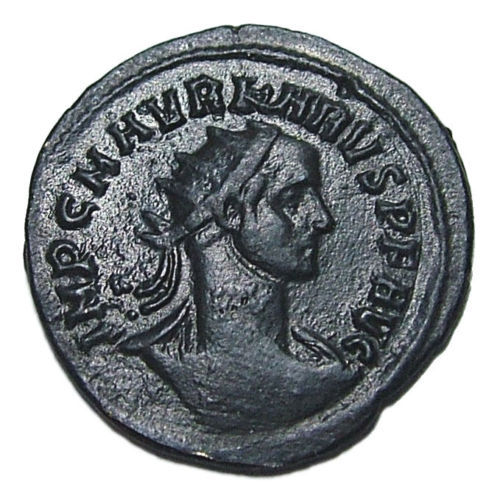 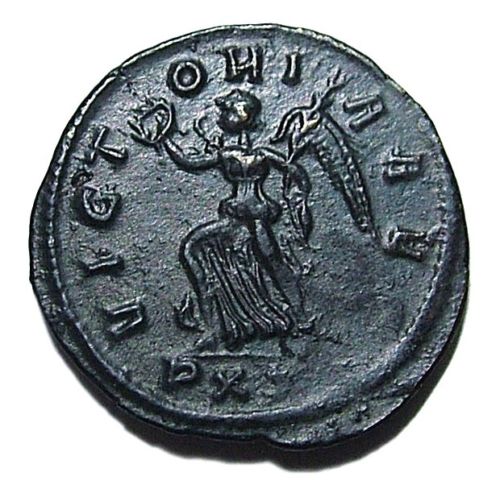 |
|
|
|
Moderator
 United States
16709 Posts |
Very nice! Is that DX reverse?
swcoin.ecrater.com
|
|
Moderator
United States
23731 Posts |
That's a very interesting find. I wonder how rare it is? Eddop might be able to give us more information on this.
|
|
Pillar of the Community
United States
3499 Posts |
I believe that is PXX. A tarif mark indicating the coin is valued at 20 to 1 for gold. Of course you would have been an idiot to exchange one gold aureus for twenty of these as almost all the silver was in the 'wash' covering it. The base coinage had become mere tokens with little inherent value.
The K is interesting. As Ticinum was in northern Italy it wasn't some out of the way phenomenon. Perhaps it reflects a real difference in the actual pronounciation of the emperors name. I am accustomed to saying 'Care us'. Perhaps 'Kay rus' (emphasis on Kay) would be more correct.
My tenth grade Latin teacher corrected me concerning Septimius Severus. I had referred to him as 'sever us'. I was informed that it was properly pronounced 'sah verus' (emphasis on verus) I have been saying it that way ever since.
|
|
Moderator
United States
16709 Posts |
I'm sure even back then they could tell the difference between a silvered bronze and a Denarius, no?
swcoin.ecrater.com
|
|
Pillar of the Community
United Kingdom
2838 Posts |
Have never seen this before, very interesting.
Is the 'KA' in monogram form?
|
|
Pillar of the Community
United States
3499 Posts |
The denarius was only very infrequently issued and was of the same composition. Just a small silver washed coin officially valued at 2 to 1 on the (double denarius) 'antoninianus'. The term 'antoninianus' is also merely a modern designation. We are actually unsure what they were called. No doubt something much easier to express in everyday conversation like our word "dime".
Silver issues of this period when attempted simply vanished once circulated. Bad money as they say chases 'good money' out. The real crisis occurs when the issuer refuses to take payments for taxes in it own currency. The silver content being all but gone the tax authorities wanted payment in gold. The later third century was a time of wild inflation and economic crisis after crisis.
Diocletian attempted a total reform with his new denomination the follis. After twenty years they had been reduced to the coins we associate with Constantine and his sons. While still militarily quite strong they could never put the economic system back on track.
Interestingly while the government mints played games with the silver coin they basically left the gold as a pure metal. Other than a reduction in size the gold was still 99 percent pure.
In some ways it sounds rather familiar doesn't it ?
The top one percent play with gold coinage and the rest of us have base metal tokens or paper money that only has value by our faith that the government will accept it.
Bit coins anyone ?
|
|
Valued Member
Netherlands
409 Posts |
RIC rates this coin as Scarce, I think that may be correct.
In my database I have 16 specimen.
Carus antoniniani with a K are known from Ticinum and Lugdunum.
This Ticinum coin is a early emission at the beginning of his reign ( sole reign ), september/october 282. Only these first emissions do have Carus with a K.
Your coin:
Obv. IMP C M AVR KARVS P F AVG, Radiate, draped and cuirassed bust right seen from the back
Rev. VICTORIA AVG. Victoria walking left, holding wreath and palm
Ex. PXXI
Pre emission Oct.282
|
|
Pillar of the Community
 United States
551 Posts |
Now there is strong evidence that XXI does not refer to the number of coins of this denomination that correspond to a gold piece (Gold pieces were very rare in in the late 200s, anyway). Rather, it refers to 20 parts base metal (copper) to 1 part silver. There are very rare "XI" coins with about double the silver. Here is an short article on the silver content of "XI" coins from the Numismatic Chronicle: http://augustusmath.hypermart.net/AlloyXI.pdfIt is technical, but the overall point is the "XI" coins seem to be about 8.8 to 9.8% silver, which is a lot like 10:1. Combined with articles from other researchers, the conclusion that "XXI" means 20:1 is now commonly accepted. |
| |
Replies: 8 / Views: 1,346 |
|




 Posted 01/03/2014 11:07 pm





