I see that some members here have expressed an interest in ancient Indian. India has a long, vast rich and complex history, that has only become known to us in the West in relatively recent years. Many of the ancient cultures and people that existed an ancient India left little to us in terms of documented history. Many of the ancient sources available to us come in the form of legend and story where many of the facts are obscured by both.
For the average western collector, learning about and understanding the different types of languages, scripts,cultures, personalities and religious icons, is difficult and quite alien. Focusing on the early coinage, the first stumbling block is the lack of inscription. The early coins dating from the dawn of coinage are nothing more than an bar of silver punched with a stamp. This was done by either a privet individual, as business, a bank or a government body, or in some cases all of the above. There are some agreed upon rules for determine such but they are beyond my understanding and those of most westerners. Even with that being said, many of the punch marks are not fully understood at all.
Like I said, India processes one of the longest and richest histories of the world. Likewise they made coins that circulated along side the ancient Greeks. Coins that with information that rivaled the Caesars of Rome, and maintained a precocious metal standard first established in the archaic period well into the what we consider the early modern period.
In ancient times the Indian sub Continent was never ruled by one "empire" but for the majority of its history has been a conglomeration of dozens and sometimes hundreds of smaller kingdoms, each with there own culture, beliefs and of course COINS!
I figured I would begin the 7 days of Ancient India with my oldest, most expensive and certainly the most valuable of my ancient Indian coins.
"Around 500 BCE, small kingdoms and confederations of clans arose in the southern regions of Nepal. From one of these, the Shakya polity, arose a prince named Siddharta Gautama (traditionally dated 563--483 BCE), who later renounced his status to lead an ascetic life and came to be known as the Buddha ("the enlightened one"). It is believed that the 7th Kirata king, Jitedasti, was on the throne in the Nepal valley at the time. By 250 BCE, the southern regions came under the influence of the Mauryan Empire of northern India, and Nepal later on became a nominal vassal state under the Gupta Empire in the fourth century CE. "
From wikipedia with thanks...
Nepal,
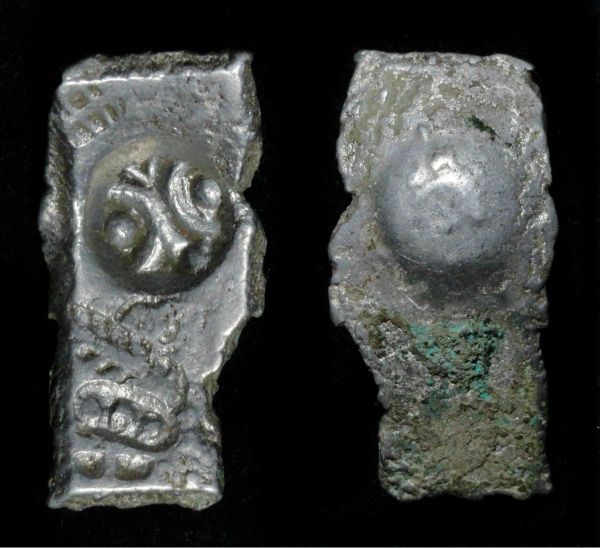
Janapada, Shakya Republic
Anonymous ( c. 600-500 BC)
Lifetime and Homeland of Gautama Buddha.
AR Archaic 5 Shana
30.4 mm x 14.6 mm x 6.79 g
Unifaced: Primary Punch- Two Crescents (one with a root)
Five secondary punch marks.
ref: Rajgor 534
Note: A coin in EF condition, that is religious, historically significant coin that is also PHAT.
Cupric Deposit on reverse.




 Posted 05/16/2014 12:11 pm