| Author |
 Replies: 197 / Views: 19,868 Replies: 197 / Views: 19,868 |
|
|
|
Pillar of the Community
United States
4429 Posts |
VT, I thought it could very well be a mint product when I bought it some years ago. I took it to the FUN Show, and a few error specialists said not. Yet, neither one could explain how it came to be. Your multiple strike 1904 is the only piece I've seen that's remotely similar. I've long wondered if there were others. Mine has been in the "errors box" for years. I'm hoping that this thread might bring a few more to light. I bought mine cheap, so there was no profit motive apparent.
|
|
Moderator
  United States
16694 Posts |
Mike Diamond put a link to a Lincoln Memorial cent. Do we see this on silver and gold too? One wonders. More expensive mistake to mess up gold if one was to try this! swcoin.ecrater.com
|
|
Moderator
United States
23522 Posts |
Quote:
VT, I thought it could very well be a mint product when I bought it some years ago. I took it to the FUN Show, and a few error specialists said not. Yet, neither one could explain how it came to be. It's pretty simple - it is a physical impossibility for a Mint die to strike letters that close to the rim. Can't happen. If the collar weren't there, it would have broadstruck, and that's the only way to shift a die any closer to the rim. So - both coins - we know what they ain't.  |
|
Pillar of the Community
United States
4703 Posts |
Untrue. The mint could strike stars this close to the rim. Here's an example 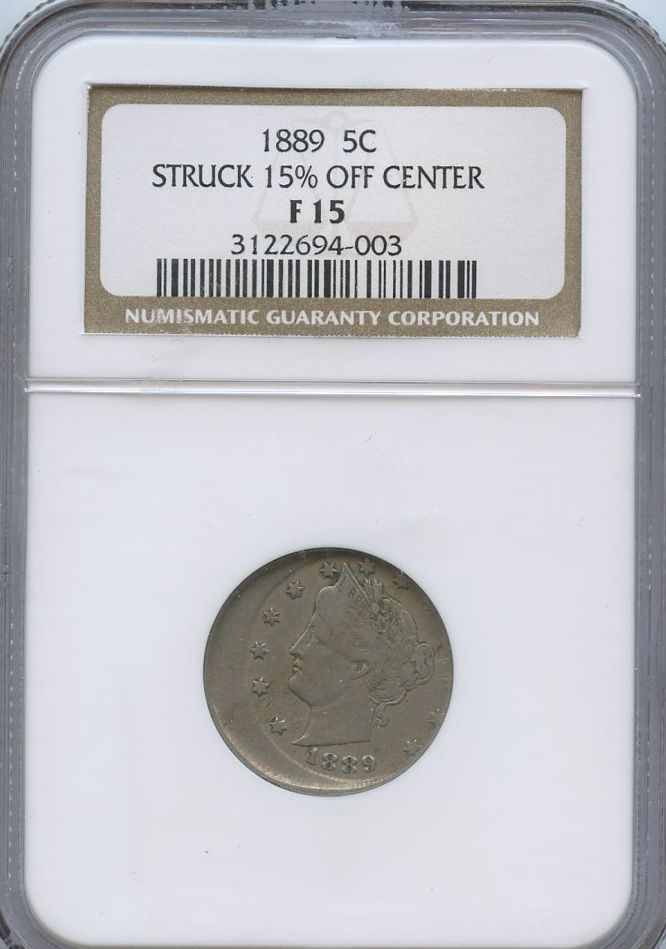 |
|
Moderator
United States
23522 Posts |
Off-center strikes aren't possible with the collar in place either.
|
|
Bedrock of the Community
United States
10045 Posts |
Quote:
How did the "soft die" not impair the letters on the 1909 and still manage to leave a strong impression in the field? Asking--not knowing--if U,C,E towards the rim were struck afterwards, why don't they overlap on top of the primary letters?  Just trying to understand here. I guess that's what ExoGuy asked--sorry for the  Edited by DVCollector
10/11/2014 4:50 pm
|
|
Pillar of the Community
United States
937 Posts |
This thread and threads like it are why I joined this forum.
I am no expert on anything and know just about nothing about errors but I think I need to point something out.
On that big beautiful picture that is on like page 10. Look at the stars.
Using the ghost of the hair curl as a guide IF this coin was struck two or more times by the same die then the inner (original) star nearest the date should be the same star as the secondary star that is at its 5 oclock. Those two stars should be identicle, or as close as possible.
They are not. The seconday (outer) star at 5 oclock is (I am not sure how to say it) The angles on the 'arms' or points do not seem to match.
I know nothing but I put my dollar down on those stars coming from different dies.
|
|
Moderator
United States
16694 Posts |
We are 95% certain a second, counterfeit die was used.
swcoin.ecrater.com
|
|
Forum Dad
United States
24220 Posts |
We can show it to Fred in person at the FUN show. He's usually there.
|
|
Moderator
United States
16694 Posts |
Sounds good.
swcoin.ecrater.com
|
|
Pillar of the Community
United States
4703 Posts |
I am in the 5% that it is a mint product. A partial lamination that stuck to the die and was deposited on the coin is my theory, and I will stick (no pun intended) to that.
The counterfeit/soft die theory just does not seem plausible.
But I respect everyone's theory. It is an interesting topic.
Edited by jimbucks
10/14/2014 8:06 pm
|
|
Moderator
United States
23522 Posts |
Mike's explanation is the only thing that makes any real sense to me. It's just applying that process to a metal as hard as nickel that slows me down.
|
|
Pillar of the Community
United States
3546 Posts |
Quote:
...a metal as hard as nickel The concern is a valid one and what has not yet been postulated to the best of my knowledge is the remote possibility of an existence of a 1904 prototype nickel composed by the Mint analogous to ones resulting from a '2012 Department of Treasury/CTC Alternative Metals Study': CTC - Concurrent Technologies Corporation http://www.ctc.com/I was unable to locate a related paper documented back in 1904 but the U.S. Mint at that time may have chronicled similar verbiage compared to the following passage taken from this CTC-assembled 2012 paper entitled: ‘2012 Biennial Report to the Congress on the Current Status of Coin Production Costs and Analysis of Alternative Content' An applicable summarizing excerpt from this 2012 document found on the last page # 8 reads as follows: ‘II. Recommendations for Changes to Coin Composition: As we believe the CTC report makes clear, the Mint must perform additional work before it has sufficient information to recommend possible new metallic materials or technologies for the production of circulating coins. Among other things, the Mint needs to (1) conduct production-scale tests with multiple lots of proposed coin materials to verify the potential supply chains and the results from the preliminary tests described in the CTC study, and (2) further research estimated stakeholder costs associated with a change in electromagnetic signature. As a result, the Department of the Treasury recommends that the Mint continue to study the issue before endorsing any specific changes to coin composition.' If interested, one can find this entire 2012 document at: https://www.google.com/url?sa=t&rct...CcQFjAB&url=https://www.usmint.gov/about_the_mint/PDFs/United_States_Mint_Report_2012_Biennial_Report_to_the_Congress_on_the_Current_Status_of_Coin_Production_Costs_and_Analysis_of_Alternative_Content_December_2012.pdf&ei=vw4-VJORH46oyAT33oHYCg&usg=AFQjCNEdecRjP_zqrK5jpiyZlSK03vI3Yg&sig2=zW7u53lVpcFvxFk1QQdkNg mdpmedia |
|
Pillar of the Community
United States
3546 Posts |
Thoughts on the previous post having cited references: Similar to today's cost cutting measures routinely performed by any large organization, I feel confident that the U.S. Mint continuously attempted to optimize and economize the production of nickel coins even as far back as in the early 1900s. Assuming that results of prototypical tests manufactured back in 1904 rendered several hundred samples of varying hardness that inadvertently made their way out into the general circulating population of nickels, our subsequently modified post-mint (counterfeit or error) coin under scrutiny may indeed be softer compared to the normal nickel stock typically found in the greater majority of V nickels minted at that time in history. In summary, one might consider performing a non destructive Brinell test and/or additional electrical experiments on a verifiable ‘normal' 1904 Liberty nickel to be able to compare the conclusions to the coin in question to at least partially address these subsisting compactness concerns. Reviewing the high number of reads on this thread it would seem to me that a sufficient interest by the folks would exist to warrant the generation of these type of test results. Obviously, please update the thread with these indicative evaluations should one feel so inclined to spend the time and effort to pursue these types of analytical procedure(s). mdpmedia |
|
Pillar of the Community
United States
4703 Posts |
That's an interesting thought regarding non-destructive testing. To have significance, I would suggest a sample size of 6 or so "normal" nickels. A SEM analysis may help solve the mystery. Rockwell hardness testing on the "normal" nickels may be interesting to see how the hardness varies, but since it is destructive it would not be prudent to try it on the subject nickel. Seems we may be turning this thread into a science experiment, but I guess that's OK.
|
| |
Replies: 197 / Views: 19,868 |







 First Page
 Previous Page


 Posted 10/11/2014 12:12 am


