| Author |
 Replies: 34 / Views: 8,604 Replies: 34 / Views: 8,604 |
|
|
|
Pillar of the Community
United States
1761 Posts |
I am in agreement with Bob on the platinum issue. Since gold and platinum are side by side on the Periodic Table of Elements there is a high tendency for XRF results to show Pt as a false positive. Since this was a new frontier the platinum levels seem real but were not in the end in most cases even in coloboration with others at this time. They will appear in South American mint issues where platinum is present. This HOWEVER changes nothing as to the gold signature value of 0.2% being a recommended value if below there should be "SOME" concern in the struck 8R's coin's attribution process that the piece is a regal instead of a forgery. Remember- XRF is just ANOTHER attribution tool discussed in the book - not a final stand alone attribution tool. I will be seeing the MCC at NYITL lets see how many STRUCK 8Rs issues are less than 0.02% Au (one order of magnitude lower) and from which Mints? Remember - we are now looking at the ENTIRE UNIVERSE of 8 Reales from all the Mints for ALL TIME PERIODS - we should expect some exceptions - we shall see what these are FOR THE FIRST TIME.
JPL
Edited by colonialjohn
11/13/2014 11:45 am
|
|
Pillar of the Community
United States
1801 Posts |
RockyRoad
Please, rattle on all you want about these two coins, I for one would love to hear about them. And if I understood you correctly, you are now going for a date set of Portrait 8 Reales? Go for it. Are you going just for "date" or are you restricting yourself to a particular mint or any mint will do?. It is a great project, I have been working on mine for about 37 years and I am still finding coins to add and upgrade. The more you delve into them, the more interesting they become and the more knowledge you acquire, the more you will find yourself branching out into the history of the time period. My collecting has led me to some great friends and on some wild adventures. Jump in with both feet, the water is warm!
|
|
Valued Member
Germany
194 Posts |
I am not sure about the readings on a single War for Independence coin studied on its own.
Take the 1811 LVO. In my opinion, a number of coins of exactly the same type would have to be tested, to see how the metallic content averages out. We might be seeing surprising results.
Now this is only an assumption, but as I see it, the silver used for the Mexico mint coins came from all around the country and, after many rounds of assaying, melting, storaging and mixing up, was finally made into coins. So theoretically a Mexico City 8 reales should show traces of all the metals that can be found in the ore coming out of mines in Mexico.
But how did the Zacatecas mint operate in 1811? It was recently established. There was political turmoil. It can be safely assumed that the silver used for coinage came from the local mines. As it was a makeshift mint, I would very much assume that any silver brought in was right away transformed into coins. So, at least theoretically, it could happen that a certain batch of ore which was brought in, coming from one mine, maybe even from a certain mine shaft, contained way less gold than the average. An 98% silver content does not speak for too much effort having been placed into assaying. There was no other ore mixed in to bring it down to 93%. So "uneven" amounts of elements (or maybe even the lack thereof) should not be ruled out.
One example are the Guerrero pesos from the Mexican Revolution, the ones where a gold content was given on the coin ("oro 0.300" and "oro 0.595"). Studies of the coins showed very large discrepancies in the amount of gold, even with coins of the same type / die combination. If you have to work with what comes in by the front door that day, you get the same coin type with very different alloys.
|
|
Pillar of the Community
United States
1761 Posts |
Yes - DOS MUNDOS. Ore mixing many times levels everything out from different sources but there are rare exceptions from my experience as I experienced with copper ores and U.S. Colonial coins - some ore refining operations may have been isolated and where some mines have generic ores in low gold values and some readings may be very low below the 0.2% proposed standard in the GNL book which in some ways originally was suggested to us by Craddock of the British Museum and then verified with our own lab results of regals. We are now moving from the analysis of Bust CC8Rs to Regals of Cobs,Bust & Cap and Rays from all Mints - lets see what pans out. The other area which is different in terms of non-consistent results will be the cast silver pieces of the War of Independence. I plan to discuss this further with some dealers at the NYITL if they have concerns. Its funny - as I mention - I keep getting why should I buy the GNL Book as I don't collect CC8Rs - well actually there are two books in ONE - the first half is for the non-collectors of CC8Rs and the second half is for the Type 1 Collectors of off-metal CC8Rs. We originally started with Part 2 but then realized Part 1 was necessary so as to give everyone a migraine. Its working ... <BG>.
|
|
Pillar of the Community
United States
5362 Posts |
dosmundos You say: Quote:
But how did the Zacatecas mint operate in 1811? It was recently established. There was political turmoil. It can be safely assumed that the silver used for coinage came from the local mines. As it was a makeshift mint, I would very much assume that any silver brought in was right away transformed into coins. So, at least theoretically, it could happen that a certain batch of ore which was brought in, coming from one mine, maybe even from a certain mine shaft, contained way less gold than the average. If it can be safely assumed that the silver came from local mines - then the silver came from the Veta Madre intrusion. That entire system of gold/silver bearing veins is cross contaminated. That fact is supported by literally thousands of test borings and the historic results of over 500 years of mining and extraction of ore. That safe assumption actually requires a conclusion that the coin MUST BE COUNTERFEIT. I am actually trying to explore alternative reasons for a FEW coins that do not fit with the other 99.99% of coins made in the colonial era. Pure silver did not - I repeat NOT come from the central Mexican mines that were in operation in the first decades of the 19th century. What you are postulating in the above statement is actually an argument from silence that provides a "way out" for the opposition to IGNORE the actual scientific and historical facts. This is why I may seem to be in "attack mode" at this point, but I do not want to allow a scintilla of hope for the nay sayers to make a claim that any great number of Mexican coins could exist without gold contamination of roughly 1/2 of one percent gold. Craddock in his work for Museum authentication of artifacts uses the gold contamination theory as PROVEN not as a theory that is suspect in any way. So I do not accept that "theoretically" a goldless silver coin could exist made with silver from the Veta Madre formation. It has to come from another "non-mine" source. For just one source of many read the technical reports of tests run by Great Panther mining. http://www.greatpanther.com/
|
|
Valued Member
 United States
63 Posts |
jfransh - Thanks for the encouragement. I am working on a date set of portrait 8 reales. I decided that restricting myself to one mint would narrow my options and lengthen the time it would take to build the set. The historical periods during which the coins that I collect circulated is of such interest to me that in the beginning of the binders in which I display my collections I have at least one historical note for each year minted. In the case of my Spanish colonial collection it also includes a photocopy of a painting of each monarch along with an abbreviated life history. History gives the coins a context and makes them seem just a little bit alive. That's why I'm not a real fan of the plastic slab. Oh, I get the attraction and I do see some benefits, but to me it just removes the coin one step further from the collector. And... many of us want to see the edges of our coins.
As for the two coins I originally posted about, one of my questions concerns their numismatic market value. I'm not sure how to approach valuation in order to determine whether or not I paid too much. If they are genuine then I would assume that the World Coins catalog and others would be the pertinent reference. However if they turn out to be Class 2 counterfeits I would have no idea. Can you help on this one?
My source for these coins is in possession of many more 8 reales. He purchased a collection years ago an is now in the process of selling them off one by one. He has sent me high quality pics (no edge pics though) for the higher grade pieces and it looks to me that some of his other Charles III and IIII are similar to the two we've been talking about. I picked these two dates because they appeared mark free. However upon examination they do have hairlines from being rubbed with a cloth. Others he has are of the same grade as mine but with unusual distracting marks or weakness in the strike. Even his pillar pieces seem to be a bit unusual. I would have bought his 1739 with an XF obv. but turn it over and...well you get the idea. I suppose I could post some of the more interesting pics if there is any interest.
Swamperbob - A few posts north of here you will find my post for the other side of the 1787 edge showing the ATIA area. When you have time let me know what you think. I'm really enjoying the current conversation about residual gold. I was amazed to hear that there is so much information available about mines from that time period.
|
|
Pillar of the Community
United States
1801 Posts |
RockyRoad
Great collection you have started! I tried to message you but unable to, if you would like to converse about building your Portrait Collection, send me a message through the Forum system, I can offer up some ideas for certain date/mint coins you may want to consider because of their "unusual" circumstances, such as obtaining a Lima mint 1808-1811 with the imaginary bust of Ferdinand VII (which my friends and I lovingly refer to as the "alien head") and obtaining the various transitional coins where the portrait is one monarch and the legend reads another (example 1790 Mo has bust of Carlos III and is found with legends reading either Carlos IIII or Carlos IV).
As for valuations, the catalogs mean nothing if you have a high grade coin. Most coins do not even show a value for examples over XF. I have found that truly uncirculated portrait dollars are very scarce and in high demand. Auction catalogs are probably a better indicator of current value.
I agree with your feelings about slabs, with the exception of my Ferdinand VII portraits, my collection is raw coins. (I am having the "Ferdinands" graded by PCGS on a whim, I want to see where my registry set will stack up when they all come back.) I also like to hold and examine each and every coin and think about the history. However I will comment that if you go to sell a coin, the current market will pay a premium for a high grade PCGS or NGC coin. Enjoy the hunt, I commend your decision to include all mints so you can have a representative collection of the New World coinage of that period.
|
|
Pillar of the Community
United States
5362 Posts |
RockyRoad I tried to open the link for the edge at ATIA but it links me to an add for Google every time. Regarding the prices. In my opinion the prices for Class 2 coins (in average to low grades - EF down) are effectively the prices seen in the major price guides. That is because the standard guides reflect total numbers of coins available on the matket. So until the relative rarity level between the two types is established there will or should be no change in prices of average grades whatsoever. If they are found in a 50-50 ratio ultimately little would change. If either type is relatively rare the price for that type should run higher but I personally do not expect that to be the case. High grade coins of the type referred to by jfransch would likely be the ones most seriously effected by the label of counterfeit. That is precisely where I expect the pressure against my theory to come from. I would predict that the genuine coins would rise dramatically in price (driven by non-collecting investor interest) while a commensurate loss in value would be experienced by the coins that prove to be counterfeits made before 1930. Regarding the collection you have the opportunity to buy into. The provenance of the coins is very critical when you buy. The Class 2 coins were made for the China trade so any coin that traces historically back to or through China or the far east could fall into that category and be treated with some suspicion. However, a hoard find in Mexico is far less likely to have been contaminated with Class 2 coins. Class 2 coins have no financial reason to be in Mexico. The Class 2 coins were made largely after the 8R was demonetized and not used in Mexico - they theoretically should have stayed in China until after 1940 and probably until after they became collectables in the 1950s or until after the dramatic rise of world silver prices in 1978 - 1981. When and where the owner got his coins is likely to be VERY critical. Mexican sources would be significantly safer than dealers known to have been importing coins from China (like the guy I worked for in Boston). Finally you say: Quote:
I was amazed to hear that there is so much information available about mines from that time period. The information about the mines comes from borings and tests that were recently made to trace the silver and gold deposits for possibly re-opening the veins for extraction. These come mostly to try to convince investors to invest in the mines. There are 226 corporate entities that are involved with Mexican mines. There are thousands of reports regarding these borings and tests that can be found on-line. If you correlate the bore sites with the locations of the old mines and their periods of operation you can effectively determine the nature of the deposits that were worked historically. The mines worked historically in the Guanajuato area in general are hard rock intrusive vein deposits of silver and gold that were hydrolologically deposited from superheated liquid carrying gold, silver other metals in a solution of SiO4 siliconâ€"oxygen tetrahedral (quartz). The cause was intrusive magma which heated the crustal rocks allowing the trapped gold and silver to be leached upward through a myriad of small fissures (cracks) in the bed rock. When the liquid cooled and crystalized free gold and silver were crystalized along with the quartz. This type of deposit can be worked mechanically (by grinding to a dust level) and the gold and silver can them be removed with mercury in a simple process of amalgamation. The result of this type of deposit is both silver and gold that are NOT combined with other elements - hence easily extracted. This is quite unlike other forms of silver deposits (like silver chlorides) which require chemical reduction not practical in the late 18th and early 19th century in Mexico. So it is the composition of the Mexican Mother Lode (Veta Madre) which makes gold an essential part of the silver production. It is how the western Sierra Madre range was formed that resulted in these massive discoveries of easily extracted silver and gold. I have now read in detail perhaps three dozen mining reports for the major historic mine areas. They all have in common the identical rock formations. Located in the vicinity of a porphoritic-skarn boundary they are all characteristic of hardrock quartz deposits and both fire assay and XRF results place the general gold content at 1/2 percent of the silver content. There are no bore holes that show No gold except those that also show NO silver.
|
|
Valued Member
United States
63 Posts |
Swamperbob - My wife went to the link, and saw a Google ad saying "Help people tag you in their photos" or something like that. This is probably because the link goes to my Google+ account. Wife says all you need to do is hit your "Escape" key, or click on "No thanks." She's a Google support person, and assures me that there are no booby traps lurking, so it's safe. Your comments about value are reassuring so I will not pursue a return on these coins and add them to my collection. I will attempt to get more information regarding the provenance of his collection and post my findings later. The following photo is a new edge shot just at the first 7 in the date. Do I see two squares or circles next to each other in the weak, bright area? If you think that there is a lap there, 180 degrees would be in the damaged area with the diagonal lines. One of the first photos posted. Thanks again for taking the time to help me out. 1787 with suspect edge |
|
Pillar of the Community
United States
5362 Posts |
I tried escape and there is no "No thanks" option on what I see when the Google page pops up.
.
|
|
Valued Member
United States
63 Posts |
Swamperbob - Sorry you're having problems viewing the photos. My wife can't figure out what screen you are seeing. We use the url posting format because we can't figure out how to post the pictures directly to the post. When we try, it always says it's too big and when we use the optimizer the photos are so grainy and blurred as to be useless. Can you give me any tips on how you post photos using the forum tools? Thank you.
|
|
Pillar of the Community
United States
1801 Posts |
Swamper,
I emailed you a copy of the picture that I saved off RockyRoads upload to Google.
|
|
Pillar of the Community
United States
5362 Posts |
jfransch I got the photo of the edge and as I wrote to you I see some serious problems with the edge that likely confirm a Class 2 status. The two issues are the irregular alignments of the individual segments and the fact that the overlaps -if there actually are two - are not opposite one another. I took jfransch's picture and rotated it so I could properly align it and then enlarged the vertical aspect so I could see how the individual segments aligned. Enlarging the vertical aspect ratio is an engineering tool used to make a minor shift in alignment very clear. It does so very well in this case and points out the problems clearly. Here is the picture: 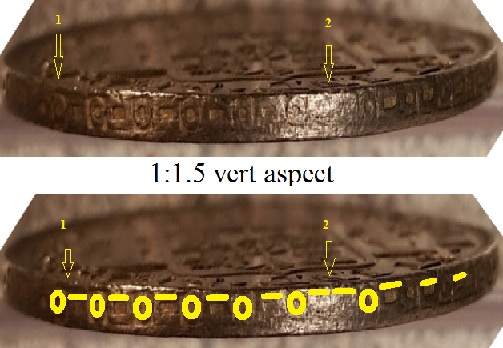 RockyRoad RockyRoad Regarding how to load a picture. I start with a regular photo - save it as a jpeg file and in that format resize it so that the portion I want to show is under 80k bits. Posting pictures to this site works fine if you presize the file. In the photo I show two points # 1 and 2. At # 1 is a very high O that is clearly above the side of the adjacent rectangle. If you look at each segment there are high low and correct alignments of the O. This variation in the position of the O in relation to the adjacent rectangles is not possible if the mint used the matrix die punch. I also see what may be a flat sided circle. This edge alignment runs rapidly side to side and could NOT have been made with a three segment edge punch. At point #2 are the two rectangles that are placed next to one another. The position of this feature is NOT at a proper location for an overlap. I would postulate it is not a lap at all but rather a die design feature because the die was created with two punches a rectangle and a circle. This was NOT the normal procedure - but the two rectangles are a die sinker's error. All in all this edge is that I do not believe could have been made in the mint. This means that with little wiggle room that the coin has to be a Class 2 silver counterfeit (replica if you choose) which was made for the China trade sometime between 1830 and 1930. It is a circulating and non-numismatic type.
|
|
Pillar of the Community
United States
3229 Posts |
Great thread!  |
|
Valued Member
United States
63 Posts |
Swamperbob and jfransh - a very big thank you to both of you.  Another question I've had concerns the often seen sets of diagonal, parallel lines scribed into the reverse of both pillar and portrait 8 reales. Sometimes it's just a single line and other times it appears to be one or two sets of parallel lines. Sellers often call them adjustment marks but it is my understanding that weight adjustments to the planchet were made before the strike so that the only thing you might see after the strike are very faint marks if the strike was light. Can you enlighten me? |
| |
Replies: 34 / Views: 8,604 |






 First Page


 Posted 11/13/2014 12:29 pm


