| Author |
 Replies: 7 / Views: 1,713 Replies: 7 / Views: 1,713 |
|
|
Pillar of the Community
United States
4883 Posts |
Despite its bearing the word "token", I've posted this here for two reasons. First, provincial 1d & ½d issues also so marked are in the catalog of Canadian coinage I have and thus evidently circulated (so I'm presuming this type is also in that category), and second, this seems to me to be where those folks who are most likely to be the most knowledgable about something like this will probably be looking. 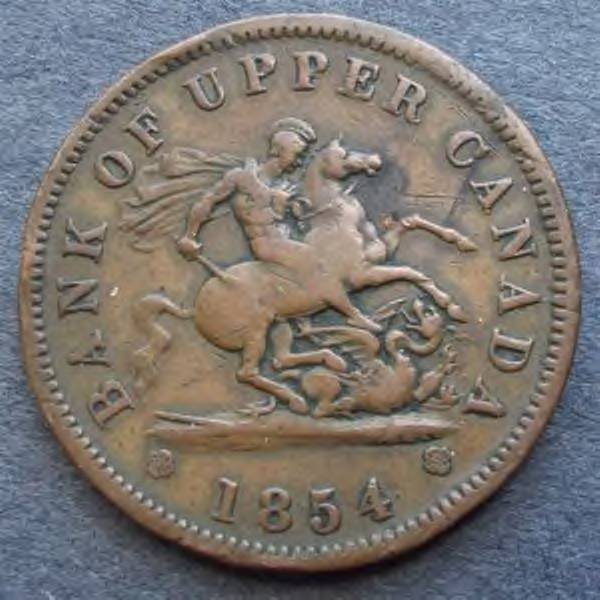 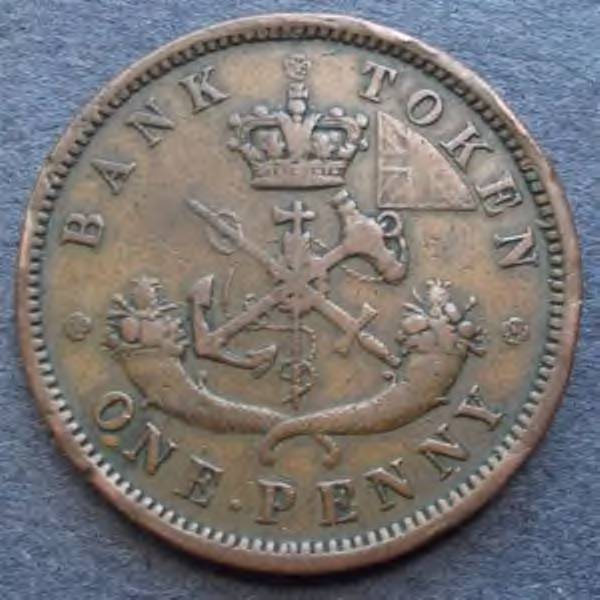 Colligo ergo sum
|
|
|
|
Pillar of the Community
 Canada
5662 Posts |
These circulated heavily in Canada before England saw fit to let Canada have their own coinage. Before 1858, Banks and some merchants made tokens to be used as money, along with coinage from England, France, Spain, Mexico and the US. There was nothing else but bartar to conduct commerce. I think Doug will weigh in with what variety this is, but there are quite a few around.
|
|
Pillar of the Community
 United States
4883 Posts |
At what point was the usage of these entirely superceded? This specimen certainly looks as if it has more than 4 years worth of wear to it.
Colligo ergo sum
|
|
Pillar of the Community
Canada
1049 Posts |
plain 4 variety, VG10, IMO
As Okie mentioned Doug will prob chime in here.
|
|
Pillar of the Community
United States
840 Posts |
Charlton list the 1854 ONE PENNY TOKEN in two categories, dependent upon the
type of the numeral 4. PC-C1 is the normal or plain 4; PC-C2 has a crosslet 4.
Doctor Courteau has identified 17 different varieties within this grouping (numbered
258-274 inclusive). The crosslet 4 is Courteau variety 274, thus our search is amongst
varieties 258-273. Dr. Courteau is primarily concerned with the different variations
of the Anchor Rope Dots in the section of the Anchor Rope betwixt the left-side of the
Fledging and the upper-side of the Blade of the Sword.
Varieties 258 and 259 have two defective elongated (vertically) dots.
Varieties 260, 261, and 262 have two very large dots.
Varieties 263, 264, 265, and 266 shew three normal sized dots.
Varieties 267, 268, and 269 also shew three dots, but the left dot is faint (weak).
Variety 270 has three strong normal sized dots.
Variety 271 also had three dots, but is unique as having three Grass-Blades from
the fruits of the right-side of the right Cornucopia, pointing to the right Rosette.
Variety 272 has four dots.
Variety 272 has the bottom of the E in ONE broken.
more to follow
doug
|
|
Pillar of the Community
United States
840 Posts |
Typos change the last line to read 273.
Variety 260 has two dots (the left is weak).
Another area of concern is whether or not the Anchor Ring is broken.
The Anchor Ring is perfect on varieties
258, 259, 261, 262, 268, 269, 271, 272, 273, and 274.
The Anchor Ring is broken on all others.
Concerning the token in the photo, we can eliminate
varieties 258 and 259 (defective dots).
We can eliminate varieties 261 and 262 (large dots).
We can eliminate variety 272 (four dots).
We can eliminate variety 274 (crosslet 4).
The search as been reduced to varieties 268, 269, 271, and 273.
Dr. Courteau further distinguishes betwixt the remaining as to
the size of the Knob on the Dagger Hilt, and various Die-Cracks.
And variety 269 is the only variety having a bold 'Dot' betwixt
the Stand of the left Leg of the third A in CANADA and Paw of the
Dragon.
The token in the photo is Courteau variety 269, having a rarity factor
of 2 (common). VG-08.
doug
|
|
Pillar of the Community
United States
4883 Posts |
That is just awesome. 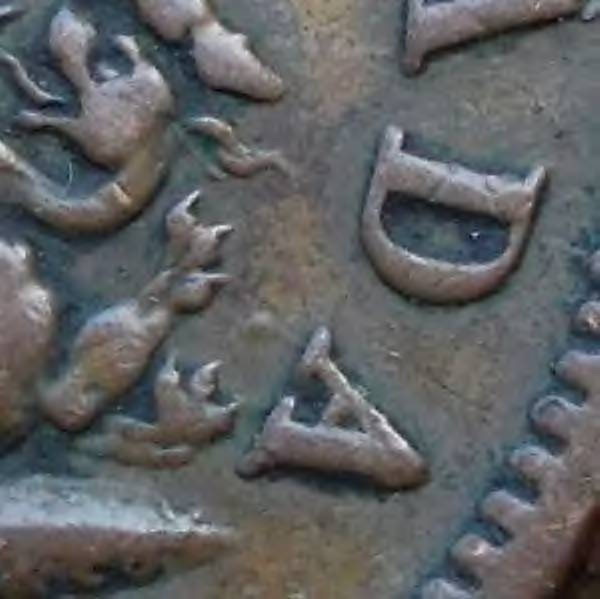 Colligo ergo sum
|
|
Pillar of the Community
United States
840 Posts |
As with many of the Vicky Cents, much goes unnoticed with but a cursory glance.
As previously mentioned in previous threads (p.s. to the moderator or web master...
how does one access threads more than one year old. Is an archive available ?)...,
In bygone years (pre confederation), tokens were the only numismatic resource available.
Extensive detailed study was conducted concerning this field. With the emergence of decimal
coinages, interest in the detailed study of tokens became replaced with advent of decimal
collecting. The former research materials are still present and somewhat available. Some
die-hards like me and a few others are trying to re-kindle interest in the vast realm
Canadian Colonial tokens. Most present collectors desire to collect decimals by the entire
series rather than merely a 'type' set. But these same collectors are satisfied with collecting
tokens by 'type,' rather than by varieties.
You have one variety (269), now try for all 17. p.s. Dr. Courteau identified over 319 different
varieties within the St. George and the Dragon series. I and others have discovered several varieties
that Dr. Courteau was not privy to.
Warning...This is addictive.
doug
doug
ra
|
| |
Replies: 7 / Views: 1,713 |
|




 Posted 01/16/2015 8:51 pm





