| Author |
 Replies: 67 / Views: 17,518 Replies: 67 / Views: 17,518 |
|
|
|
Pillar of the Community
 2087 Posts |
Yesterday and today I played round trying to set up a lens so that it projected on to the front element of a microscope objective which would then send the image to the camera sensor. I had no joy with my 10X objective so today I tried the set up with a 3 X objective. I managed to get it working with the SK 45mm lens( took a lot of adjustment to get it right) Here the thread from another forum that I used as a model fro setting up the rig http://www.photomacrography.net/for...asc&start=15(Second page 3rd post) I tried set the 45mm on the bellows to 1-1 but it was more like .8 magnification. The result After some fiddling the 45mm resolved group 6 element 3 easily and was just(!!) resolving group 4. the rig was not as accurate as I would like but I think it confirms my initial test. PHotos: Straight out of the camera ( but reduced for posting here) 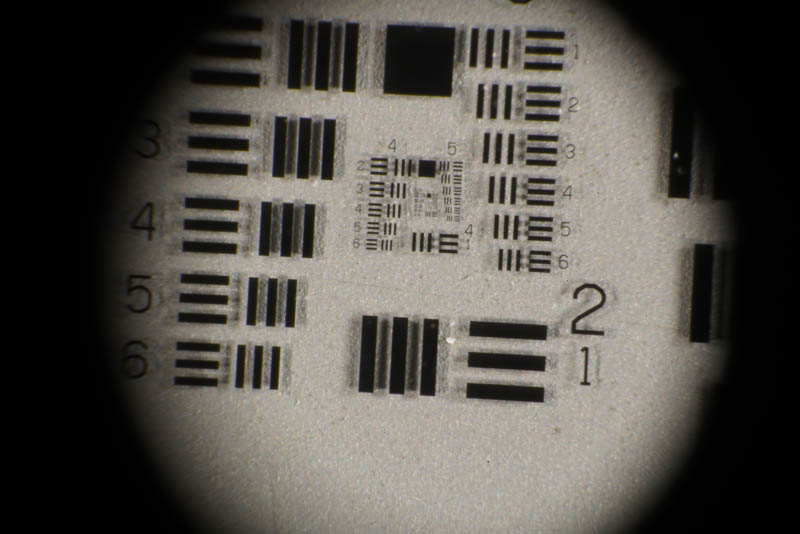 That shot gives an idea how small an area the following 100 % crop is from. The vignetting is due to the fact the image has passed through a Microscope objective ( Not you can see shadows from the resolution lines.. my Target is glass (with chrome plating for the resolution lines) to reduce the shadows I place the target on the focusing stage wrong way round( I then flip the image in post processing) 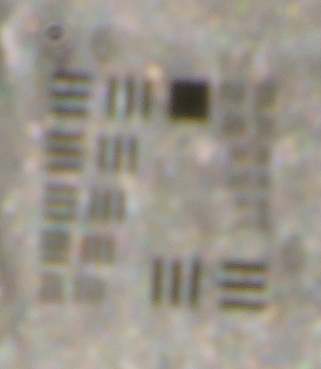 Edited by austrokiwi
01/25/2016 11:54 am
|
|
Pillar of the Community
United States
9395 Posts |
It's interesting that this lens didn't resolve up into the 7-2 to 7-5 range, although with 0.8x magnification, the level of detail at the sensor is probably equivalent to 6-5, since the lines are smaller than indicated at the sensor. I assume the 3x microscope objective by itself resolves up in the 7-6 range or better, so it shouldn't be a big factor in the limited resolution.
Maybe the low resolution is because the lens is not optimized for 1x, like the ones I tried are? I should probably do this test on the 75mm EL-Nikkor (also not optimized for 1x) and see if it has limited resolution. Now that I have a better USAF test chart, I should verify how good the microscope objectives are, at least with "casual" illumination of the USAF test chart (no microscope condenser underneath).
|
|
Pillar of the Community
 United States
4051 Posts |
Where did you guys get the USAF test charts?
|
|
Pillar of the Community
United States
9395 Posts |
Quote:
Where did you guys get the USAF test charts? I got the low-resolution test target from Edmund Optics several years ago. More recently (within last 2 years) I got a higher resolution chart (used) from ebay. I had to wait quite a while before It came up, but new high resolution charts are really expensive at Edmund. BTW -- I tried to measure the resolution of the Mitutoyo 10x using the high resolution chart, but the objective outresolves the smallest lines on that chart (Group 9 element 3, at 645 lp/mm). Also, BTW, The EL-Nikkor 75mm f/4 also outresolves the sensor at 1x, even though it's not optimized for that magnification. The only lens I could measure that performed poorly at 1x was a Schneider 80mm Componon-S, so maybe the Schneider lenses are highly optimized for some non-1x magnification? Or, maybe I have a bad copy? I'll post details later, once I get all 77 test images processed. |
|
Pillar of the Community
2087 Posts |
Re Resolution target: Mine is an edmunds optics product I luckily found it on ebay The chrome on glass is not the best option but as the saying goes beggars can't be choosers. It cost just under US$100.00, new they are very expensive. I would recommend a paper target rather than the type I have. At Edmund optics you are spoiled for choice and type: For my needs the high resolution Target is too expensive for the amount of use I would give it http://www.edmundoptics.com/test-ta...est-targets/ Quote:
It's interesting that this lens didn't resolve up into the 7-2 to 7-5 range, although with 0.8x magnification In writing this post I reviewed my thinking and although I initially didn't understand you now I also wonder the same. It is quite possible, indeed likely, my first successful play at projecting the image from the lens onto a microscope objective suffered from very poor tolerances. I was linking two tilt shift bellows together by mounting them to a 200 mm Arca rail it was quite clear that I needed a rail at least twice that length to get a much more secure mounting. Also: I could have had one or both of the two objectives slightly out of focus. I honestly think at this point in time I don't have the equipment to produce repeatable results. I am hopeful that my macro rig is protected from external vibration.The base board is a 60Lb granite slab that sits on Sorbothane feet. I would hope it is successfully reducing vibration to the level needed for this test. I believe I can't be sure that is the case until I can set up the lens and Microscope objective securely and accurately. Ideally I need to have both bellows mounted on separate focusing rails mounted to a common base rail ( I have a very clear picture in my mind of how it could be set up). Such a set up would be much more accurate than what is available to me at the moment. My greatest fear (in relation to this test) is that my rig is not as isolated from vibration as I assume it is. Heres what I understand about resolution testing. As Rik on the Photomacrography forum advised me the resolution limit on my cameras sensor is around Group 6 element 4. assumption 1: Riks comment is only relevant at 1-1 magnification Group 6 element 4 provides a frequency( Is that the right word?) of 50.8 cycles per mm. Assumption 2: If I use a magnification of 2-1 I effectively halve the frequency to 25.4 cycles per mm. If I reduce the magnification to 1-2 then I double the frequency to 101.6 cycles per mm. Quote:
{ This point in my thinking is where I realized I should have been getting better results...by increasing the image size ( from the lens) I was effectively reducing the frequency so Group seven should have been easily seen assuming the lens being tested can can resolve that set of frequencies. So we know my set up and technique must be at fault. Clearly I was expecting one result and when I got it I thought I had proved my case; now I realize that is not the case} Assumption 3. Riks advice as to the sensor limit is based on the laws of physics and relates to the pixel size on the sensor..on my camera that is 4.5 µm Are my assumptions correct? I will look at getting the gear to ensure I can perform this test properly (repeatable) but it will take a couple of months( based on budget restrictions: I do want to buy some coins!) Edit Quote:
The only lens I could measure that performed poorly at 1x was a Schneider 80mm Componon-S, so maybe the Schneider lenses are highly optimized for some non-1x magnification? That doesn't surprise me. Although the best standard Enlarger lenses from SK are "Componon-S" for macro work the HM( High modulation) and Makro Iris( enlarger lenses adapted by SK for Machine Vision) are the real performers from SK( these lenses also have the Componon S designation) they usually have muli-coatings on the lenses and are optimized for macro work but I was surprised to discover not for 1-1. From the SK web site: the Sk 50mm F 2.8 Makro Iris is designed for 1:20 to 1:1, optimized for -0.10 My 45 mm is designed for 1:20 to 1:1, optimized for -0.17 the 80mm and 90mm have the same optimization as the 45mm However the site does not mention how they perform reversed... the 50mm (V38mm mount) has a front and rear mount so that it can be reversed very easily. Edited by austrokiwi
01/26/2016 06:41 am
|
|
Pillar of the Community
United States
9395 Posts |
Assumptions 1 and 2 seem correct, for group 6 element 4 as seen by the sensor at the various magnifications. For assumption 3, the anti-alias filter also comes into play for most cameras (like mine). For the T6s, it looks like the best possible resolution (at the sensor) is about 3 to 4 3.72 micron pixels, or 11-15 microns per line pair.
|
|
Pillar of the Community
United States
9395 Posts |
I tested some additional enlarger/bellows lenses, hoping to find one that performs poorly at 1x. I was trying to find one that would not outresolve the sensor. As before, the areal images were magnified by a 10x Mitutoyo infinite-corrected objective with a Thorlabs ITL200 tube lens. Magnification was as close to 1x as I could get, but it looks like the actual magnification might have been closer to 0.98 or 0.99. Results: 1) Schneider 80mm f/4 Componon-S -- this was the worst lens at 1x. Unlike most of the other lenses, it got better when stopped down from f/4 to f/5.6: 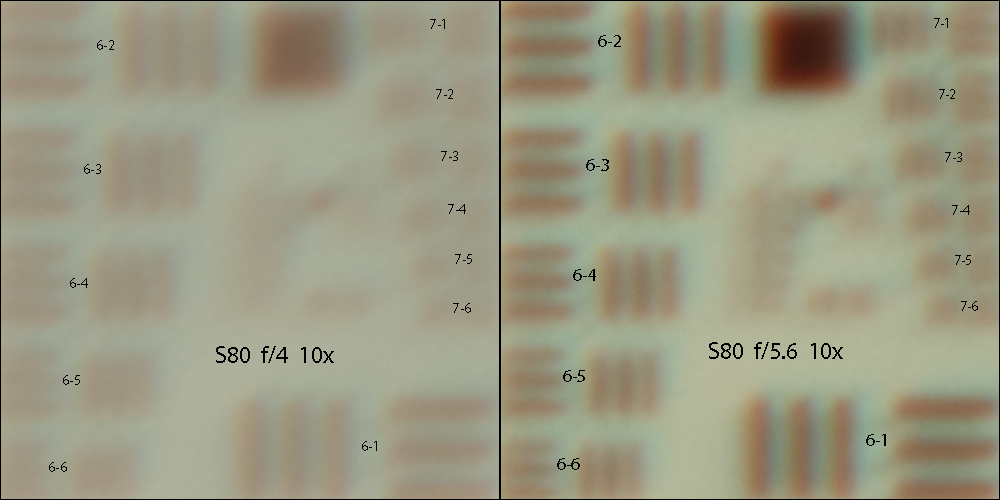 2) Pentax 100mm f/4 Bellows-Takumar: 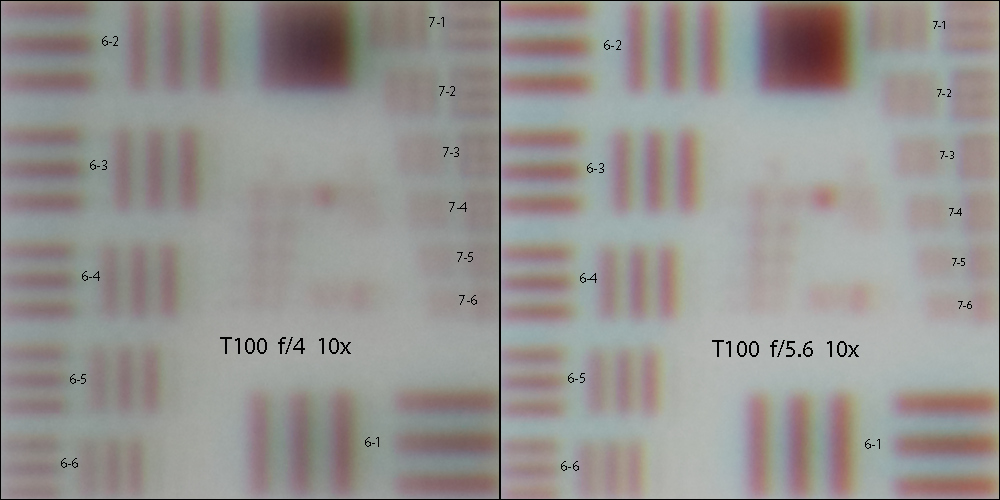 3) EL-Nikkor 135mm f/5.6: 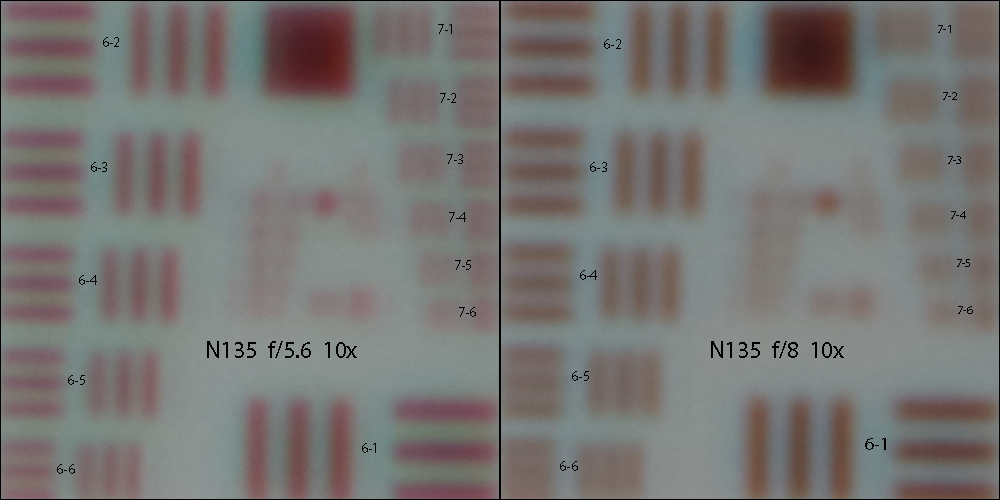 4) EL-Nikkor 105mm f/5.6 (old-style): 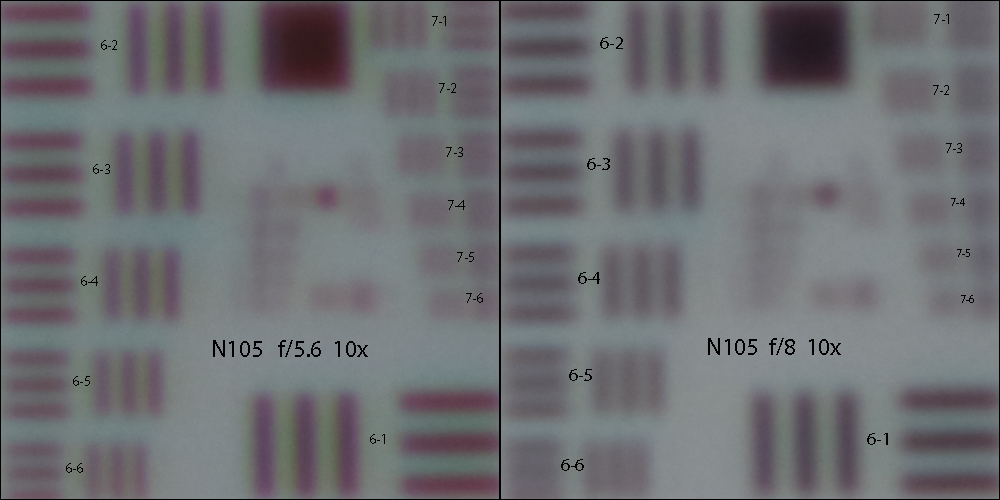 5) EL-Nikkor 80mm f/5.6 (old style): 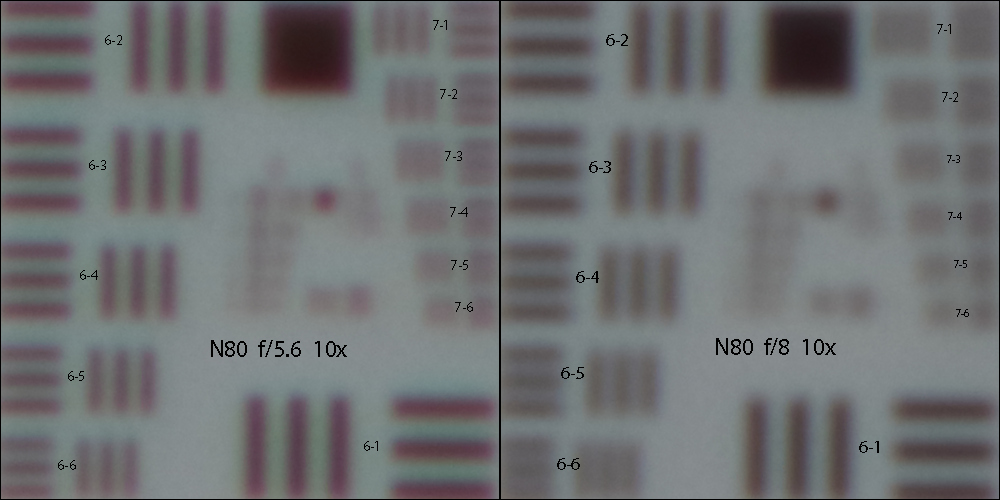 6) EL-Nikkor 75mm f/4: 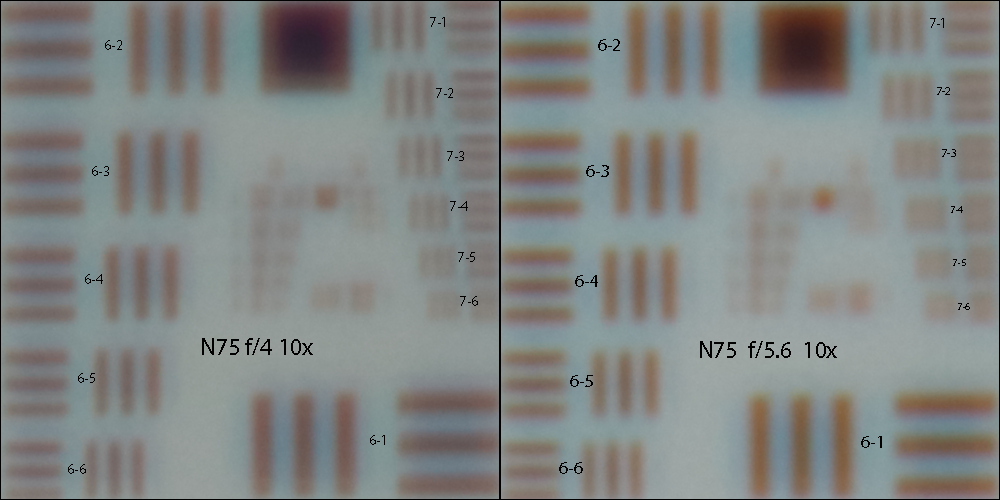 7) Olympus 80mm f/4 bellows lens: 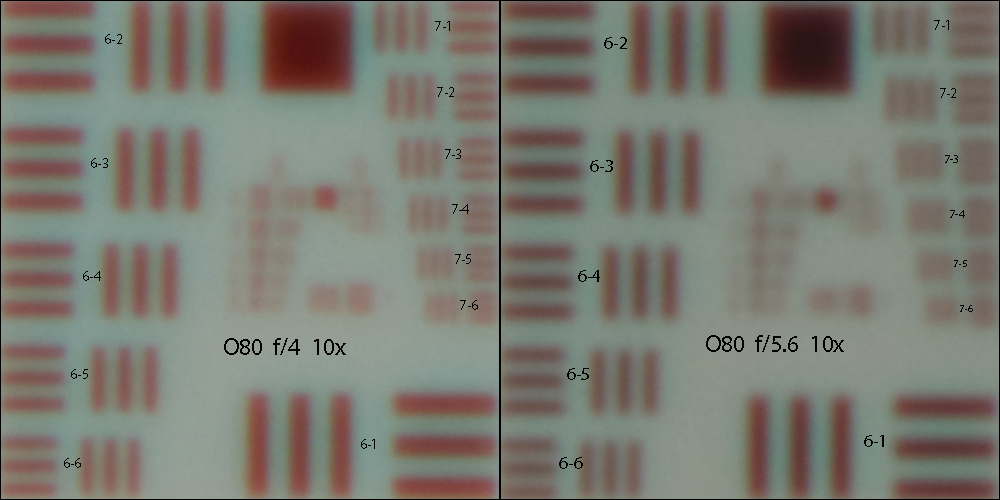 8) APO Rodagon 1x 75mm f/4: 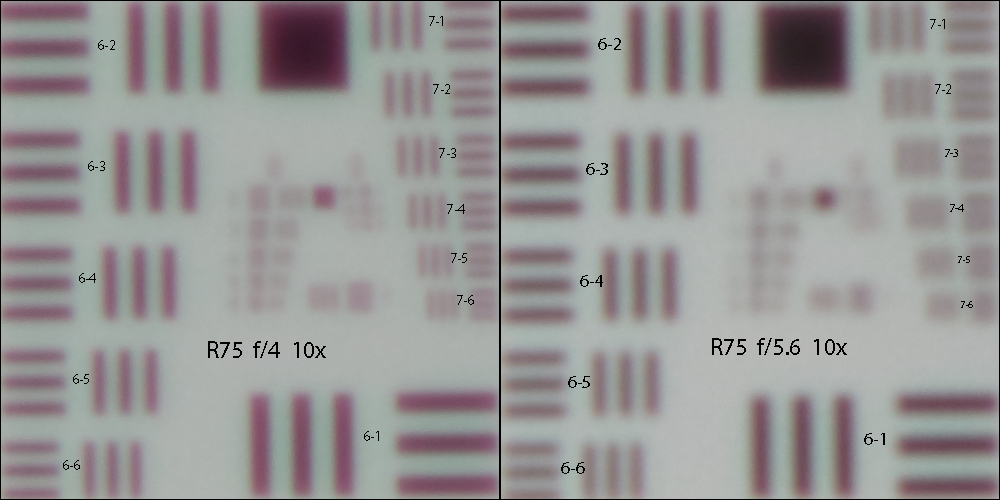 - - - - - - - - The sensor resolves around group 6 element 4, and the only lens that did not exceed this at 1x at the center when wide-open was the Schneider Componon-S 80mm f/4. However, this lens did improve at f/5.6 so it does outresolve the sensor when stopped down. I will continue my search for bad lenses, with some Nikon bellows lenses that are hard to attach to the Olympus bellows. The 105mm f/4 has a mediocre reputation, and the 135mm is really old (1950s, adapted rangefinder lens). I'll use the Nikon PB-4 tilt/shift bellows, which might allow testing out to 10mm off-center (this might not work?). |
|
Pillar of the Community
United States
9395 Posts |
This is what the center part of the USAF 1951 test target looks like through the 10x/0.28 Mitutoyo objective (200% crop): 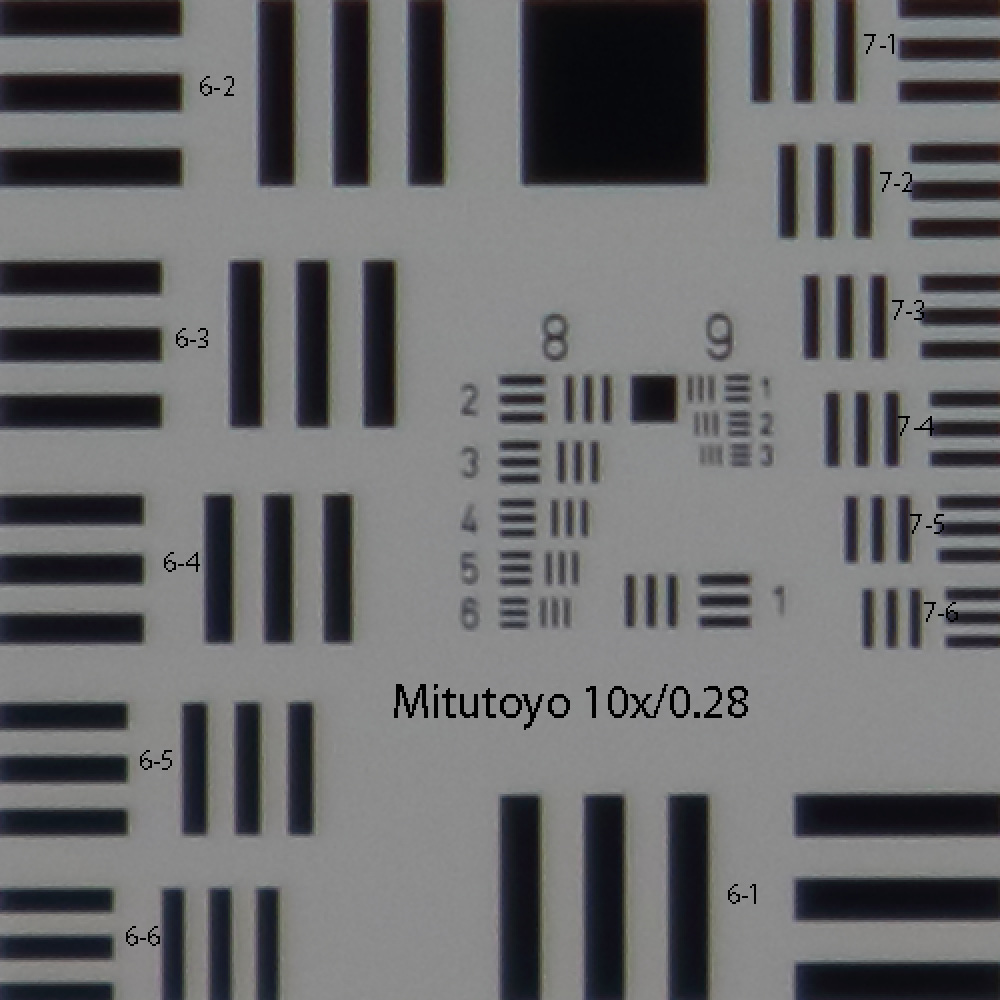 400% crop with the Mitutoyo 5x/0.14:  500% crop with the Nikon 4x/0.20 CFI60 objective:  |
|
Pillar of the Community
2087 Posts |
I have to ask for coin imaging is a high resolution target necessary? I had been looking at finding one until rik told me my cameras sensor limits. Once he told me that I was pleased I had only got the stantdard 1X resolution target. I know that the hIgh resolution target is for lenses like the PN 105mm. ( all that said I would buy one at the speed of light if it came up for sale cheaply on ebay except for the Chinese copies) Re: Assumption 3 My camera doesn't have an anti aliasing filter.... But I am looking at getting a MFT as a second camera and that will have that filter The modern SK lenses are designed for Machine vision cameras with very small sensors hence the 1:20 to 1:1 magnification range. For coins They should perform well an MFT camera as 1-1 magnification would only be needed for the smallest of coins ( less than 13 mm in diameter) I know there are faults in comparing sensor, but one advantage of MFT is with the lower magnification requirements an MFT camera is going to see a much deeper DOF at each aperture than an APSc FF, or medium format camera. ... as the sensor size increases the needed magnification ( so that a coin fills the sensor) increases. With increasing magnification DOF decreases. So when ensurign a coin fills the sensor area: F5.6 on a MFT will see a deeper DOF than F5.6 on a APSc camera. However The APSc camera has the potential to produce qualitatively better photos. A medium format camera can produce better photos than a Full frame. { this is not the reason I want an MFT, my reason: I want a smaller lighter camera that I can use most of my normal( non macro) lenses on} I actually believe that for ebay selling and just sharing coin pictures online a MFT camera might well be the best bet for many coin collectors. Particular the models that have built in focus stacking Edited by austrokiwi
01/27/2016 01:17 am
|
|
Pillar of the Community
United States
9395 Posts |
Quote:
I have to ask for coin imaging is a high resolution target necessary? Up to 1x, you don't need the high resolution test chart, as long as the pixel size remains over 2 microns or so. If you want to test lenses for closeups and stacking, it might come in handy. At 1x, the sensors currently resolve at group 6 element 4 or 5 (6-4 or 6-5). At 2x, current sensor shoulds resolve 7-4 or 7-5. At 4x, this would be 8-4 or 8-5, and you'd need the higher resolution target, if you wanted to measure resolution. (See the above 4x shot using the Nikon 4x, for example.) For 10x, my high resolution target is not sufficient. I guess people use special diatom test slides to check out higher power (higher NA) objectives. Of course, lighting with Jansjo lights shining upward through Canson Opalux diffuser paper may not be good enough, either. You might need a real microscope condenser for these more powerful objectives. |
|
Pillar of the Community
2087 Posts |
Regarding the comparison between the Printing Nikkor 105mm and the Sony FE 90mm F 2.8. Based on published lens specs the Printing Nikkor is the better of the two lenses by a very wide margin Sony in advertising some new lenses( G master line) note they are now producing lenses for 40 Plus mp sensors ... so they are now producing lenses that resolve 50 lines per mm. Isn't that less than a quarter of the PNs resolution? That said on the A7rii the Sony 90mm is a dream to use...as it was designed with that camera in mind...so there is in camera correction specific to the lens.... and it is so nice to be able to AF coins. As nice as the native lens is.. the PN will remain that most used and most important lens I have!
|
|
Pillar of the Community
United States
4051 Posts |
AK...you may want to look into the 95PN as well. It is designed for 1:2 forward, 2:1 in reverse, so picks up nicely where the 105PN starts to lose performance.
Contact me for photographic equipment or visit my home page at: http://macrocoins.com |
|
Pillar of the Community
United States
9395 Posts |
Quote:
so they are now producing lenses that resolve 50 lines per mm. Isn't that less than a quarter of the PNs resolution? That number might be some sort of worst case or guaranteed value. Most of the lenses I tried resolved over 100 line pairs per mm at the center. |
|
Pillar of the Community
2087 Posts |
At 1-1 magnification? ............
Or its my bad. Or a combination of the two. Just rechecked the info and in a more technical report not the initial source, it is 50 Line pairs per millimetre. In the same report it notes canon and Nikon lenses are designed for 20-30 Line pairs and Zeiss are at 40 line pairs. I assume line pairs means 50 line pairs = 100 lines per millimetre. I don't think the report is wrong as Nikon and Canon would have jumped on it by now!! Particular Nikon as it quotes their anti mirrorless comments at CES. ( sony has just announced a Camera that has AF focus tracking that exceeds a DSLRs abilities)
Some have already said if the claims are correct then the next lenses coming from Sony( not Macro) in march are going to out resolve the Otus lenses( I find that hard to believe)
I have been looking for both of the other two PNs but at the prices I have seen( and I do have some coins to buy) It will be some time before I get them. I am going to check the terminology in more depth... sometimes there is a real mismatch between Normal Photography reports and what macro/micro photography reports. It could well be the reported line pairs are the point of optimal performance
Edited by austrokiwi
02/06/2016 06:11 am
|
|
Pillar of the Community
United States
4051 Posts |
I was lucky to own 3 95PNs in the last few years. First one was the early model. It performed well, but inexplicably the Canon 35MP was superior in my tests. I traded that lens for my current stacking setup (other guy wanted the lens, and was good at making mechanical contraptions) but was always unhappy I got rid of it. I found an "A" version for sale at a good price, but turns out it had undescribed scratches and fungus, so I returned it, but not until I had tested it to see it was superior to the 35MP. A fairly long search later, and I found another "A" version in good shape for a good price. It just takes patience, and a bit of frustration...I saw several sell for very low prices on BIN from folks who didn't know what they had. There are a few very lucky folks out there who snapped those up quickly.
The "resolution" numbers you guys are talking about seem to be MTF10, correct? While MTF10 is indeed interesting as it says the ultimate capability of the lens, I am far more interested in MTF50, or what folks call "sharpness". In my qualitative lens tests, I look for more subtle changes in the image that affect sharpness, and when I see even a small decrease in apparent sharpness I know I am already beyond MTF50. In addition to pixel-pixel contrast I look also at overall contrast, color shifts, etc when judging lens performance. I've never thought of MTF10 as very useful in actual photography, though it is a good measure of ultimate lens performance.
I'm of course looking for a 75PN (I have never seen one for sale), as well as a 150PN, though with my setup the 150PN is really too long to be practical. Mark Goodman's tests show the 150PN to be very high resolution, higher in the center even than the 105PN, but worse in the corners (even on APS-C) at 1:1. The advantage the 150PN has (at least the older models) is the magnification optimization control, which allows sharpness to be improved over a wide mag range. Newer models don't have the control and are only optimized at 1:1.
One more point I'd like to make...I prize wide coverage more than center sharpness in a lens, but the method you guys are showing only looks at center sharpness, correct?
|
| |
Replies: 67 / Views: 17,518 |





 First Page


 Posted 01/25/2016 4:21 pm


