| Author |
 Replies: 67 / Views: 17,510 Replies: 67 / Views: 17,510 |
|
|
|
Pillar of the Community
United States
9395 Posts |
Quote:
One more point I'd like to make...I prize wide coverage more than center sharpness in a lens, but the method you guys are showing only looks at center sharpness, correct? I only tried looking at the center of the image, or as close to it as my setup would allow (1mm-2mm, I suppose?) My macro setup isn't really designed to do this sort of testing, but it is possible to have two lenses (maybe even 3 or 4) attached at the same time. Maybe it's possible to use a Nikon PB-4 to shift the lens up to 10mm off the centerline and look at the outer portion of the image. I didn't try this, since light would be going through the microscope objective and tube lens assembly at an angle, and I have no idea what problems that would cause. Maybe you could combine tilt with the shift, and put the USAF test target at some proper angle and get everything to work, but it doesn't sound easy. All this test does is show that almost all the lenses can outresolve the sensor (at the center). In real coin photos, I don't see much difference between lenses, since I usually just shoot at f/8, where you've lost some resolution anyway. The most important thing seems to be lighting, and I often have a hard time getting acceptable images on many coins due to bad lighting (and scuffed-up slabs). |
|
Pillar of the Community
 2087 Posts |
For now I have only been looking at Center resolution. But I also think corner to corner resolution is important. Sharpness: I haven't started assessing the lenses I own formally. For sharpness, for now, I rely on the assessments of others. {My understanding is that Sharpness is a combination of resolution and contrast.} For my own education I want to learn how to make my own MTF assessments. For now I just want to sort out being able to test resolution reliably ( in three weeks I will have the final piece of kit I need for another try). I suspect a better test of Sharpness, across the whole field of view, (for coin photography) would be to use Ronchi Rulings however they are produced with only one frequency and are expensive. The other option is a star chart. For me the problem is sorting out what the best target is for the money. For now my edmunds USAF resolution target is the best tool I have and before I can move on to a more appropriate tool I need to master this first one. Edit I have been looking hard at this wheel resolution target..... but the price to my skill level rules against the investment at this time: http://www.edmundoptics.com/test-ta...arget/59205/Edited by austrokiwi
02/07/2016 01:34 am
|
|
Pillar of the Community
2087 Posts |
Its taken a while but I have enough gear now to repeat the test with a greater degree of Accuracy. I am projecting the image from each lens onto a generic 10X objective( that seems to have a few bubbles in the glass) This is a preliminary test and it is not yet as accurate as I believe it can be. the APO Rodengon 90mm may have been unfairly disadvantaged in this test( I used a magnification lower than 1-1) The lenses: 1 Printing Nikkor 105mm ( used as the reference) 2: Schneider Kreuznach Makro Iris 50mm F 2.8 ( equivalent to a standard SK 50mm F 2.8 enlarger lens) 3. SK APO HM 45mm F 4.5 4. Minolta CE 75mm F 4.5 5: Rodenstock APO 90mm F 4.5 based on my mark one Eyeball the results were interesting. Of course the PN was the best, but every other lens was able to out resolve my cameras ( Sony A7rii) sensor. What surprised me was the MInolta 75mm although it always looks horrible in the view finder it performed better( although the worst in this group) than I anticipated. the SK 50mm was actually better at resolution than the 45mm I still need to fine tune my technique for this testing but the results at this point are interesting. 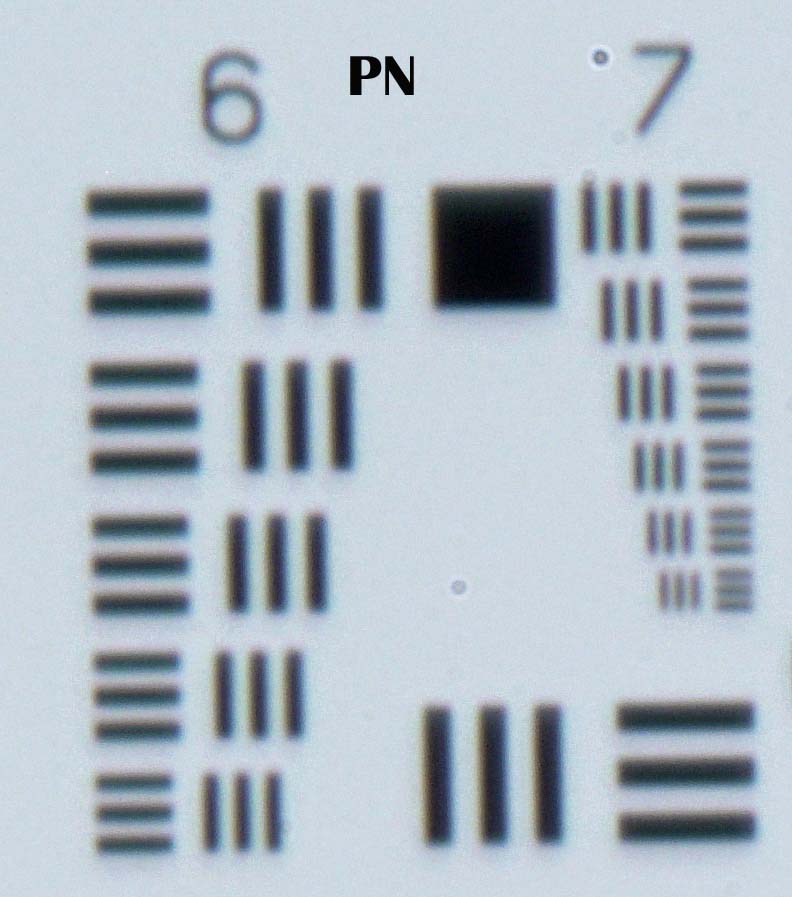 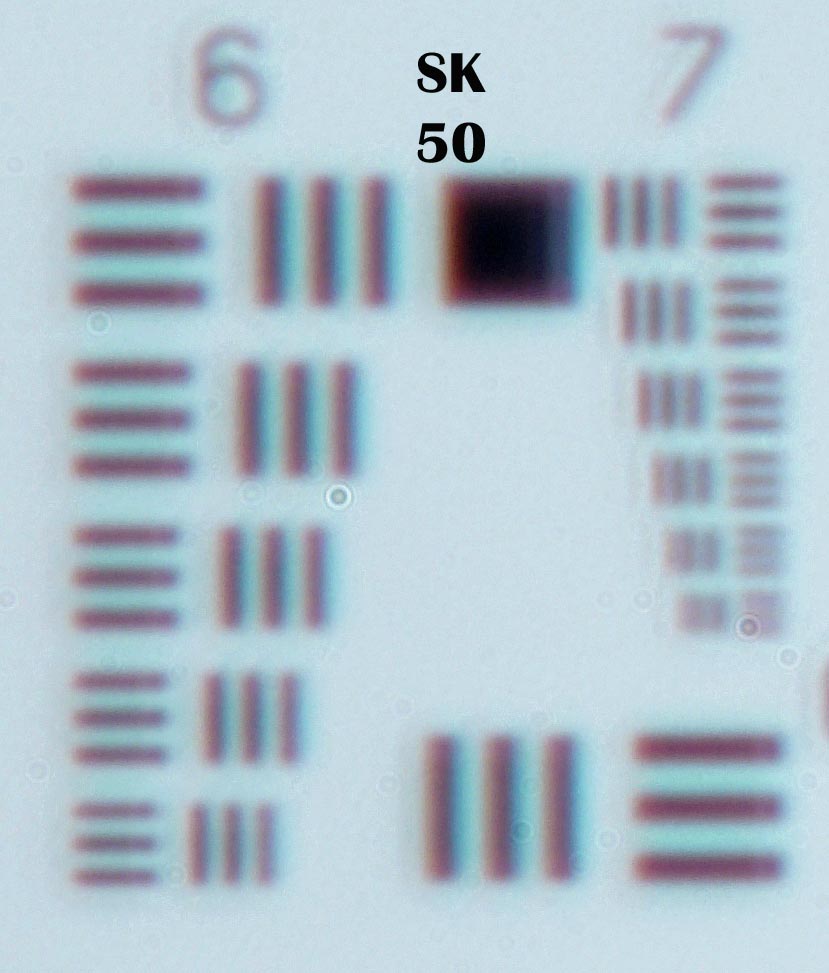 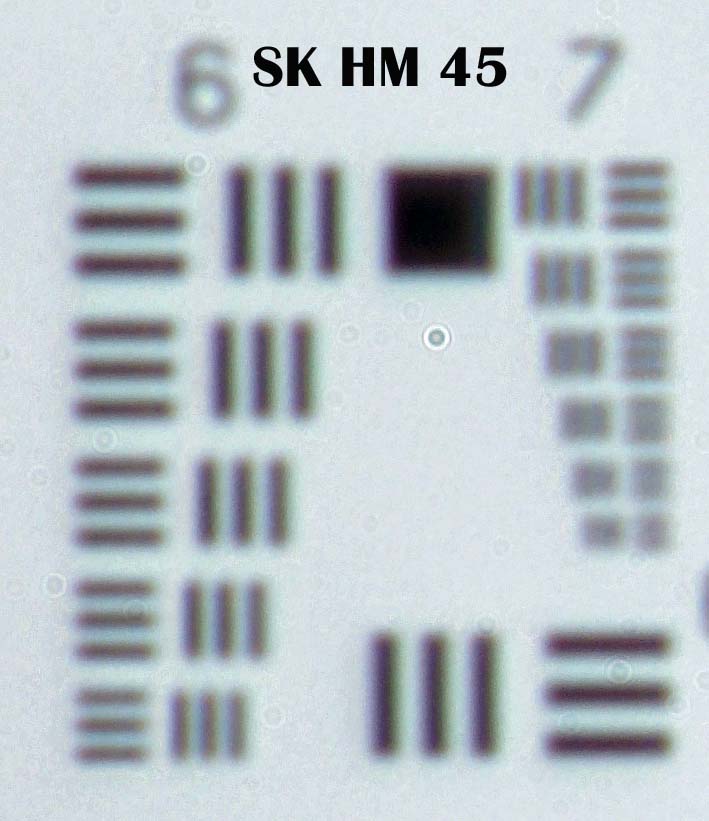 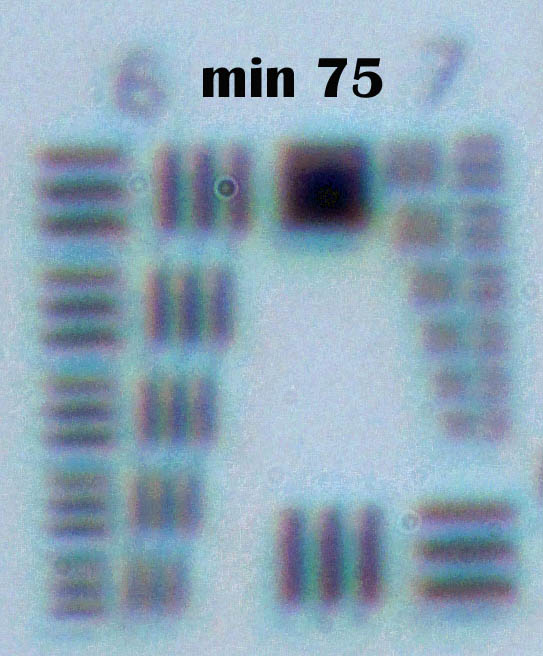 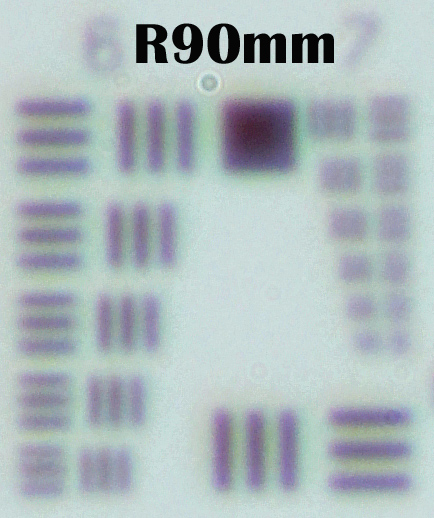 I redid the Rodagon 90mm test. Of all the lenses this lens produced the most disappointing results ( I expected it to perform much better than it did): 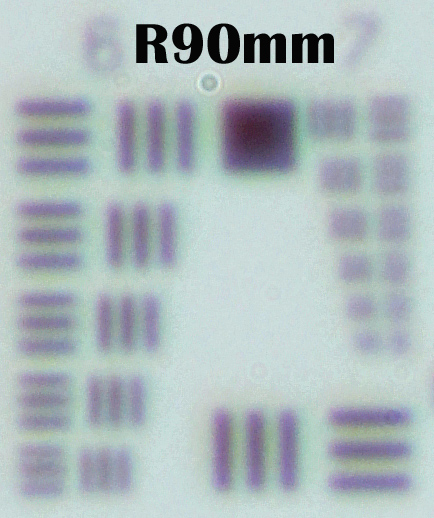 Edited by austrokiwi
02/26/2016 1:48 pm
|
|
Pillar of the Community
United States
9395 Posts |
One interesting thing here is the red/purple color from all the lenses except the Printing Nikkor and the SK 50 lens (and the Mitutoyo 10X and Nikon CFI60 4X objectives from the earlier tests).
|
|
Pillar of the Community
2087 Posts |
It is tending to show which are the real APOs and which aren't. I say tending as I am not yet confident my set up is nailing the focus. With my limited experience so far I have noticed color fringing occurs with APO lenses when I miss the focus. That said from the time spent settign up these shots I suspect that the Rodenstock APO 90mm is unlikely to see any improvement. The SK 45mm might see some improvement as the color rendition is very much like the PN so I suspect the focus may be a little off( enough to create the chromatic aberration) I was surprised at the SK 50mm performance ( less color fringing than I expected) given that it is specifically designed for Machine vision perhaps there is more to that lens than I expected
Edited by austrokiwi
02/27/2016 11:21 am
|
|
Pillar of the Community
2087 Posts |
As a result of the tests already conducted I sold off my Rodenstock APO-Rodagon 90mm. Its performance just wasn't that impressive. In the 90-105mm range I still have the PN105mm, Minolta 100mm F4 bellows lens and the native FE90mm F2.8. I did like the Rodenstock but I have coins to buy ( and a second Camera to get) and it wasn't adding to my tools boxes capabilities. As I had anticipated I didn't loose anything selling it. I had purchased it,with postage, for just over €100.00 and I sold it for €160.00. With enlarger lenses I believe if you buy good lenses you will never loose out as at the very least you will get your money back. After the experience of finding the Rodenstock wasn't as good as I thought it was, I decided I better test one of my other favorite lens the Olympus OM Zuiko 135mm F 4.5. I like the lens because it has a very long working distance which makes lighting problem coins much simpler. The long working distance was a problem this time. It made it much harder to focus ( with projecting the image from the lens onto a microscope objective)and I am pretty sure I missed the focus slightly. ( I also had the white balance set wrong so ignore the yellow cast). I am pretty sure with some further modifications I can get the focus even more accurate. For now this test picture is all I need as it tells me everything I need to know. The Oly 135mm bellows lens is definitely a keeper. It exceeds the resolution capabilities of my Cameras sensor( around Group 6 element 3 or 4). I am sure I was slightly out on the focus and I expect, based on what I have learnt so farm the lens might resolve Group 7 element 1 or even perhaps 2 I tested this lens at F 5.6 which is the F stop that I have found my particular example performs best at. Note this was about .9 (90% life size) On my bellows I can't get enough extension to get 1-1. This is due to my latest adapter, an Olympus OM 14mm extnsion ring (I replaced the camera mount of the extension ring with an M42 to Minolta MD adapter). My previous adapter provided almost another 40mm extension, 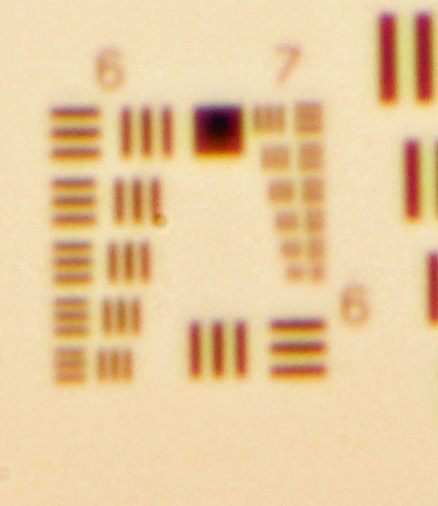 Edit: I thought I would test the last Bellows lens I had as well( while I had the test rig set up). Minolta 100mm F4 bellows lens. With a shorter working distance than the Oly it was easier to focus. This lenses best aperture is F8 which is right at the diffraction limit for this camera( half a stop more and diffraction blurring will set in). Its a lens I rarely use now. I am repairing a Minolta IV bellows( non-tilt shift) at the moment which will be sold when repaired so I may include this lens in the sale. It resolves to about the same level as the cameras sensor( at 1-1). ( I had the white balance set correctly this time so was very surprised at the yellow Cast. I recall some Minolta lenses having Radioactive( but safe) coatings but didn't think this bellows lens was one of them: it is of the right vintage for such a coating. If it is due to a radioactive coating then the yellow cast is easy to fix( just leave the lens in the sun for a few hours the UV light corrects the cast. 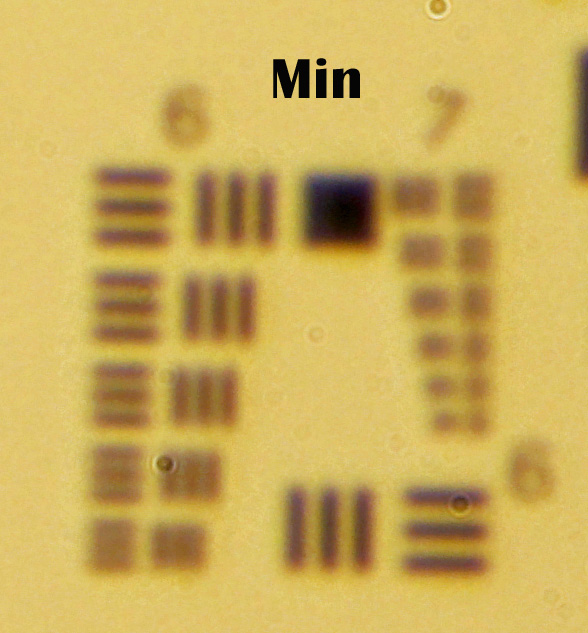 Edited by austrokiwi
03/13/2016 01:28 am
|
|
Pillar of the Community
 United States
4051 Posts |
I have a couple examples of the Minolta 100mm bellows lens, with and without tapered/conical front mechanics, but have never been impressed enough to use them for much work. I suppose having to adapt the mount may be the bottleneck for me. I actually went on a Minolta kick at one point and bought several "mixed lots" that had various pieces of Minolta gear, including several Bellows III and even an Auto Bellows III with tilt shift, macro stand, focus rail, etc. They made quite the range of equipment for macro, but the mount is very limiting. I sold one group in the past, and may sell another group soon. In general, I only recommend folks buy more generic mounts such as M39, M42, etc. I don't even like Nikon or Canon EF mounts for any of my macro stuff, though I do recommend Canon FD. The fixed bayonet mount is very convenient, and FD-M42 adapters are cheap and plentiful. Still, not as convenient as straight M42...
|
|
Pillar of the Community
2087 Posts |
These simple tests have made me very aware of the limitations of the Minolta lenses for macro work. When I up graded from the A7r to the A7rII I discovered the Minolta MC/MD 50 and 100 mm macros( both manual focus)really weren't up to the task on the 42MP sensor.
For Sony and MFT users the adapters for using Minolta bellows are very easily available. the big problem with Canon and Nikon was the fact that in both cases the registry distance is longer than the Minolta. This resulted in very few adapters for Minolta to other mounts( until fotodiox brought in Speed boosters)
Focusing on M39/42 mount bellows makes sense... but I also understood one of the best bellows one could get was the Nikon PB6
JUst a note for ordniary photography there are some legacy minolta lenses that are phenomenal performers. I have a MD 135 mm F2. That is incredible, likewise an exotic MD 24mm VFC(Variable field curvature) reversed it does take good coin photos but one has to ensure the field is adjusted correctly( at the price it demands its not worth gettign for coin photography). Generally for coin work I have to say minolta lenses are best left on the shelf
Edited by austrokiwi
03/12/2016 3:42 pm
|
|
Pillar of the Community
United States
4051 Posts |
The PB6 is a nice piece of machinery. I find the Canon Auto Bellows to be just as good, though the Canon does not have accessories to extend the bellows length. The Pentax is also right up there in build quality. A big plus for the Pentax (besides being native M42) is the 360-degree rotation capability on the camera mount. This makes optimizing the framing very quick and easy. The Canon is relatively easy to modify for 360-degree capability, but the Nikon is not. The native Nikon and Canon bellows only offer "upright" and "sideways" orientations. In my setup I need "upside down" orientation, and by removing the reference screw from the Canon I can set it up for any angle, with +/-45 deg adjustability. As long as you can live with the fixed range from upright to sideways, the PB6 is a good choice. If you want the easiest rotatability, then the Pentax is my recommendation. Note the Vivitar also gives full 360-deg rotation natively, with very robust build quality, but not as well-fitted or smooth as the other bellows.
|
|
Pillar of the Community
United States
9395 Posts |
Quote:
I decided I better test one of my other favorite lens the Olympus OM Zuiko 135mm F 4.5 This is the lens the Rick Littlefield tested over at Photomicrography.net, using a microscope objective to get around the camera pixel limitations. He tested at small magnification (less than 0.05, IIRC). The 135mm lens is not optimized for 1x (with Olympus you're supposed to use the 80mm for 1x), but is designed to cover the range below 0.5x, perhaps down to 0x. I use it mainly for photographing whole PCGS and NGC slabs, and also for any coins over about 46mm in diameter (I don't have many of these). Someday, I hope to do a test of this lens to compare it with the 135 Nikon bellows lens. It's not that easy to adapt the OM bellows to take a Nikon F lens (OM to 49mm reversing ring + 52mm to 49mm stepdown ring + 55mm to 52mm stepdown ring with full inner 52mm threads + Nikon B2 or K3 ring). I suppose it would be harder to adapt the Nikon PB-4 to take the Olympus lens, however. |
|
Pillar of the Community
2087 Posts |
That useful to know: which bellows have movable camera mounts. The Minolta bellows are also limited to only landscape( sideways) and portrait ( upright) orientations. Another bellows that can be modified to allow full 360 degree mount rotation is the Mamiya 645 tilt-shift bellows Quote:
The 135mm lens is not optimized for 1x (with Olympus you're supposed to use the 80mm for 1x), but is designed to cover the range below 0.5x, perhaps down to 0x. I use it mainly for photographing whole PCGS and NGC slabs, and also for any coins over about 46mm in diameter (I don't have many of these). I have the Oly extension tube its a nice piece of kit. However its not that cheap ( often its cheapest to buy it with the lens rather than separately) On that purpose built extension tube(Auto Extension Tube 65-116) the 135 focuses to infinity, but it really stinks as a every day 135mm lens. As you point out its great for large coins and that is why it stays in my tool box. The fine focusing helicoid is a nice touch but I hardly ever find the need to use it. For any one interested in getting an example always get the last production run of this lens it has the best lens coatings earlier versions flare very easily. Latest versions serial numbers start with 113XXX. The 80mm has been on my nice to have list for a while Edit: walking the dog and thinking about other things allows my subconscious to realize I missed something out. As I understand it the resolution target used properly requires the lens to be tested at 1-1 if I used a 2X magnification the effective frequencies on the target would be halved. At half sized magnification the frequencies are doubled. Assuming there is nothing wrong with that logic the test shot of the Oly 135 F4.5 is impressive we know that it is imaging at resolution frequencies higher than the test shows. Edited by austrokiwi
03/13/2016 04:21 am
|
|
Pillar of the Community
2087 Posts |
see my previous post as well. Noting the comment that Oly 135mm F4.5 is optimized for a lower magnification range than 1:1 here is another test taken at 1:2 ( half life size) This means the frequency of the resolution chart should be doubled. From my old eyes it looks like the lens is just managing Group 6 element 4 At 1:1 this would equate to 90.5 cycles per mm but at half life size it is actually 181 cycles per mm which equates to Group 7 element 4. If you think I am over generous with my assessment we can take it as resolving at group 6 element 3 which is a 1:1 equivalent of 161 cycles per mm ( group 7 element 3) in my book that is an impressive result ( assuming my logic is correct). Edit: Actually I think I have been reading group 6 wrong. Is that group 6 element 1 at the bottom right... under Group 7. If it is then the lens is actually resolving 203 cycles per mm. 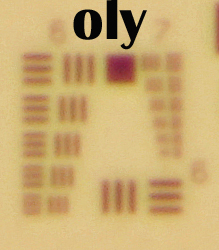 Edited by austrokiwi
03/13/2016 08:47 am
|
|
Pillar of the Community
United States
9395 Posts |
Quote:
Edit: Actually I think I have been reading group 6 wrong. Is that group 6 element 1 at the bottom right... under Group 7. If it is then the lens is actually resolving 203 cycles per mm.
I think group 6-1 is the large one below group 7 -- see my earlier AF test images where I labeled the groups and elements. I guess the resolution depends on how you look at things. When the magnification is not 1x, the resolution at the target and sensor will be different. The target resolution is still what is shown in the image (6-4 or whatever), but the resolution at the sensor will be the target resolution (lines/mm) divided by the magnification. It's convenient to use magnifications of 1x, 2x, 0.5x, 4x, 0.25x, etc. for testing with the USAF test chart, since you can compute the resolution at the sensor by just shifting up or down the group number on the USAF test chart. |
|
Pillar of the Community
2087 Posts |
Yep I was reading the chart wrong.....I twigged to my mistake when I realized I was counting only 5 elements in group 6 when there should be 6.
|
|
Pillar of the Community
United States
9395 Posts |
Quote:
see my previous post as well. Noting the comment that Oly 135mm F4.5 is optimized for a lower magnification range than 1:1 here is another test taken at 1:2 ( half life size) I just finished doing some of these ultimate resolution tests at 0.5x, mainly to compare the Olympus 80mm with the 135mm, and also the 50mm Micro Nikkors. The results in order of increasing ultimate central resolution at 0.5x: 1) Olympus 135mm bellows lens 2) Olympus 80mm bellows lens -- (outresolves the 135 by about 2 steps on the USAF test chart) 3) Micro-Nikkor 55mm f/2.8 and f/3.5. These outresolve the 80mm Olympus by about 1 step. The 3.5 may be slightly sharper than the 2.8 at the center, but by less than one step. 4) The biggest surprise is the 50mm Olympus f/2 Macro lens. It seems to outresolve the Micro-Nikkors by another 4 steps on the AF test chart. Interestingly, it may be slightly better at f/2 than at f/2.8 at 0.5x. I thought I'd try the Olympus 50/2 at 1x, but the results are not that great -- about the same as the 75mm APO Rodagon D 1x. The 50/2 has close range correction, which is optimized only up to 0.5x. The best results at 1x seem to be at f/2.8 rather than f/2. It would be interesting to compare this lens reversed at 2x with the Olympus 38mm and Canon 35mm bellows lenses. |
| |
Replies: 67 / Views: 17,510 |





 First Page
 Previous Page


 Posted 02/07/2016 01:27 am


