| Author |
 Replies: 67 / Views: 17,521 Replies: 67 / Views: 17,521 |
|
|
|
Pillar of the Community
 United States
4051 Posts |
Would be interesting to see how the 50/2 performs at the corners (or at least at center top/bottom, most appropriate for coins) and also for loNGCA.
|
|
Pillar of the Community
 2087 Posts |
Quote:
4) The biggest surprise is the 50mm Olympus f/2 Macro lens. It seems to outresolve the Micro-Nikkors by another 4 steps on the AF test chart. Interestingly, it may be slightly better at f/2 than at f/2.8 at 0.5x. I had read somewhere that some 50mm lenses were very good in terms of resolution. With that in mind I am pretty sure the SK 45mm F4 ( APO HM) is optimised for way below 1-1. It may well work best at .3X which would make it a very good lens for MFT. I need to modify my rig to test it in its ideal magnification range ( if I stick it on the bellows at minimum extension it is already out of the optimal range. |
|
Moderator
United States
54300 Posts |
What do all the blurry images mean - in non-technical terms?
Show your financial support of the Coin Community Family (click here)See my topic on Mexican Numismatic Medals (click here) |
|
Pillar of the Community
United States
9395 Posts |
Quote:
What do all the blurry images mean - in non-technical terms? In non-technical terms, the fuzzier the picture is, the worse the central resolution of the lens is. You have to compare two lenses at the same magnification and f-stop to be valid. The differences between lenses may not be visible in real coin pics or may be dwarfed by other more visible lens problems, like flare or other contrast issues, chromatic aberration, field curvature, various off-axis aberrations, distortion, etc. |
|
Pillar of the Community
2087 Posts |
heres another way of understanding those blury lines Here is a full photograph(compressed for viewing here) of the resolution test target with a lens set to 0.4X ( 40% of life sized. the sensor is 36mm X 24mm. Look at the pattern square with 4 and 5 that square in real life is 4 millimetres on a side. Look in side it and the square with 6 and 7 is a millimeter each side(according to my calipers and old eyes) 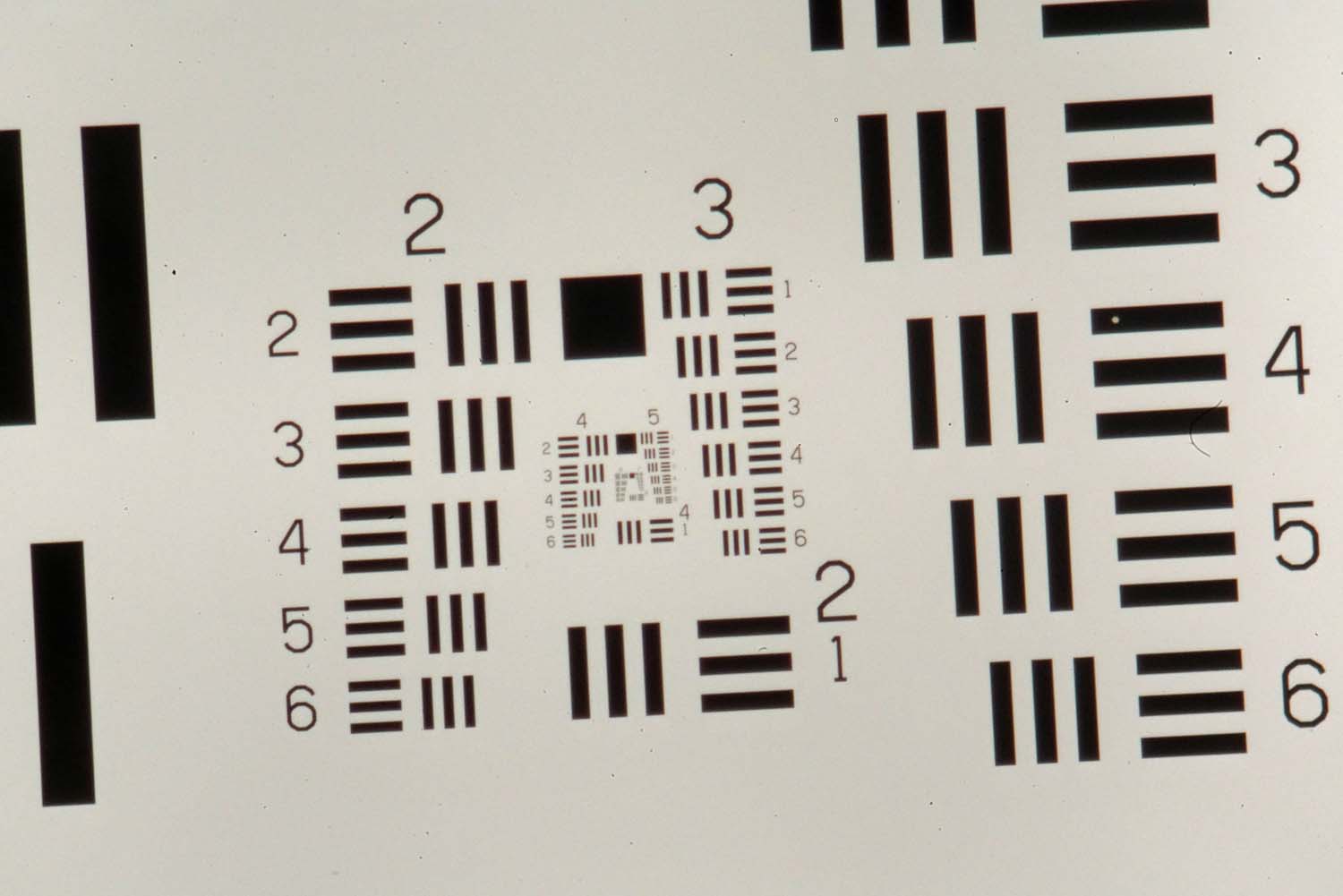 By zooming in we get to see how small the lens can actually "see" 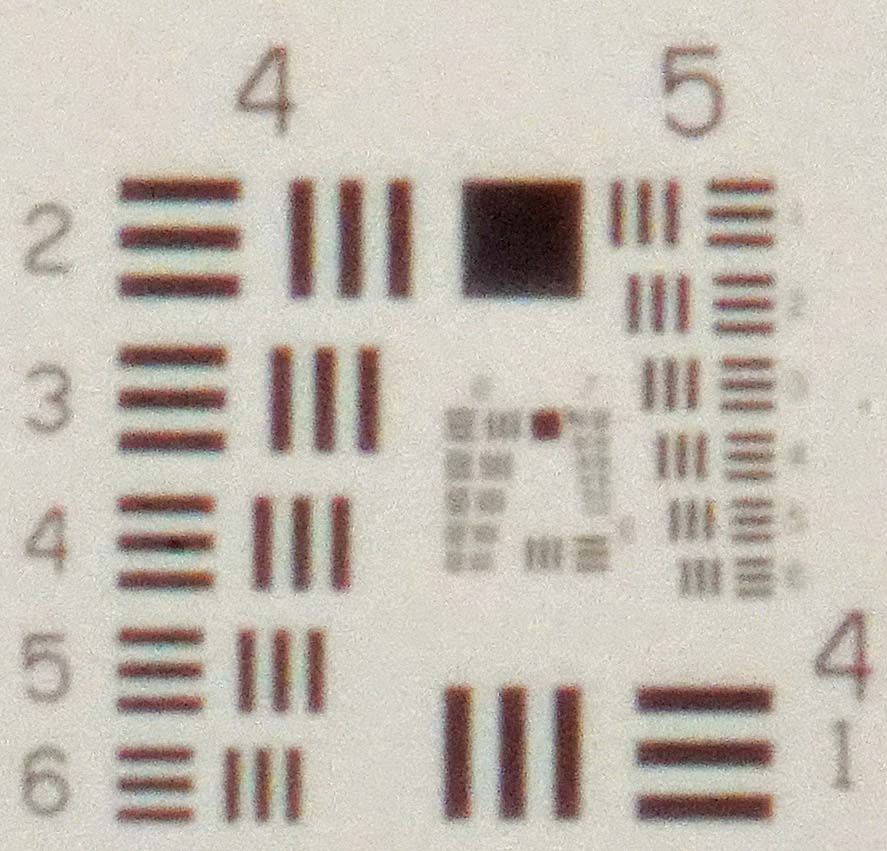 If this was using life size magnification we would say the lens is resolving ("seeing") to group five element six which equates to 57 cycles per mm or the lens can see 57 lines inside a single millimetre. However this lens was reducing the image it is less than half size . If it were at half size we would know from this test the lens was actually resolving 114 lines per mm. but the lens was at .4 magnification which means it is resolving better than that probably it is able to see 143 lines inside a millimetre..... give the magnifications involved I think you understand why the pictures are so blurry.... most of them are zoomed in around 300% ( this last picture was only zoomed in 67%) The test tell me the lens has very good resolution..... and it was not at is optimal magnification( around .25 to .3X) the lens is the Schneider Kreuznach APO 45mm F4 HM( high modulation) What the test tells me is in real life stick this lens on a MFT camera and take a picture of an ASE and you are going to see incredible detail ( assuming you do everything else right) the test also tells me it won't perform so well on an APSc or full Frame sensor Edited by austrokiwi
03/14/2016 5:29 pm
|
|
Pillar of the Community
United States
9395 Posts |
Quote:
Would be interesting to see how the 50/2 performs at the corners (or at least at center top/bottom, most appropriate for coins) and also for loNGCA. I tried to measure longitudinal CA by reversing each lens and shooting at 2x, to simulate how far off the focus is at the sensor for various colors. I used filters I had on hand -- H-beta at 486nm, green at 500-550nm, and H-alpha at 656nm. I measured the difference between the highest and lowest focus positions among the three colors. Results: - Micro Nikkor 55/2.8 -- 0.19mm - Micro Nikkor 55/3.5 -- 0.23mm - Olympus Macro 50mm/2 -- 0.30mm I don't know how accurate or valid these measurements are. |
|
Pillar of the Community
2087 Posts |
On the Oly 50mm F2, I did some research and discovered it is supposed to have an extremely flat field... its gone past the 80mm ( which was on my nice to have list and jumped on to my must get list) There was also a 90mm macro produced I had never heard of it!
|
|
Moderator
United States
54300 Posts |
Thank you for the explanation.
Show your financial support of the Coin Community Family (click here)See my topic on Mexican Numismatic Medals (click here) |
|
Pillar of the Community
United States
4051 Posts |
Well, 0.3mm is a fairly big number. The method I use is qualitative. I simply focus high, center, and low to see what the effect is on hue. Comparing these tells me what effect the CA will have on the final image, given single images rather than stacks. This is not so different from the "tilted ruler" technique used by Mark Goodman in his lens reviews. Un-toned silver coins are the most telling, since they show the shift from the normally grey-ish color often very dramatically. Also, since the effect of the loNGCA depends on aperture (DOF) it's often necessary to shoot wide open as well as stopped down to normal shooting aperture. Shooting wide open has of course the strongest presentation of the loNGCA effects. Note that while Mark does not mention it (that I can find), in the various photos he takes using each lens, the ones of the un-toned ASE are excellent for showing the loNGCA effects in real-world shots. In many of the reviews, for lenses with large-ish loNGCA, the ASE has tone shifts from high points to low points. Edited to add: I don't know why the forum software changes "long CA to "loNG CA". Edited by rmpsrpms
03/15/2016 5:15 pm
|
|
Pillar of the Community
United States
9395 Posts |
Quote:
Well, 0.3mm is a fairly big number.
The method I use is qualitative. I simply focus high, center, and low to see what the effect is on hue. Qualitatively, when the USAF test target is in best focus to show the highest resolution (I guess mainly shorter-wavelength blue + green light?) it looks like there is more red in the image with the Olympus 50mm f/2 than with the Micro-Nikkor 55mm f2: Olympus 50mm at f/2 (0.5x):  Micro-Nikko 55mm at f/2.8 (0.5x):  Perhaps it's best to compare the Olympus 50mm at f/2.8 rather than f2, although the image is a bit fuzzier: Olympus 50mm at f/2.8 (0.5x):  These are the usual images for this thread, magnified by a 10x microscope objective. I don't know how meaningful the amount of red color is in these images. You can move the focus and see blue rather than red, but the resolution is lower then. |
|
Pillar of the Community
United States
4051 Posts |
Is this without a filter? If so this seems like very severe longitudinal / axial CA.
|
|
Pillar of the Community
United States
9395 Posts |
Quote:
Is this without a filter? If so this seems like very severe longitudinal / axial CA. There's no color filter in this shot. Some of the blue color (and lack of contrast) might be from light leaking in from the blue windows desktop background of the nearby monitors. In this setup, there's quite a bit of daylight between the top of the bellows (where the camera was removed from) and the bottom of the microscope objective. Here's what it looks like without the microscope objective:  This photo is only a 500% crop (rather than 1000%) so it shows 4x the area of the earlier photos. It's also unclear if the focus point is the same, since you can't focus as well with the huge pixels in the sensor. |
|
Pillar of the Community
2087 Posts |
Note this is a completely reedited post. After rmpsrmps post( below this one) I disassembled the rig with the two two bellows on it. I then used a micrometer, set square and electronic calipers to reassemble it. I then took three different test shots for each lens. The final shots posted here are repeatable shots. Unlike my first post the Schneider Kreuznach APO 40/2.8 HM performed impressively well( at F 4) As I noted originally my testing rig just isn't as good as pepactonius's the issue may be skill but also the microscope objective is a real weak point. Both final test shots were taken at 1-1 magnification through a five times objective. With this more rigorous test the Agfa 80mm F4.5(@5.6) is performing at about the same level as the SK. I am sure with a better set up Both lenses would be showing better resolution This is the Agfa ( F4.5 @5.6) Note this was not the F4 lens 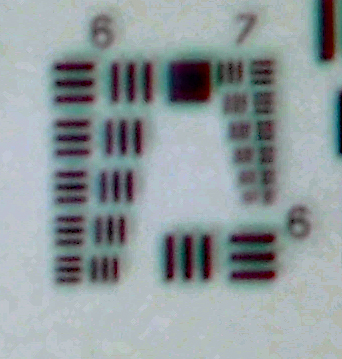 This is the SK APO 40/2.8 @ F4 Comparing the two I think the SK would with a better test rig be resolving very close to group 7 element 5 where are the Agfa might only make it to group seven element 4. given the differences in prices( second hand on ebay) the Agfa is a winner. 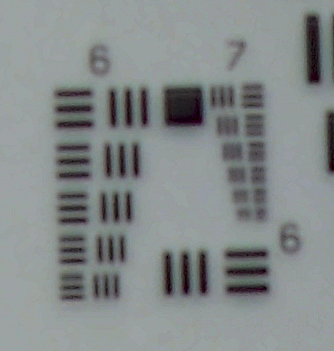 Note While the rig is tuned I will add a test shot from the AGFA F4. Here is that shot from the Agfa 80/4 also at 5.6. 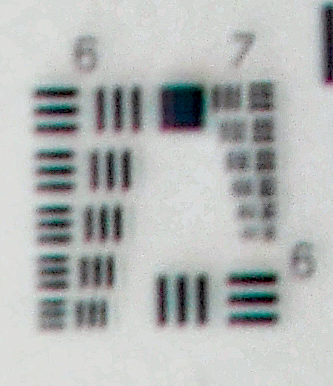 Edited by austrokiwi
05/10/2016 3:09 pm
|
|
Pillar of the Community
United States
4051 Posts |
Hard to compare with them being a different size.
Contact me for photographic equipment or visit my home page at: http://macrocoins.com |
|
Pillar of the Community
2087 Posts |
I recall pepactonius mentioning the oly 80mm bellows lens could out resolve other lenses at 1-1. I tried it just now. it resolves to about the same level as the Agfa and SK perhaps a little more. but what was really noticeable was the Chromatic aberration, just moving the focus too far one way would see the image turn red, and the other direction it would go green. This final shot has a purplish tinge which shows how different it is to the APO lenses( I am assuming the Agfa is APO). I know the other shots I have posted seem to have a slight red tinge but the Agfa 80mm process lenses and SK 40mm and 45 mm lenses are far better than the oly as far as CA goes. ( of course the PN 105mm beats them all) Oly 80mm at 5.6 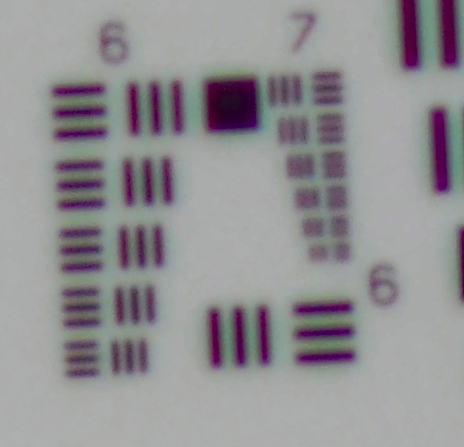 Edited by austrokiwi
05/10/2016 11:23 pm
|
| |
Replies: 67 / Views: 17,521 |





 First Page
 Previous Page


 Posted 03/14/2016 2:20 pm


