| Author |
 Replies: 716 / Views: 131,051 Replies: 716 / Views: 131,051 |
|
|
|
Pillar of the Community
 India
1996 Posts |
|
|
Pillar of the Community
India
1996 Posts |
|
|
Pillar of the Community
India
1996 Posts |
TRAVANCOREThis state located in the Southern tip of Indian peninsula has historic background stretching back to third century AD. Chera dynasty of that period had differing fortunes in their struggles with the Cholas and the Pandyas. It went partially under Vijayanagara empire until the defeat of the latter in 1565.AD. There were local Kings known generically as Kulasekhara Permals who were in constant struggle with the Muslim rulers and the Nayaks. By 1729.AD, Marthanda Varma established "Thiruvithamkur" that is known as Tranvancore. The name takes origin from "Thiruvazhumcode" meaning "abode of prosperity" in the local dialect. Marthandavarma established a stable state and ruled for 29 years. In that period, he dedicated his kingdom to God "Padmanabha" and called himself "Padmanabhadasa" meaning "servant of Lord Padmanabha". He and his descendants ruled the land on behalf of the Lord. This land had constant threat from Tipu sultan. That resulted in the state becoming an ally of the British and finally subsidiary to it. It is now mainly in the state of Kerala and parts went to the state of Tamilnadu. List of rulers -
1. Anizham Tirunal Marthandavarma-1 (1729-58)
2. Karthika Tirunal Ramavarma alias Dharmaraja (1758-98)
3. Balaramavarma (1798-1810)
4. Rani GowriLakshmi bhai (1811-1815)
5. Rani Gowri Parvathi Bhai (1815-29)
6. Swati Tirunal Ramavarma (1829-46)
7. Uthram Tirunal Marthandavarma (1847-1860)
8.Aayilyam Tirunal Ramavarma (1860-1880)
9. Visakham Tirunal Ramavarma (1880-85)
10. Sreemoolam Tirunal Ramavarma (1885-1924)
11.Rani Sethu Lekshmi Bhai (1924-31)
12.(Sree Chitra Tirunal Balaramavarma (1931-1947)
Precise identification of coins of the first ruler, Marthandavarma-I has not so far been successfully done.
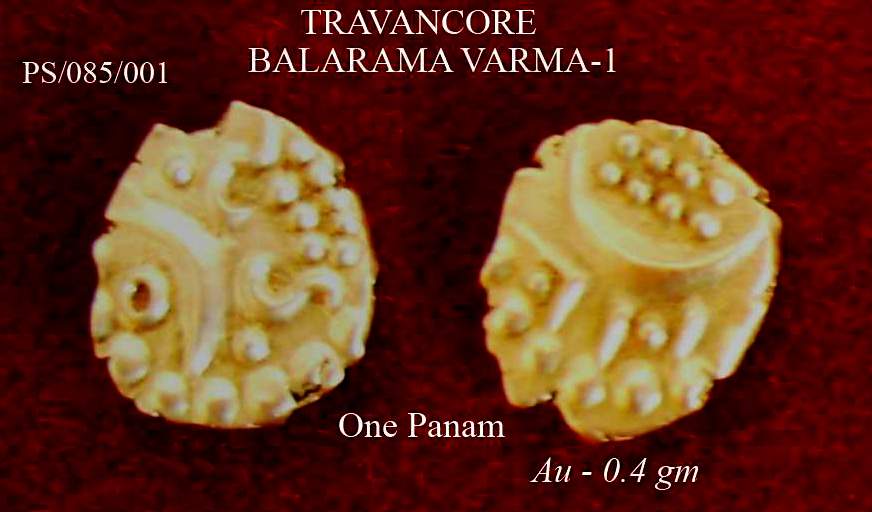
Symbols without any legend on either side is a striking feature of such coins. On the obverse, the symbol resembles "OM" in Devanagari, but some say it is a degenerated Tiger image. Reverse has some lines and dots arranged in a peculiar manner and a crescent. There are twelve dots seen inside that. They are supposed to represent "rasi" or the twelve zodiacal months in Malayalam era. These dots can be seen in the Dutch RASI coins issued for Cochin and on the "fanam" coins of South India.
Edited by drnsreedhar
12/17/2016 2:13 pm
|
|
Pillar of the Community
India
1996 Posts |
|
|
Pillar of the Community
India
1996 Posts |
|
|
Pillar of the Community
India
1996 Posts |
On this coin, there is the figure of a mythical five headed snake called "Ananta naga". It is believed that Lord Vishnu reclines on this snake. So this coin is known as "Pambu kasu" meaning "snake cash". 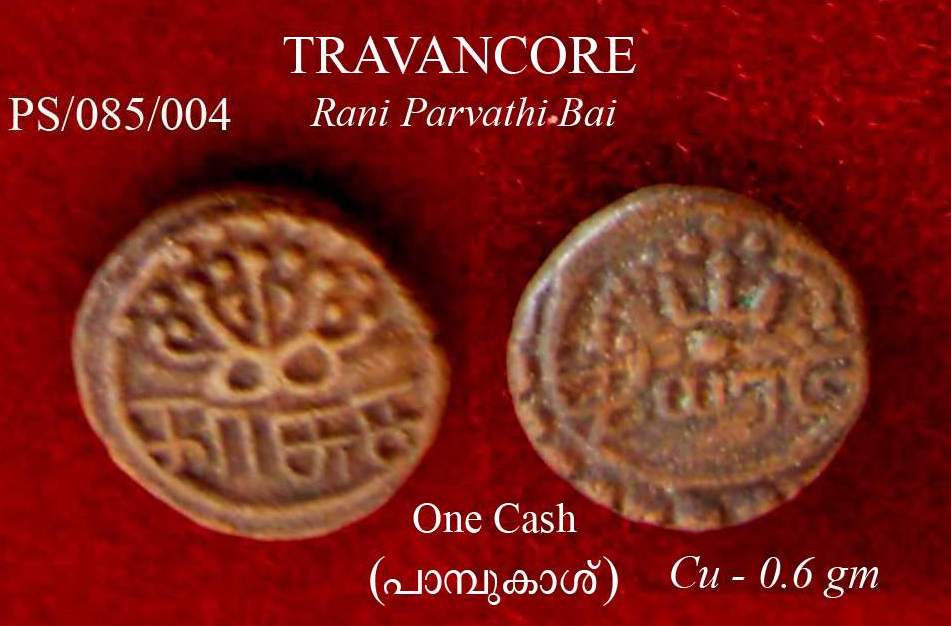 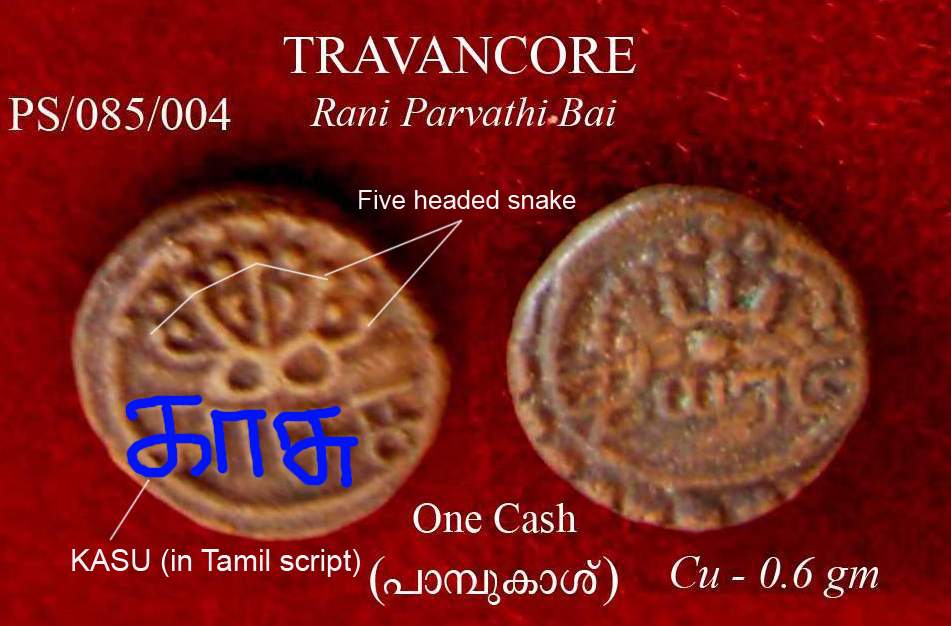 |
|
Pillar of the Community
India
1996 Posts |
A two cash of the same variety 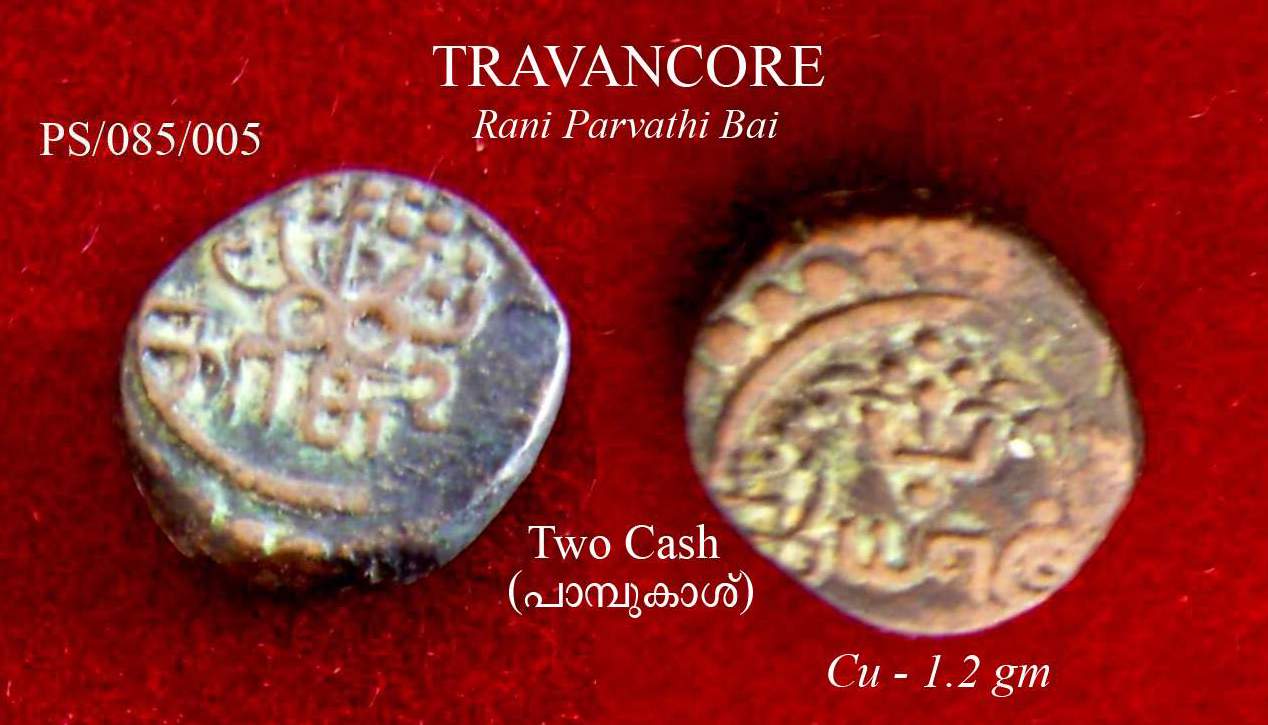 |
|
Pillar of the Community
United States
6130 Posts |
Very nice, Travancore is one of my favorite Princely States to collect.
Out of curiosity, do you know why nearly all of their coins (except for the bronze 8 cash and chuckram) are incredibly small? Did they simply have an abundance of silver compared to copper?
|
|
Pillar of the Community
India
1996 Posts |
@Finn235:)
Thank you for the post.
Your question is one that has been asked by most of Travancore coin collectors. And there is some reason behind.
Travancore area belongs to the extreme South of Indian peninsula lying like a ribbon on the Westerns coast.This area is socio-culturally related to Tamil area that occupied the land South of the present Karnataka and Andhra pradesh states. Their local dialect "Malayalam" has evolved from a form of Tamil and both Malayalam and Tamil languages share lots in common. Travancore has evolved from "Desinganad" that included present day Kanyakumari and parts of Tirunelveli districts of Tamilnadu. They ruled from "Kalakkad", now in Tamilnadu. so Tamilnadu influence is beyond segregation in culture and politics.
To add to this, this area had been under control of Cholas, Pandyas and Vijayanagara rulers at different times. Of this, Pandya influence is most pronounced. This happened from around tenth century. The local rulers were descendants of Chera dynasty and a local royal family known as "Ay" dynasty.
Pandyas are known to issue "kasu" that is "cash". That used to be very tiny coins in copper. This prevailed in this area for many centuries. By late sixteenth century, cash began to be produced in bronze/brass. Bronze/brass coin is locally called "tiraviyam", a word derived from the Sanskrit word "Dravya" meaning wealth. Those tiny copper cash was the precursors and prototypes for Travancore coinage after its formal formation in 1729. Tiraviya kasu was the only common transaction currency in those days. Their design (the figure struck on them to be precise) used to be changed every three years. So there is an abudance of such coins issued. When it came to trade, silver and gold were used to mint coins in the same pattern. That is why the "famam" (panam in local language) looks alike for Travancore, Tanjavoor, Kochi (Cochin),Coorg and Vijayanagar. Nayakas of Madurai, Tirunelveli and Nawabs of Arcot etc.. are some of the other examples who followed same pattern for some of their coinage. Barbara Mears and Beena Sarasan have brought lots of them to light.
So that is the background why early Travancore coins are tiny and without legends. when it came to milled coins later, they started growing in size.
Regarding availability of gold and silver, I have to say that they were in plenty. The dynastic temple of Travancore Kings, the Padmanabha swami temple in Trivandrum is world's largest treasury trove. Its value runs in multiple trillions of dollars. (In fact the total value could not so far becalculated). It was a custom during a King's coronation in Travancore to distribute gold coins equal in weight to the weight of the new ruler among dignitaries. The entire gold will be minted into presentation coins for this purpose. These coins are known as "Tulabharam" coins. I hope this helps.
|
|
Pillar of the Community
India
1996 Posts |
Here is a coin of Dharmaraja. This one belongs to Thirai kasu variety. 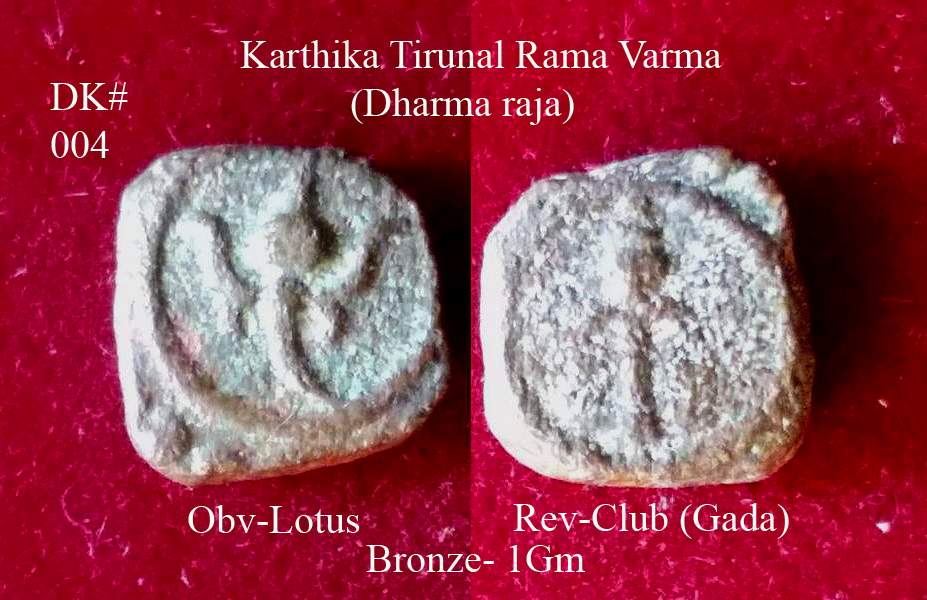 On one side, is a lotus. On the other, a club known as "Gada" is shown. There are several obv-rev combinations with same lotus and other symbols and club with other symbols. |
|
Pillar of the Community
India
1996 Posts |
Swati Tirunal Ramavarma (1829-46) Swati Tirunal Ramavarma holds a unique place in the history of Travancore. He was a renowned poet and composer who has a sizable lot of more than four hundred Karnatic and Hindustani style music compositions in several languages to his credit. Observatory in Trivandrum is his contribution. The famous ritual of "nawa ratri concerts" where eminent Karnatic musicians render concerts for nine days in worship of Goddess Saraswathi in his innovation. His compositions are sung on all the days. This has a fixed schedule and format. He lived only thirty three years but left behind his rich cultural and scientific contributions. 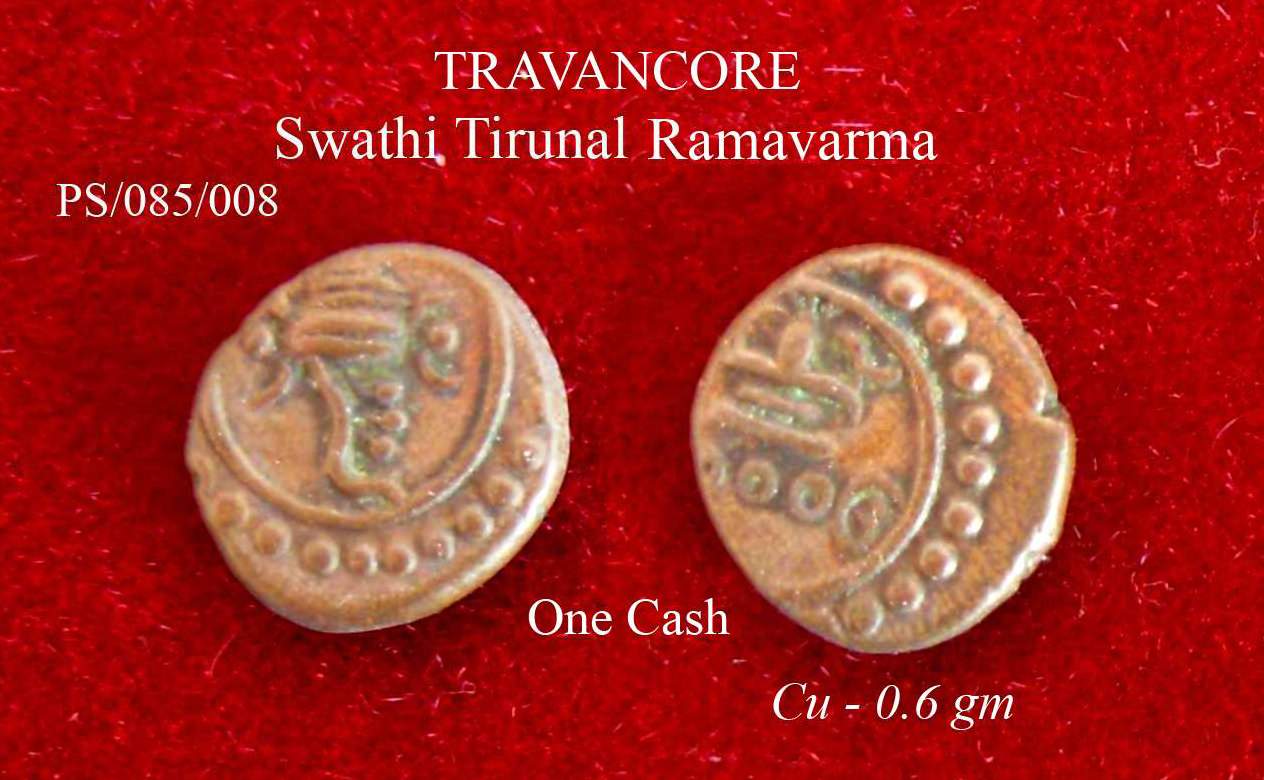 On the obverse there is a conch shell within a lined circle inside a circle of dots. On the reverse, there is figure of a "shiv linga" with date "1005" in Malayalam numerals all surrounded by a linear circle inside a dotted circle.
|
|
Pillar of the Community
India
1996 Posts |
Another variety of Swati coins 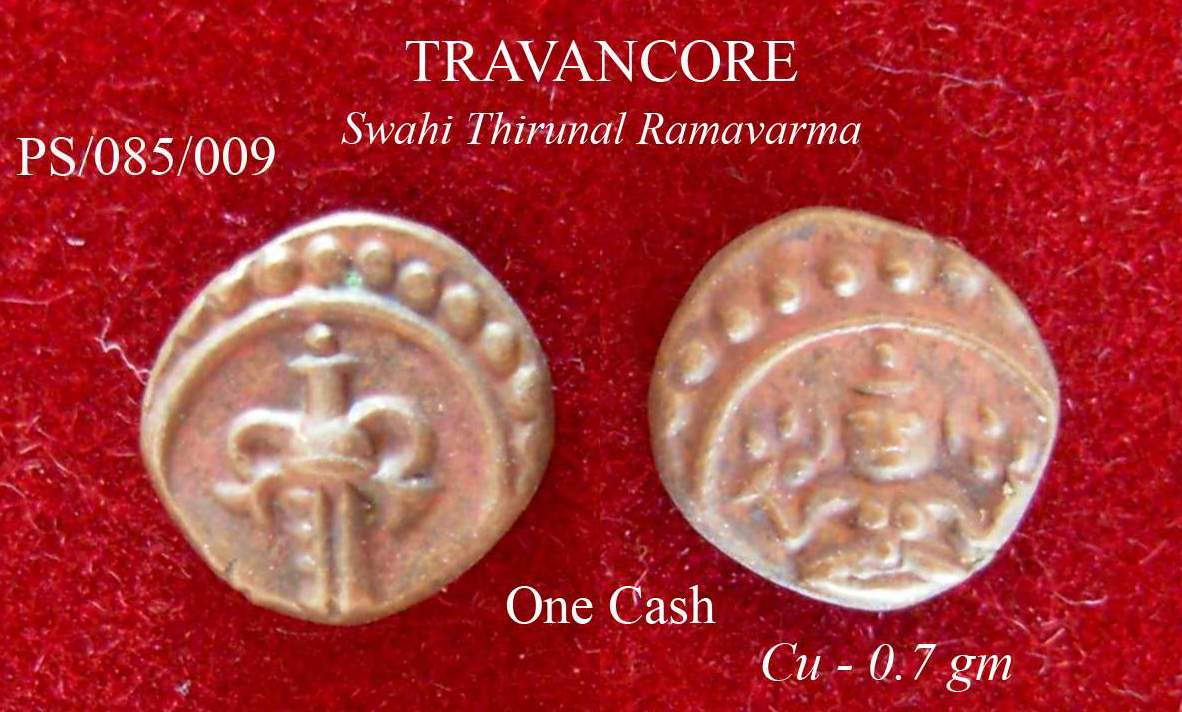 Obv: Seated female deity - represents Goddess Lekshmi Rev: Conch in stylised form. The top looks like the grip and pommel of a sword. |
|
New Member
Poland
13 Posts |
Do yuo help me with this coin? I think it is india ~3,3 g size: 16mm 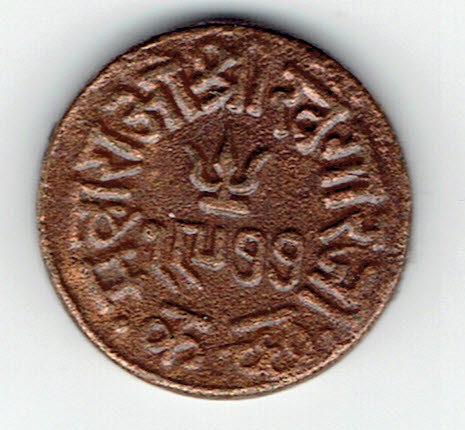 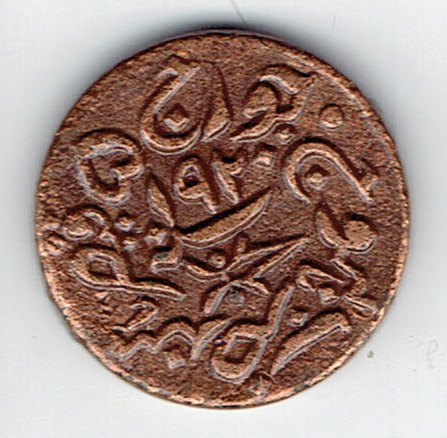 Edited by Jazon
01/03/2017 10:27 am
|
|
Pillar of the Community
India
1996 Posts |
|
|
New Member
Poland
13 Posts |
thanks a lot for explain :)
|
| |
Replies: 716 / Views: 131,051 |







 First Page
 Previous Page



 Posted 11/21/2016 2:09 pm