First Page
 Previous Page


 Posted 09/05/2018 11:37 pm


Hadleydog has my sentiments from page one much more effectively stated than me.
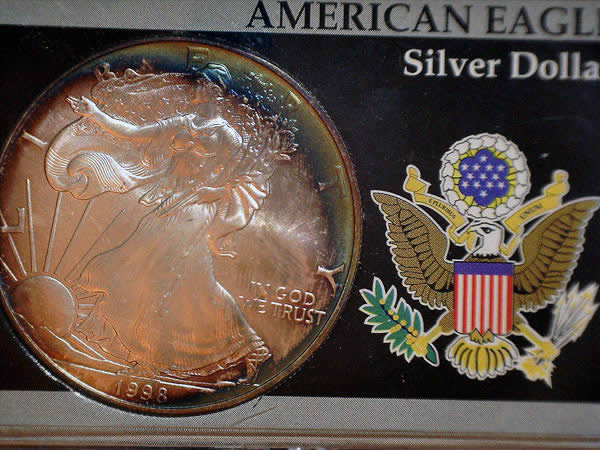
I am a "non-believer" when it comes to toned coins. I personally have seen only one truly rainbow toned example of an ASE, and that was one I bought at a local auction, sold off to Thedollarman in Canada. It was in a snapcase display, where apparently the ink and cardboard insert reacted very well over a few short years. Climate may have been humid Missouri weather, stored in a desk drawer. I can vouch it was a "natural" but I had to restrain everything in me to refrain from some tarnish remover! I have witnessed these "ink-toned" silver coins, mostly having a more encrusted look and turning blacker rapidly. Seems to speed up the process.
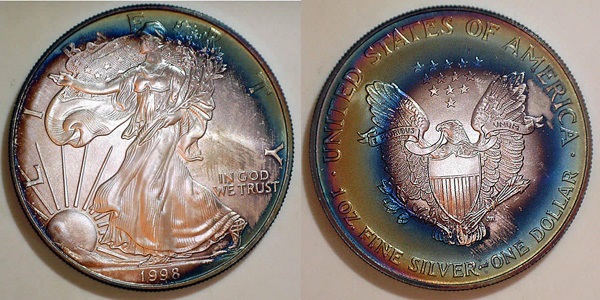
So, for the OP's benefit, here is a naturally toned 1998 ASE, purchased in 2017, not quite 20 years in the making with all "natural" influences. Here was the result:
Quote:
From the moment a coin is struck, and this applies to every single silver coin struck, the natural process of oxidation begins.....eventually leading to corrosion.
Some believe that by dipping a coin and making it all shiny and white again (by removing that silver oxide layer) they are restoring the piece back to how it came from the mint.
What they are really doing is stripping a small layer off the surface ( where do you suppose the silver in the silver oxide layer comes from). This exposes a new surface to the environment, and the process begins again (only faster now). Dip and strip. Not long before the luster becomes subdued, and the coin appears dull and lifeless.
The bottom line, all silver coins unless kept in a vacuum will eventually succumb to corrosion.
From the moment a coin is struck, and this applies to every single silver coin struck, the natural process of oxidation begins.....eventually leading to corrosion.
Some believe that by dipping a coin and making it all shiny and white again (by removing that silver oxide layer) they are restoring the piece back to how it came from the mint.
What they are really doing is stripping a small layer off the surface ( where do you suppose the silver in the silver oxide layer comes from). This exposes a new surface to the environment, and the process begins again (only faster now). Dip and strip. Not long before the luster becomes subdued, and the coin appears dull and lifeless.
The bottom line, all silver coins unless kept in a vacuum will eventually succumb to corrosion.
I am a "non-believer" when it comes to toned coins. I personally have seen only one truly rainbow toned example of an ASE, and that was one I bought at a local auction, sold off to Thedollarman in Canada. It was in a snapcase display, where apparently the ink and cardboard insert reacted very well over a few short years. Climate may have been humid Missouri weather, stored in a desk drawer. I can vouch it was a "natural" but I had to restrain everything in me to refrain from some tarnish remover! I have witnessed these "ink-toned" silver coins, mostly having a more encrusted look and turning blacker rapidly. Seems to speed up the process.
So, for the OP's benefit, here is a naturally toned 1998 ASE, purchased in 2017, not quite 20 years in the making with all "natural" influences. Here was the result: