| Author |
 Replies: 10 / Views: 1,569 Replies: 10 / Views: 1,569 |
|
|
Pillar of the Community
United States
751 Posts |
I'm curious and have 2 questions.
One-How long do you spend checking a coin for flaws or variations.
Two- What is the preferred method for initial checks, Hand help monocle, or under the scope ?
The reason I ask is I have a bucket with approximately 12,000 cents, dating from mid century Wheat to 2018 current issue.
Dan
|
|
|
|
Bedrock of the Community
United States
78220 Posts |
For me, since I am used to going through Lincoln Cents, it's usually maybe a couple of seconds. If I find something not normal, then I spend more time looking at that particular coin. To answer your 2nd question, I use a 10x loupe to examine the devices and fields of the coins. For picture taking, I use a Plugable USB microscope. I hope this is helpful in some way.
Errers and Varietys.
Edited by Errers and Varietys
01/17/2019 10:29 pm
|
|
Pillar of the Community
United States
2567 Posts |
If you are looking for minor imperfections, look at each one closely for a few seconds a side. I did that for a long time. But if you are looking for major errors like strike through or planche flaws, you should be able to see them with the naked eye. If you want to look for doubled dies there are a few sites you can use. Just so you know, a lot of them have little to no value above face. Also the doubled dies will take some time to look for depending on how easy they are to spot. http://varietyvista.comhttp://www.coppercoins.com/advsearch.phphttp://doubleddie.com/228401.htmlI use hand held! |
|
Pillar of the Community
 United States
751 Posts |
Yes, this is very helpful, I'm not too far off in my procedure. Thanks.
I mainly look for variations in errors for the novelty of it. Not really interested in making a big profit.
Dan
|
|
Pillar of the Community
5464 Posts |
That's a very generic question. Everyone is different. It depends on your experience. You look as long as it takes till you find the answer you're looking for. You shouldn't be under any time constraint, no matter how many coins your searching or looking at.
|
|
Moderator
 United States
56855 Posts |
I agree with EV,but I use a 14x jewelers loupe doublet. John1  |
|
Pillar of the Community
United States
2775 Posts |
I use a 10x jewelers loupe, but am ready for an upgrade. My minds eye typically makes a conscious effort to recognize the date and mint first. This may trigger a known variety or other things I might wish to slow down and examine closer for.
If nothing else peaks my interest, I'm usually in and out in under 2-3 sec. a coin.
So far I'm still not much interested in some newer designs. I'm still partial to what I grew up with. That said the newer designs is where the new variety discoveries will most likely be. Finding the small details takes longer than 2-3 sec.. Thanks, Doug.
Adding: the ease of using a microscope today for higher magnification can aid in finding the smallest irregularities.
Recall seeing a video concerning NGC grading practices. They all used nothing more than a 10x loupe in the process of grading a silver dollar.
Edited by Halo1st
01/18/2019 11:46 am
|
|
Pillar of the Community
United States
5240 Posts |
Only a few second per coin and that depends on the date and where it's minted. I use a lighted jewelers glasses and I really am interested I use an additional macro lense to really see up close.
|
|
Pillar of the Community
United States
559 Posts |
Usually only a few seconds unless I spot something that requires closer study. Best $20 I've ever spent. Led adjustable lighting & has interchangeable 2x to 25x lenses for both sides. Plus the optic can be removed to utilize whichever eye is better for you. Also keeps both hands free :) 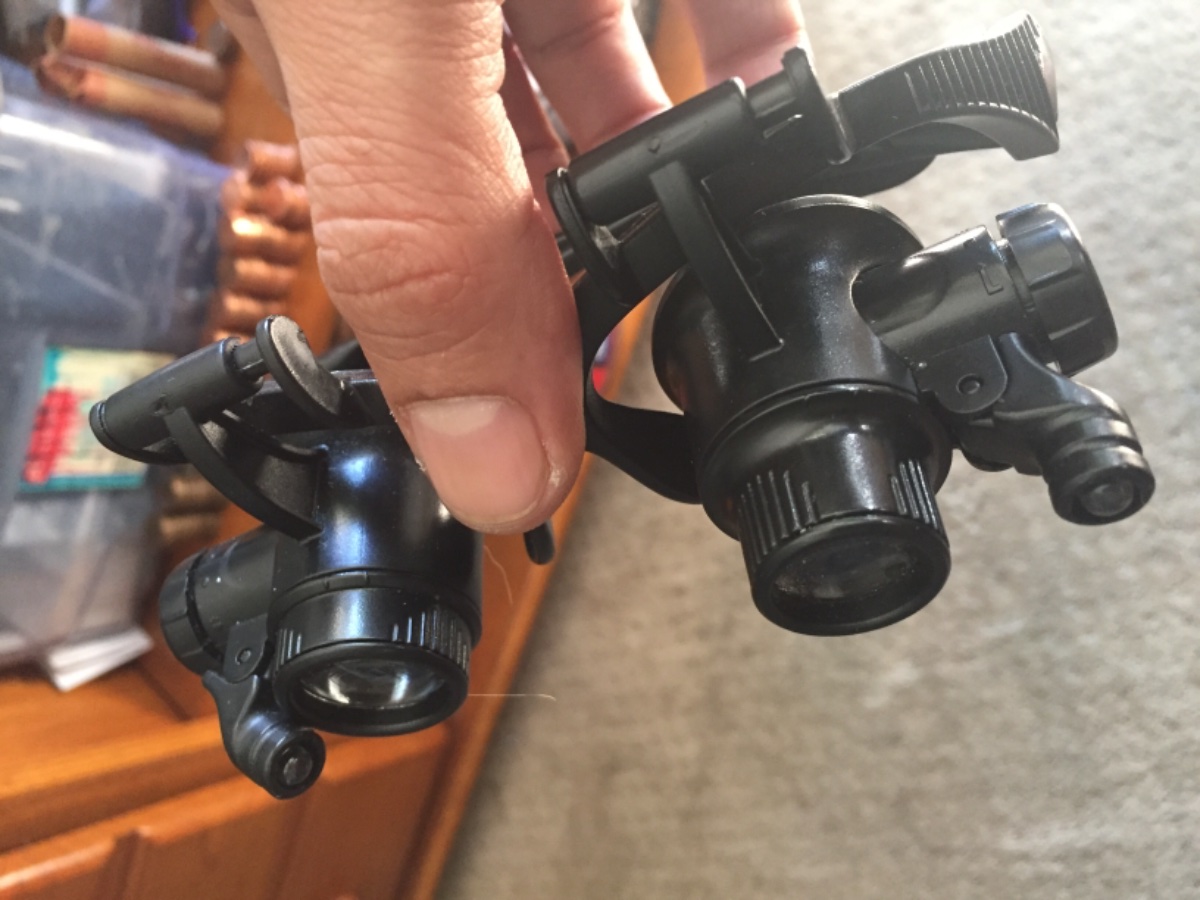 |
|
Pillar of the Community
United States
2376 Posts |
Dan , I search with a 10x jeweler loupe and if needed , a 14x.
It sounds like you have a broad range of dates to search.
If you don't mind a bit of advice
You should first separate your stash by date. Fill bags , boxes , tubes, whatever. Then go to the usual sites and familiarize yourself with the known varieties and listable errors of a date. Pull out that dates container and go through them.
Without realizing it , you will start recognizing what normal looks like for each date. This is actually just as important as knowing what a variety looks like because eventually, those two or three seconds the others refer to will make sense because those varieties you studied will pop out as different from the norm.
|
|
New Member
United States
22 Posts |
Stoneman- couldn't agree more. That is what I did. I remember saying this is going to be a waste of time. But in the end, breaking down the years and reviewing them all together, really does help you understand what each year can look like. Therefore making it easier to spot a variety.
|
| |
Replies: 10 / Views: 1,569 |
|









 Posted 01/17/2019 10:27 pm


