Money and PortugalWhile much can be written about the fall of the 2nd Republic (end of Estado Novo or the New State) , little is known about how "Currency" caused the fall of the 1st Republic and indirectly helped lead to the fall of the 2nd.
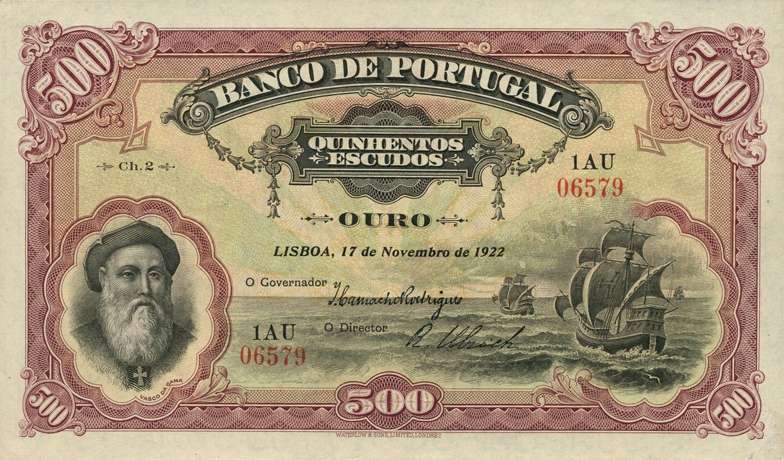
In 1924 Alves Do Reis a Portuguese embezzler and counterfeiter hatched a plan to make fake 500 escudo notes. It consisted of forging a contract in the name of Banco de Portugal (Bank of Portugal)—the central bank, responsible for issuing banknotes and partly private at the time—authorizing him to print banknotes in return for an alleged loan from a consortium to develop Angola. His plan was to use the contract to convince a legitimate banknote printing contractor to make the notes, thereby obtaining notes that would be indistinguishable from those legitimately authorized by the bank.
And while the plan almost fell apart a few times (for example the printer Waterlow and Sons Limited sent a letter to the Bank of Portugal to confirm the printing and the letter was lost), he was successful. He was able to have Waterlow print 200,000 banknotes of 500 Portuguese escudos (which was equivalent to 0.88% of Portugal's nominal GDP at the time) with an image of Vasco da Gama, with the date of 17 November 1922, to a total face value of 100 million escudos. There were almost as many false 500 escudos banknotes as real ones. First delivery was made in February 1925, one year after the real 500 escudo banknotes with the image of Vasco da Gama began to circulate.
This much extra money caused a small economic boost to the economy. And while there were inklings that there was counterfeit money in the economy no could prove it since the notes were not actually in the sense counterfeit as the printer used the same plates. But Alves was eventually caught as the serial numbers of the duplicates actually ran into what was "really" printed by the Bank of Portugal.
Eventually Alves was caught and sent to jail, but as the 1st republic already had issues, many people believed that the "Portuguese Bank Note Crisis" was actually caused by the Government. The Portuguese Bank Note Crisis eventually led to the end of the 1st republic and the creation of the Estado Novo. Reis was released in 1945 and died in 1955 a pauper.
One of the "counterfeit" bank notes:
Since we learned how a bank note caused the start of the 2nd republic, we will learn how another bank note eventually caused the start of the 3rd republic.
While Estado Novo wasn't purely tyrannical, vast parts of the economy were managed by families (such as banking, transport, manufacturing, beer, etc), there was a dissatisfaction with the economic conditions in Portugal compared to the rest of Europe. And while Salazar opened up the economy in the late 50's and caused the median GDP of Portugal to grow at a fast rate, the country was behind many others.
As also one of the last holders of colonies (especially Angola and Mozambique) the European community had issues with Portugal. When the colonies started rebelling an unpopular war was started. Several army captains realizing that this was a chance to abolish the 2nd republic hatched a plan so audacious that it was expected to fail (but so few knew about it that a risk was taken).
Hermínio da Palma Inácio (1922, Lagoa, Faro District - 2009) was a Portuguese revolutionary against the Salazar dictatorship. While he is most famous for hijacking an airplane in 1961 Morocco, forced it to fly over Lisbon dropping leaflets calling for free elections. He then allowed the plane to return to Morocco, apologized to the passengers, presented all the ladies on board with a rose, and then vanished only to reappear 6 years later.
In 1965 Portugal had printed new 1000 escudo note and had shipped them to the Banco Do Portugal treasury in Figueira Da Foz. On May 17, 1967 Herminio with a group of revolutionaries invaded Banco de Portugal's agency in Figueira da Foz and were able to get away with 29 million escudos in banknotes. They were able to get 1965 1000 Escudo Notes:
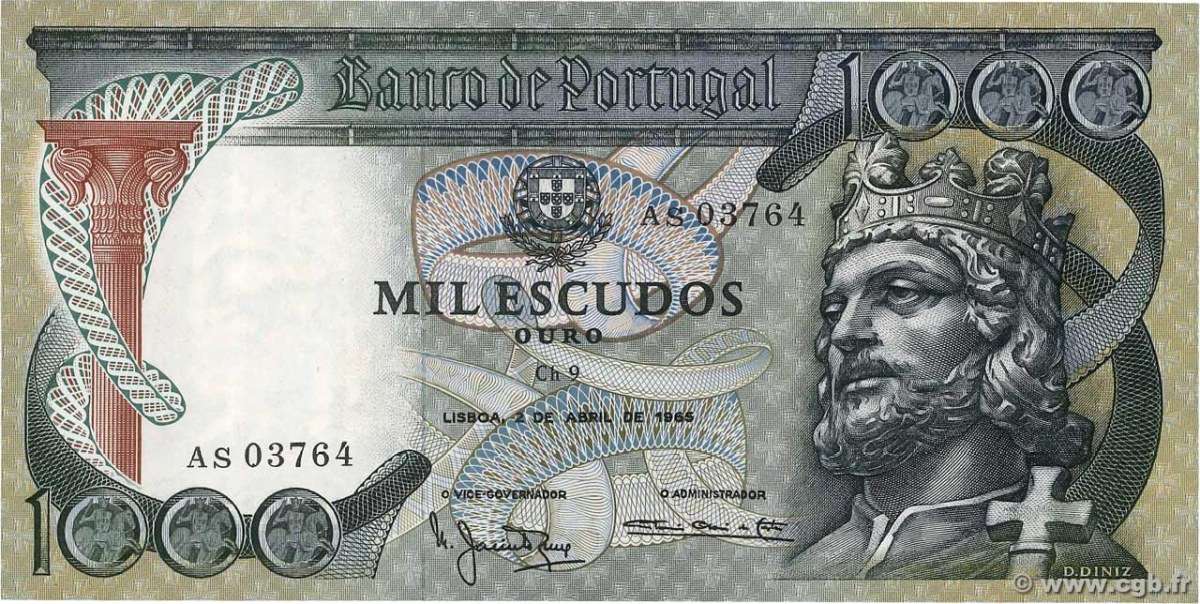
The notes were eventually moved to Bragançã and helped in the financing of the 1974 revolution. While at the time Herminio was considered a traitor, Mário Soares, who became the President in the 3rd Republic gave him the Order of Liberty , a high Portuguese honor that distinguishes important services to the cause of democracy and freedom, in the defense of the values of civilization and human dignity.
This brings us to one of my favorite notes from Portugal
Two days after the bank robbery, in order to prepare for the withdrawal of the banknote types that had been robbed, the General Council of Banco de Portugal decided that 12 million notes of 1,000 escudos already in possession of the bank, should be rapidly finalized for its first issue.
By the end of that troubled month of May, the first banknotes of 1,000 escudos featuring Queen Maria II were thus put in circulation much ahead of what had been expected.
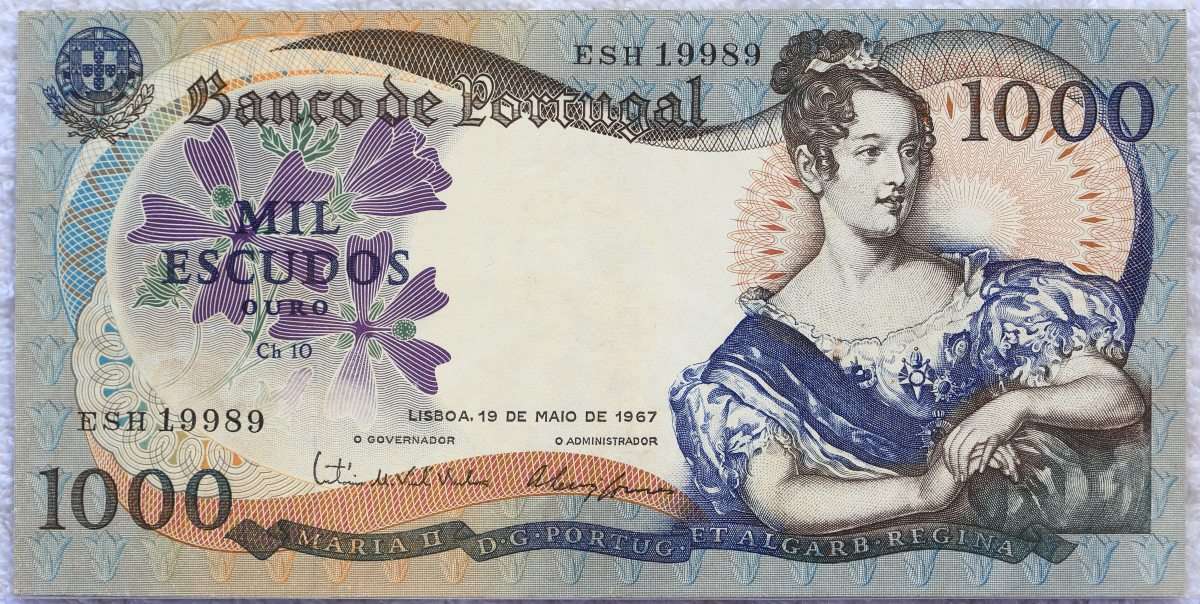
Of the 3 notes presented, only the last one (1967 1000 escudos) is mine, the other 2 are rarities and are costly.








 First Page
 Previous Page


 Posted 10/24/2021 6:31 pm