|
This page may contain links that result in small commissions to keep this free site up and running.

Welcome Guest! Registering and/or logging in will remove the anchor (bottom) ads. It's Free!
To participate in the forum you must log in or register. | Author |
 Replies: 5 / Views: 1,361 Replies: 5 / Views: 1,361 |
|
|
Valued Member
Australia
215 Posts |
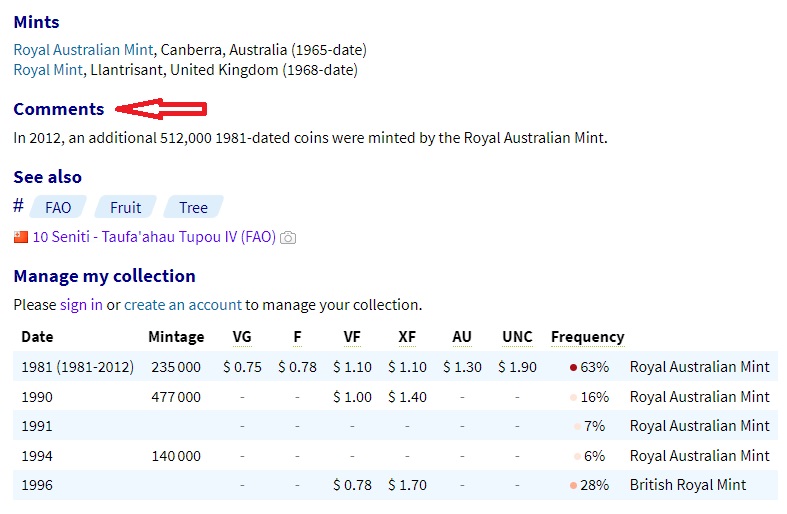
Apparently the Royal Australian Mint minted 235,000 Tongan 10 seniti coins in 1981 and another 512,000 coins in 2012 (also dated 1981).  Any idea why and if you can tell them apart? |
|
|
|
Pillar of the Community
Australia
1985 Posts |
I have no idea why the RAM minted 1981 dated coins in 2012 but earlier Tongan coins were cupro-nickel while the later ones are nickel plated steel so I believe the 2012 minted coins will be magnetic while the ones minted in 1981 are not.
|
|
Valued Member
 Australia
215 Posts |
Quote:
I believe the 2012 minted coins will be magnetic Thanks MMM, they certainly are.  I guess that means the RAM used the old 1981 dies but the new plated steel planchets. |
|
Pillar of the Community
Australia
3837 Posts |
Can't find this in numista
|
|
Pillar of the Community
Australia
1366 Posts |
|
|
Moderator
 Australia
16954 Posts |
As for "why didn't they just put the 2012 date on them", I can think of several possible hypotheses. But they all point to a decision by the Tongan government itself, rather than a decision by the RAM. The RAM wouldn't have deliberately chosen not to give its own employees more work in creating new dies. So the coins bore the 1981 date because the Tongan government requested they bear the 1981 date. So the question becomes: Why might the Tongan government have done that?
- To save money. They presumably had a master die with a "199_" date, and another with a "200_" date. "201_"-dated coins would require a new master die, and the Tongan government didn't want to pay for that.
- To try to hide the fact that new coins were being made when those coins only had a very limited life expectancy. Inflation made the old coins loss-making to produce, and Tonga at the time was in the process of withdrawing and replacing its entire coinage series, which they did in 2015. Perhaps they ran out of coins quicker than expected and needed a new batch, but weren't ready to launch their new coins yet. Issuing coins that are doomed to be withdrawn in a couple of years or so has been seen to be "wasteful", and thus something worth hiding. For example, this is the reason why no Australian predecimal coins are dated "1965", despite a great many coins actually being made in 1965: they'd already announced the planned withdrawal date, so making more of them would have been seen by the public as "wasteful".
- Perhaps tourists and collectors kept "stealing" their new coins, forcing them to order more coins, so they deliberately made more "old" coins in the hopes the collectors wouldn't take them. America did this in the 1960s, with their "frozen date" 1964 coins struck in 1965 and 1966.
- In 2012, Tonga had a change of monarch. Perhaps they'd ordered a batch of coins before the king died, then the king's death meant the old designs were no longer appropriate, or perhaps they simply needed a batch of coins before the new monarch's coins could be designed.
Don't say "infinitely" when you mean "very"; otherwise, you'll have no word left when you want to talk about something really infinite. - C. S. Lewis
|
| |
Replies: 5 / Views: 1,361 |
|
To participate in the forum you must log in or register.
Disclaimer: While a tremendous amount of effort goes into ensuring the accuracy of the information contained in this site, Coin Community assumes no liability for errors. Copyright 2005 - 2026 Coin Community Family- all rights reserved worldwide. Use of any images or content on this website without prior written permission of Coin Community or the original lender is strictly prohibited.
Contact Us | Advertise Here | Privacy Policy / Terms of Use
|
| Coin Community Forum |
© 2005 - 2026 Coin Community Forums |
| It took 0.41 seconds to rattle this change. |
 |
|
| |
| |





 Posted 11/07/2022 12:44 am