The Century of Progress International Exposition (CPIE) was held in Chicago, IL on the shores of Lake Michigan. The CPIE was Chicago's second World's Fair - the first was the World's Columbian Exposition in 1893. From its name, it would be expected that the CPIE celebrated Chicago's history over the previous 100 years, but it was actually more about Chicago's (and by extension, the nation's) hopes for the future and the benefits of modern-day life.
The roots of the CPIE date to 1921 and Chicago's pageant of Progress that was held at the city's Municipal Pier. Though it was staged for just two weeks, the Pageant drew one million+ visitors and served as the catalyst for local business and civic leaders to organize with the goal of developing a major Exposition in the city - a goal they achieved.
The Exposition enjoyed a 1933 season and a 1934 season. In 1933, the Fair opened on May 27 and closed on November 12. In 1934, it opened on May 26 and closed on October 31. Approximately 22.5 million people attended the 1933 session; approximately 16.3 million attended in 1934; ~38.8 million total attendance.
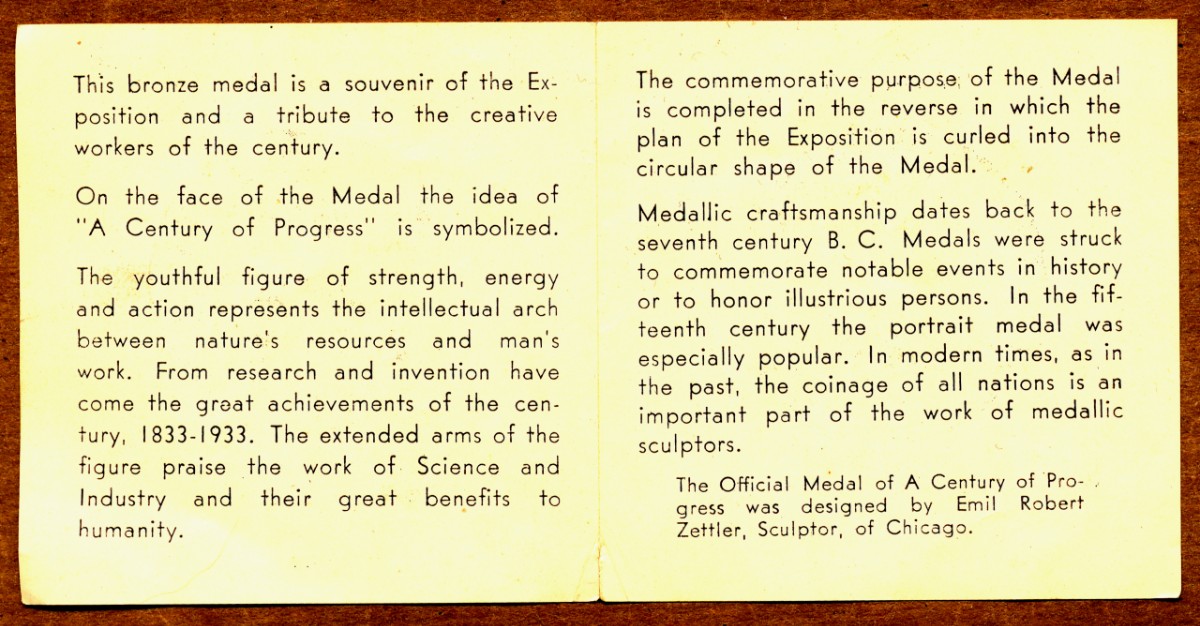
The medal's obverse depicts a symbolic representation of "A Century of Progress." It presents a young male figure, with outstretched arms and legs; he is unclothed except for a stylized cloth across his mid-section. He has one leg planted on a column marked "Research" and "1833" and the other on the "Industry" and "1933" column; he is shown looking toward the "Research" column. The design is meant to symbolize how the inventions of the past have yielded modern (circa 1933) achievements.
1933 Century of Progress Official Medal
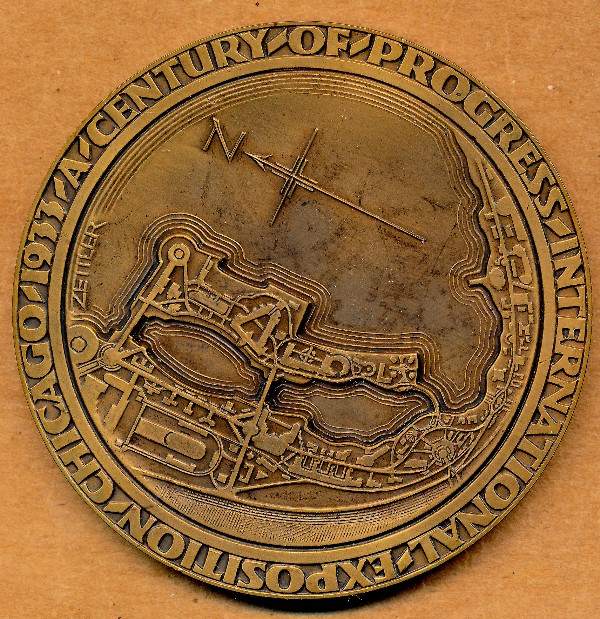
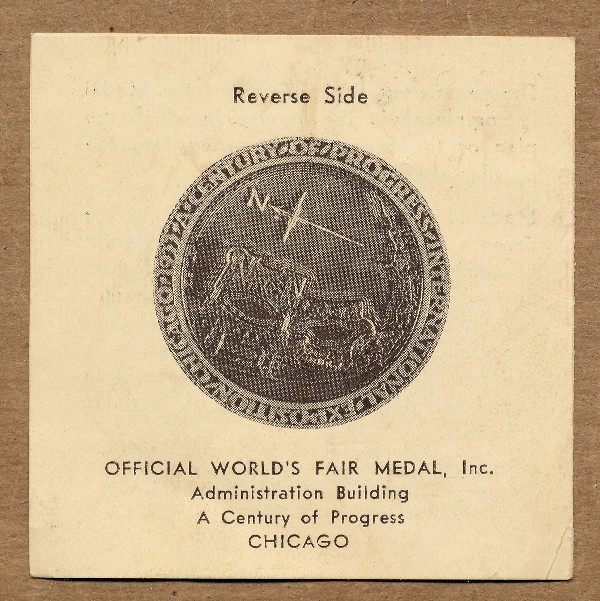
The reverse of the medal presents an overhead view of the Exposition grounds along Lake Michigan, with the arrow of a compass added over the lake to indicate the direction og "North."
The medal was designed by Emil Robert Zettler of Chicago; he was a noted artist/sculptor who won multiple awards for his sculpture prior to the CPIE commission. In addition to his busts and life sculptures, he also became noted for his many architectural ornamentation works.
Zettler was born in Germany on March 30, 1878 and emigrated from Germany to the United States, with his family, when he was four. He attended Chicago public schools in his youth, and later studied at the School of the Art Institute. In 1905, he traveled to Europe/Germany to hone his skills at the Royal Academy of Berlin. He returned to the US a more accomplished artist and soon began exhibiting his work across the country; he regularly won awards for his sculptures. Many of his professional art commissions in the 1920s and 1930s involved pieces that were used to adorn buildings, such work slowed in the 1930s due to the Great Depression. During the same period, he also taught art at Chicago schools; he retired in 1943. Zettler died on January 10, 1946.
A great overview of Zettler's life and career can be found here:
-
Emil R. Zettler: Artist, Teacher, and Creator of Architectural Ornamentation The nedal was produced in three sizes: 38 millimeters, 57 mm and 70 mm. (I have presented my 57 mm medal here.) In 1934, medals of the same design had "1934 / EDITION" added to the compass on the reverse. The small medals came in two-piece boxes, with the bottom tray wrapped in gold paper and the lid in black. The larger medals were delivered in a hinged case; the case is mostly black with some gold trim on the bottom/tray portion.
The dies for the medal were created by the Medallic Art Company (MACO) of New York. MACO also struck the medals; the 1934 medals had the "1934 / EDITION" inscription added by Crowe Name Plate and Manufacturing Company of Chicago.
1934 Century of Progress Official Medal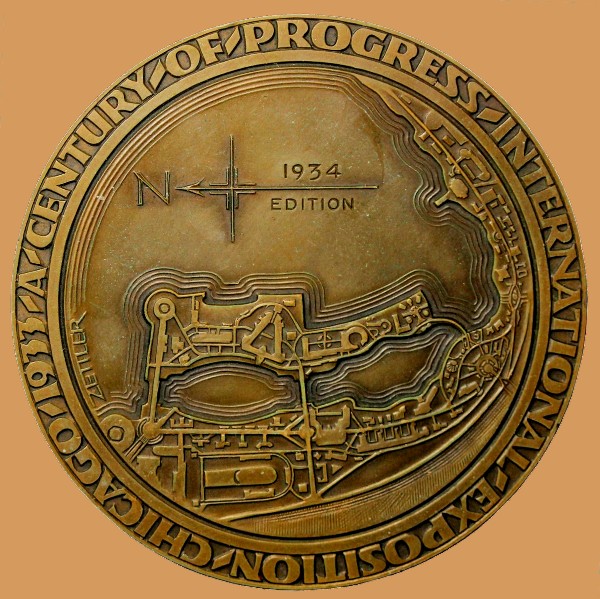 1833-34 Century of Progress Official Medal Leaflet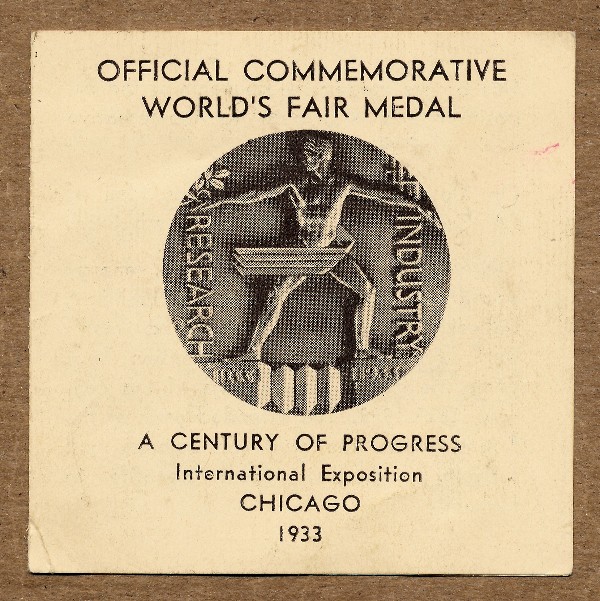
More information on the Exposition can be found here:
-
Century of Progress ExpositionFor other of my topics on commemorative coins and medals, including more Medal stories, see:
Commems Collection.







 Posted 12/11/2022 10:15 am





