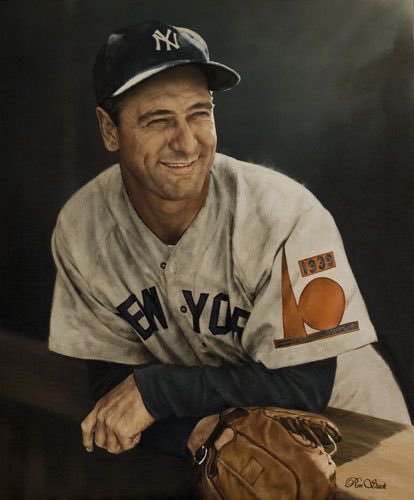
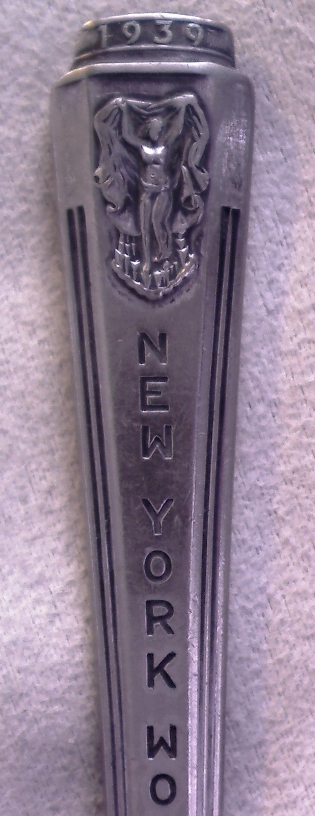
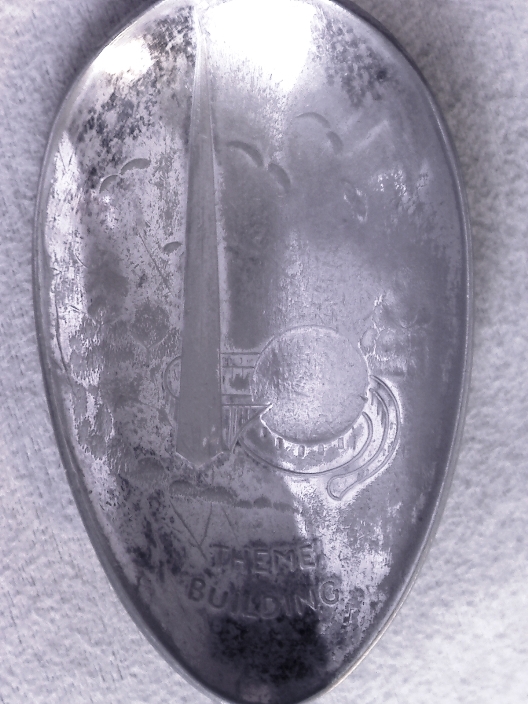
In 1939 and 1940, a World's Fair was held in Flushing Meadows, Queens, New York City. In 1939 it operated under the theme of "Building the World of Tomorrow" (i.e., a look at what the future might look like vs. a celebration of recent/existing technological advancements - as did other Fairs that preceded it)) and also aligned itself with first US President, George Washington. The Fair opened on April 30, 1939 which was the 150th anniversary of Washington's inauguration; Washington was inaugurated at Federal Hall in New York City (the nation's capital at the time) in 1789.
Statue of George Washington at 1939 New York World's Fair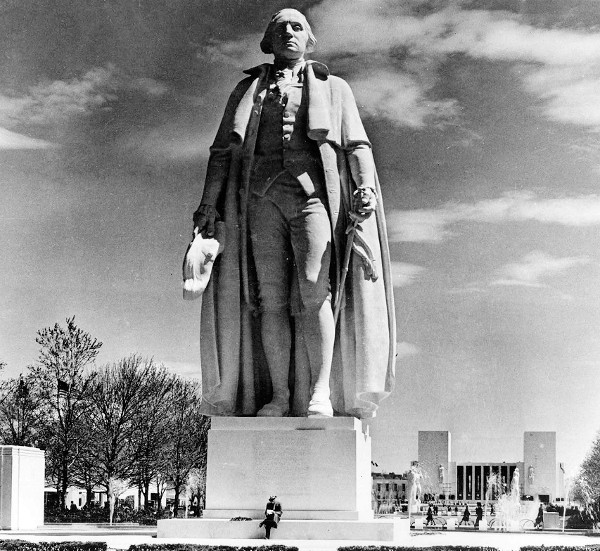 (Image Credit: Tomorrow's World: The New York World's Fairs and Flushing Meadows Corona Park. Arsenal Gallery. 2014. Fair Use; education.)The colossal statue of Washington was created by Jame Earle Fraser; it was 60 feet tall and stood in front of the US Government Building. It depicted Washington as he arrived for his inauguration in 1789.
The Fair had two seasons: April 30, 1939 to October 31, 1939 and May 11, 1940 to October 27, 1940 - both prior to the US formally joining World War II. (In 1940, with Germany on the offensive in Europe and the war theater expanding, the Fair adopted a theme of "For Peace and Freedom.")
US President Franklin Delano Roosevelt was on hand to officially open the Fair in 1939 with a speech. With a bit of in-the-moment hyperbole, he stated:
"From henceforth in our history the thirtieth day of April will have a dual significance: the Inauguration of the First President of the United States, which began the Executive Branch of the Federal Government, and the opening of the New York World's Fair of 1939." I would argue that the date is more recognized as the Washington's first inaugural date vs. the Fair's opening date.
The 1939 New York World's Fair was conceived in 1935, with the ensuing years used to plan, construct and promote it. The Fair was built on approximately 1,200 acres of land that were formerly an ash dump. Exhibits were mounted by 60 participating countries and more than 20 States, plus multiple Departments of the US Federal Government and New York City. Also exhibiting were multiple corporations (such as General Motors, Ford Motor Company, Du Pont, Eastman Kodak, Westinghouse, General Electric, IBM and AT&T - to name just a few) and various civic organizations (for example, Boy Scouts, the Young Men's Christian Association (YMCA)). The Fair also included educational pavilions and exhibits, amusements and live entertainment venues.
Over its two seasons, over 40 million people attended the Fair. Despite these attendance numbers, the Fair was not a financial successful, and its corporate management company ultimately filed bankruptcy. It was, however, a milestone event in US-based World's Fair history.
Matthew Joseph Merritt (D-NY), a multi-term member of the House of Representatives, was nothing if not persistent in his pursuit of securing a coin bill on behalf of the Fair. He introduced bills calling for a commemorative piece in 1936 (74th Congress, Second Session)), 1937 (75th Congress, First Session) and two in early 1939 (76th Congress, First Session). The bills sought "50-cent pieces in connection with the world's fair to he held in the city of New York, State of New York, in 1939, in commemoration of the one hundred and fiftieth anniversary of the inauguration of the first President of the United States of America and of the establishment of the Federal Government in the city of New York."
None of the bills specified a US Mint facility limitation or a maximum mintage (or a minimum) for the coin, just that the United States Commissioner General for the New York World's Fair, the coin's sponsor/beneficiary, could obtain the coins "in such numbers, and at such times as they shall be requested" and that "all proceeds shall he used in the furtherance of the New York World's Fair projects." Such language opened up the coin program to be one of the multi-mint/multi-year variety - P/D/S coins in 1939 and 1940 would have been an almost certainty IMO.
Each of the bills was referred to the House Committee on Coinage, Weights, and Measures but none of them were reported out or further considered in the House; each died with the adjournment of its respective Congress. Merritt's last bill was introduced on March 9, 1939. Sensing an outcome along the lines of the previous bills, the Fair 's Executive Board voted to proceed with a privately-struck official medal just a few weeks later (as noted on the medal's reverse - mislabeled as a token.)
The oval, silver medal was designed by Henry Kreis and struck by the Medallic Art Company. Kreis was the artist/sculptor responsible for the 1935 Connecticut Tercentenary half dollar.
1939 Official Medal of New York World's Fair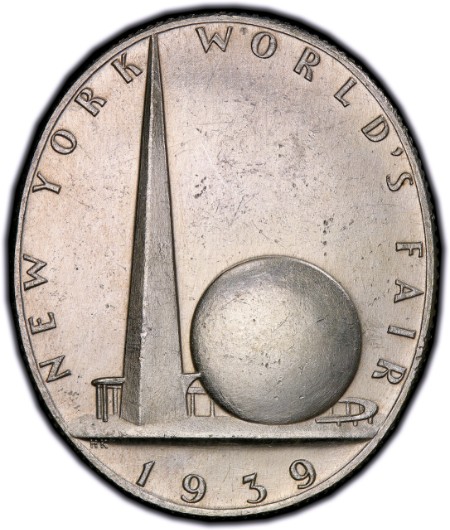
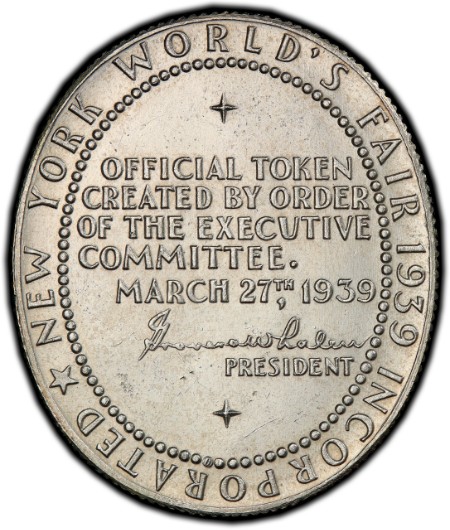 (Image Credit: PCGS CoinFacts)
The medal features the two most iconic architectural features of the Fair - the Trylon and Perisphere. (The same structures were featured on the commemorative US postage stamp.) I don't yet own one of these attractive oval medals, but its on "the List."
1939 US Postage Stamp for New York World's Fair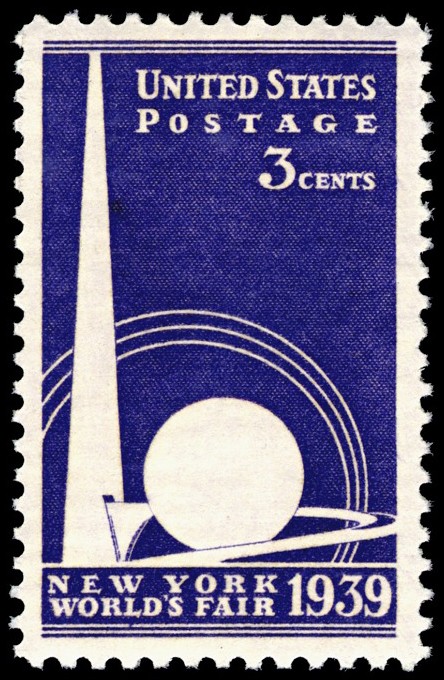 {Image Credit: National Postage Museum. Fair use, education.)
For more of my topics on commemorative coins and medals, including many more What If? stories, see:
Commems Collection.







 Posted 03/04/2023 09:22 am