As the American Silver Eagle (
ASE) is a popular coin to collect, I thought I'd stray from my commemorative coin focus and discuss a lesser-known aspect of the coin series that might be of interest to some...
In talking with collectors over the years, I've found that many do not realize the origins of the coin / how it came to be authorized. The roots of its story can be traced to decades before the first Silver Eagle was struck!
Our story begins with the establishment of the US Strategic and Critical Minerals Stockpile in 1939 via Public Law 76-117. The language of the Act stated its purpose as:
"To provide for the common defense by acquiring stocks of strategic and critical materials essential to the needs of industry for the manufacture of supplies for the armed forces and the civilian population in time of a national emergency, and to encourage, as far as possible, the further development of strategic and critical materials within the United States for common defense."
So, a move driven by the needs of the military.
The governing provisions of the US Strategic Stockpile have been updated over the years, as conditions warranted, but silver was consistently included and was a part of the stockpile for decades. Some of its silver was acquired in the market, some via transfer from the US Treasury. For example, in June 1968, the Treasury transferred 165 million troy ounces of silver to the stockpile per the direction of Congress.
During the 1970s, the tide turned against silver as a critical resource that needed to be stockpiled. As a result, the Government began exploring ways to reduce its immense silver stockpile. For example, the silver-clad collector versions of the 1971-78
Eisenhower dollars and the silver 1982 George Washington Birth Anniversary Half Dollar each made use of silver from the stockpile.
In the fall of 1981, the General Services Administration (GSA) held a series of auctions for silver from the US' Strategic Stockpile. Each weekly auction made 1.25 million troy ounces of silver available to the marketplace; the minimum lot size for prospective buyers was eight 1,000 ounce bars (8,000 ounces total); bidders could place bids for larger lots or for multiples of 8,000 ounces at various bid prices. The auctions were not structured for the average individual who wanted to speculate in silver - though most weeks bids were received from individuals looking to "steal" silver at prices significantly below market.
Prior to the start of the auctions, it was expected that the full allotment of 1.25 million ounces would be sold each week. The actual results were quite different - not one of the nine auctions held sold the full amount available. In fact, only four of the nine auctions received bids high enough to have any of the silver awarded. Congress stepped in and stopped the auctions in December 1981; at that point, just two million ounces of a potential 11.25 million had been sold.
So, with the auction approach not achieving the desired results, Congress began exploring other avenues. One option that gained traction was that of a US silver bullion coin. Standalone bills for gold and silver coins were introduced in the Senate and House of Representatives during the time the Statue of Liberty - Ellis Island coin bill was being considered. The standalone bills did not progress, however, and backroom threats pointed to potential objections to the Statue of Liberty - Ellis Island coin program if reciprocal support for the gold/silver coin bills was not forthcoming.
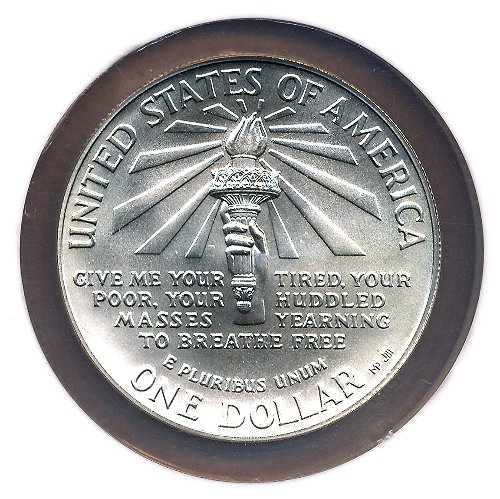
During discussions of the 1986 Statue of Liberty - Ellis Island commemorative coins, the draw down of the Strategic Silver Stockpile issue came to the forefront and a compromise was worked out that ensured the commemorative coin program would not face objection if a silver bullion coin program was amended to its bill.
Many in Congress believed it was time for the US to enter the bullion coin market (domestic and international) and by adding a silver bullion coin to the "sure thing" Statue of Liberty - Ellis Island commemorative coin program, success was at hand.
Senator James McClure (R-ID) introduced the silver bullion coin amendment to the Statue of Liberty coin bill and it became part of the bill that was passed by Congress and signed into law by US President Ronald Reagan.
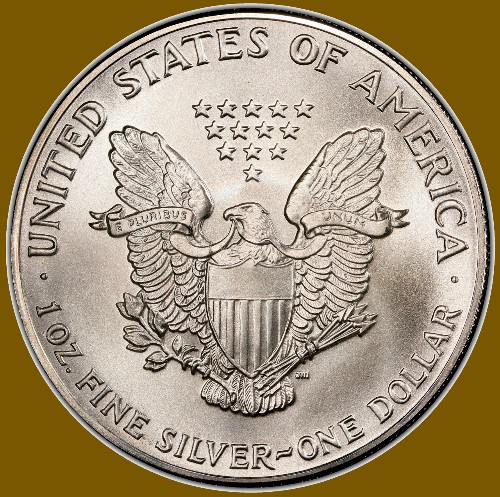
Note: In the legislation that enabled it, the silver bullion coin was referred to as the "Liberty Coin" -- it would later take on the name of "American Silver Eagle."And that's a brief overview of how the American Silver Eagle came to be - and how it is related to the 1986 Statue of Liberty - Ellis Island commemorative coin program. The Silver Eagle has been a collector favorite ever since!
1986 Statue of Liberty - Ellis Island Silver Dollar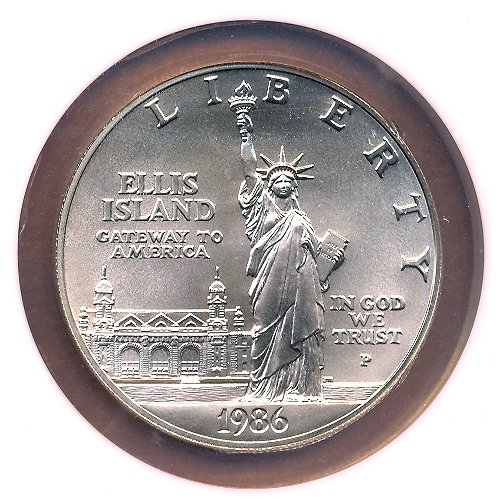
 1986 American Silver Eagle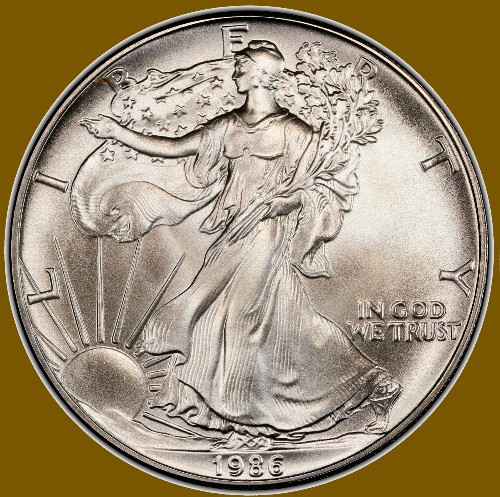
For other of my posts about commemorative coins and medals, including more What If? stores from the classic and modern eras of US commemorative coins, see:
Commems Collection.







 Posted 10/24/2023 09:52 am





