| Author |
 Replies: 13 / Views: 1,765 Replies: 13 / Views: 1,765 |
|
|
Moderator
 United States
54297 Posts |
Can a Lincoln Cent Woody be "woody" On Just One Side? I know I haven't seen every woody Lincoln Cent there is, but the ones I remember seeing are woody through and through (both sides show the improper alloy mix attributes). Show your financial support of the Coin Community Family (click here)See my topic on Mexican Numismatic Medals (click here) |
|
|
|
Bedrock of the Community
United States
19552 Posts |
Yes, in my experience--certainly they can be very visible on one side, and difficult to discern on the other.
|
|
Bedrock of the Community
United States
94367 Posts |
I'd have to agree with that, odd as it seems.
|
|
Moderator
United States
195203 Posts |
I will concur.  |
|
Pillar of the Community
United States
2689 Posts |
|
|
Moderator
Australia
16983 Posts |
The "wood-grain effect" is caused by a combination of two different effects: improper mixing of the alloy causing slight localized differences in composition across the coin's surface, and the oxidizing environment being slow enough and mild enough so that the entire coin's surface hasn't become oxidized. The patterns appear stretched-out and "wood-grained", rather than as blobs, because the ingot of coin metal was rolled flat prior to having the blanks punched out, and the act of rolling stretches the blobs out into streaks.
The "improper mixing" component is a property of the metal the coin is made of, and thus will be present on both sides of the coin - it's against the laws of physics for one side of a coin to be thoroughly mixed, and the other side not. The "oxidizing environment" component, however, can be quite different. For example, if a coin is placed face-down on a surface for a long time (for example, in an old-style coin cabinet), the side facing up will be exposed to more air than the side facing down. If the air is sulfur-rich or moisture-rich, then the "up" side will oxidize more. On the other hand, if the surface itself that the coin is sitting on is giving off noxious corrosive fumes, then the "down" side will oxidize more.
Either of these circumstances can create a coin with visible wood-graining on one side but not the other.
Don't say "infinitely" when you mean "very"; otherwise, you'll have no word left when you want to talk about something really infinite. - C. S. Lewis
|
|
Moderator
United States
106379 Posts |
yes it can happen - depending on the mix and where it ended and the metal was much better homogenized. at some point the bad mix has a start and an end during the pour in to the crucibles and turned into ingots.
|
|
Moderator
 United States
54297 Posts |
This is the coin that spurred this question: 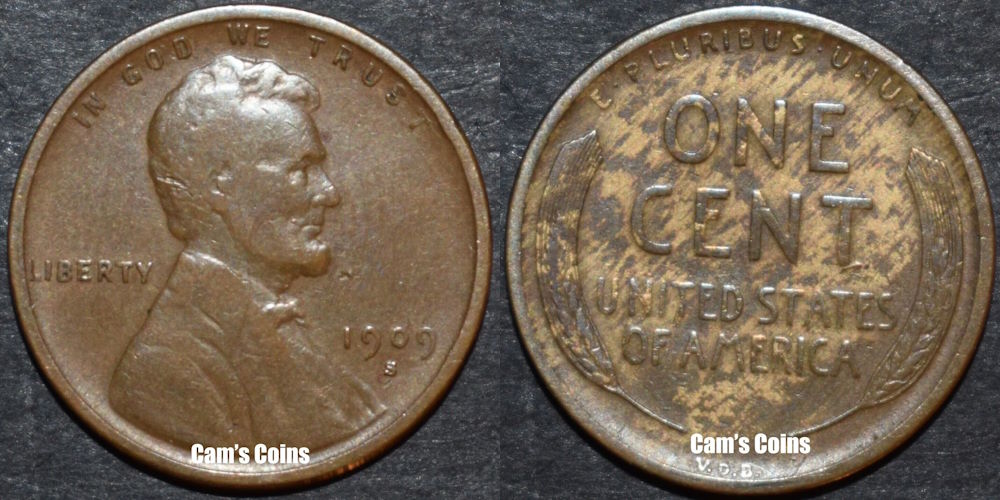 Show your financial support of the Coin Community Family (click here)See my topic on Mexican Numismatic Medals (click here) |
|
Bedrock of the Community
United States
19552 Posts |
Good example, nns-52. I hang on to my 'better' woodies and have dozens similar to what you're showing. Unfortunately, they're not '09 S wheat cents.
|
|
Moderator
United States
195203 Posts |
Quote:
This is the coin that spurred this question: Nice example for the question!  |
|
Bedrock of the Community
United States
20038 Posts |
They can but it can become questionable. On a full woody both sides will have a pattern with the reverse grain flowing the opposite direction. That said, this coin (1909 S VDB) is highly suspect as being exposed to something that stripped the patina from the reverse. The obverse has a very even, thick, heavy brown natural patina. It looks good as a VF level coin should. This was the first year for Lincolns and the quality was really high, there are not many SVDB woodies that I've seen. I believe them to be rare.
I did not expect the reverse to look like this based on the obverse. If it's a genuine woody, I'd expect the reverse to look less obvious with that toning level. I think it should be much darker. The EPLUR and VDB are also stripped of patina. The field area around the VBD is fully brown but the device is stripped and that looks suspect to me. My guess is it sat in a puddle of something that removed the toning or perhaps someone put oil on it to protect it decades ago. Whatever happened, I would say it happened a long time ago.
Given the value this would be a good candidate to let the TPGs sort out. However, I'm betting it comes back bagged.
Lincoln Cent Lover!VERDI-CARE™ INVENTOR https://verdi.care/
Edited by BadThad
06/19/2024 6:41 pm
|
|
Bedrock of the Community
United States
94367 Posts |
|
|
Pillar of the Community
 United States
2385 Posts |
Beautiful coin...I'd be proud to have in my 2nd book.
But something about this one looks "off" on the reverse...? Chemical induced...?
I'd put him on my toning table and get him back to BN in 6 months or so to even out to that beautiful obverse color...
jmho
smat
|
|
Pillar of the Community
United States
1648 Posts |
Some good replies received. This coin however may instead be some kind of exposure to one side only rather than an improper alloy mix given the look. The UN in UNITED for example also appear more like a substance over the dark patina naturally caused by copper oxide over time such as you see on the obverse and normally expected with oxygen exposure. Perhaps the substance would come off some with acetone. So at the moment it looks cool but don't believe its an improper alloy mix/woodie. Improper alloy mix errors are found on older coins and Lincoln cents prior to 1983 with streaks or lines of varying widths and lengths. A woodie is an improper alloy mix for example that has a poorly mixed alloy that can result in alternating light and dark streaks. This is often referred to as a "wood grain" pattern. https://www.coinworld.com/news/us-c...erstood.htmlhttps://www.error-ref.com/improper-alloy-mix/ |
| |
Replies: 13 / Views: 1,765 |
|







 Posted 06/18/2024 4:38 pm





