| Author |
 Replies: 25 / Views: 2,664 Replies: 25 / Views: 2,664 |
|
|
|
New Member
 United States
11 Posts |
How can the letter retain its exact specifications in height and width if there is DDD? It would need in a sense more material to obtain that look. You cannot a near perfect letter and that much extended material out of the U branches. Where did the copper come from to maintain the flat surface in correct thickness, the U on top in correct height and width...You would have to add copper to get that much extra bulge off the U legs. The letter height and width gives you a volume of material. You cannot have a correct shape/volume letter and then those legs...there would not material to fill without it coming from the letter or the thickness of the coin in that tiny spot. Please take no offense and continue to educate me. Nothing in the DDD link looked anything like this. There are some on Google like mine listed as DDD. But again if material wears off the die. It means the metal must sacrifice material from somewhere to creat that appearance. My letters are solid....the coin is correct thickness... |
|
Pillar of the Community
United States
592 Posts |
Quote:How can the letter retain its exact specifications in height and width if there is DDD? It would need in a sense more material to obtain that look. You cannot a near perfect letter and that much extended material out of the U branches. Where did the copper come from to maintain the flat surface in correct thickness, the U on top in correct height and width...You would have to add copper to get that much extra bulge off the U legs. The letter height and width gives you a volume of material. You cannot have a correct shape/volume letter and then those legs...there would not material to fill without it coming from the letter or the thickness of the coin in that tiny spot. Please take no offense and continue to educate me. Nothing in the DDD link looked anything like this. There are some on Google like mine listed as DDD. But again if material wears off the die. It means the metal must sacrifice material from somewhere to creat that appearance. My letters are solid....the coin is correct thickness... That is a word salad that I will not pretend to comprehend. I mean this respectfully and am not trying to insult you, but I'm not sure you understand the minting process or the forces involved when a coin is struck. I admire the confidence you have in your opinion that your coin is a DDO and can only offer these examples from the pages I've suggested you view: 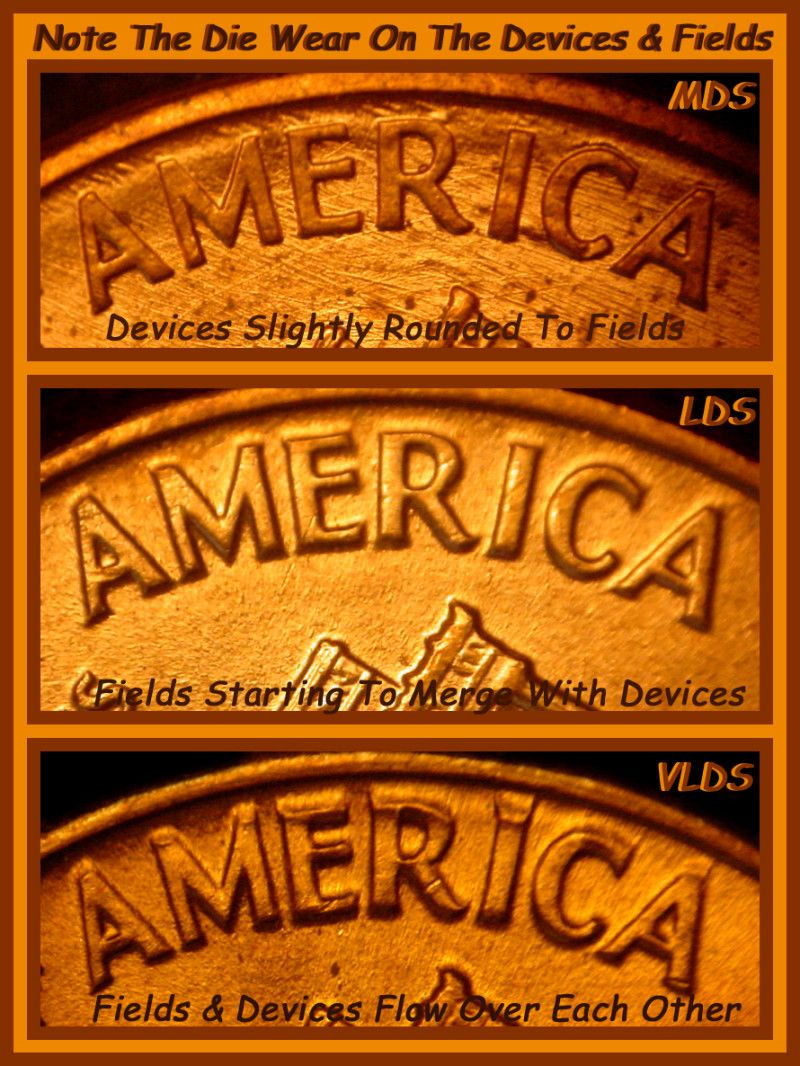 The third image from the top shows clear DDD over most of the letters, but most notably over the ERI, just like the doubling you're seeing over the R, U & T in your coin. 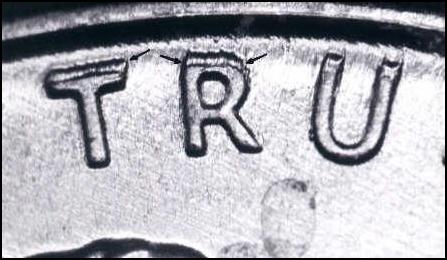 In this image you can quite clearly see the extended legs of the U from TRUST stretching outwards towards the rim. Doubling that moves outwards towards the rim is a hallmark of DDD because the energy generated in each impact between die and planchet is transferred laterally across the face of the die towards it's edge. This energy movement causes a tiny bit of distortion in the face of the die with every strike because of the enormous striking pressure. Tracking this distortion allows experts to classify each coin as early, mid or late die states, based largely on the amount of distortion. |
|
New Member
United States
11 Posts |
I'm so glad you brought those photo's. Do you see where it says field merges with devices? The material flows on a slope meeting the highest surface of the letter. Now look at my coin. There is absolutely no slope whatsoever, no merging. Each letter retained it's height perfectly, look how dark it gets around the complete border of every single letter. There is no merging whatsoever. Especially the "U" where it would be most noticeable.
|
|
New Member
United States
11 Posts |
And in the silver coin photo. On the top of the R. The height from the doubling highest point to the top of the R highest point is NOT not normal heighth of the letter. All my letters are the correct height standing on top of the doubling. You are not touching on the letters being the right height and width regardless of the DDO or DDD what have you. But I need an explanation as to how looking at this Die Deterioration diagram with the Die in worn state missing material. Now I'm pretty positive there is no way to for the letter to be in perfect form if there is Deterioration. The material has to shift from deepest point in the die to the newly worn more shallow area. The material would squeeze from the letter itself. The deepest point in the die is going try to squeeze out into the new space. That is the highest point of the letter. My letters are standard height and width all the way around. So where did the material for the extra on each letter come from? You cannot make that make sense. |
|
Moderator
 United States
108585 Posts |
Quote:
You cannot a near perfect letter and that much extended material out of the U branches. Where did the copper come from to maintain the flat surface in correct thickness So, in a true DDO (or DDR) where is the so-called metal coming from to form the doubled letters? From the same place - the copper will flow into the voids quite easily under the pressures used to strike coins. take a look at die chips for a moment, when a piece of the die beaks away and falls out, this on a hole or 'dent' in the die - does the metal not flow into it because there is not 'enough' metal to go around? NO, it does not, it also flows into the chipped area, creating a raised spot on a coin. (think of the so called BIE Errors here) when a die wears out it starts at the field of a device, which is Incuse on the die. The letters are formed quite normally at first, until the die has worn enough to reach down into the recessed areas of the design element and at that point will merge with the top of the letters and start to reduce the letters themselves (like that B&W image that HGk3 posted just above. Your coin is showing early stage DDD. Now, with all that being said, if you are so adamant about your coin being a DDO, then please send it to a grading company to see if they will attribute it as such. I would suggest ANACS for this - they are the cheapest and will attribute just about anything. The only thing I ask is that you come back to report the final findings with either a yes or no. |
|
Pillar of the Community
United States
6919 Posts |
Quote:
I would suggest ANACS for this - they are the cheapest and will attribute just about anything. The Wexler catalog is one of the big three variety attribution examiners for Lincoln cents (along with Copper Coins and Variety Vista). They are much cheaper than grading at a formal TPG, and they will research new varieties. https://doubleddie.com/402401.htmlThis coin obviously shows Die Deterioration. I think the OP is trying to order his thoughts on the striking process. The answer to the question of "where does the additional metal come from" is quite simply: the planchet. The striking dies are not set to precisely stop at the coin field depth. The hammer die approaches the anvil die until the planchet stops it via compression resistance. The resulting compression of the planchet metal is what produces work hardening, which in turn makes a struck coin far more durable than the planchet it is struck from. If you want to see an example of how much metal can be pushed into deteriorated devices, I present the following 1954-S nickel with marshmallow lettering. https://www.pcgs.com/cert/56014761I imagine that the field-to-field thickness through that coin might be a tiny bit thinner than a nickel struck from fresh dies, because a tiny amount of extra cupronickel flowed into the slightly larger letter cavities. |
|
New Member
United States
11 Posts |
I've lost the motivation. I left the penny heads up on the handle of the gas pump. Good Day. (Retiring)
|
|
Pillar of the Community
United States
6919 Posts |
Just happened to find this DDD on a Wheat cent today: 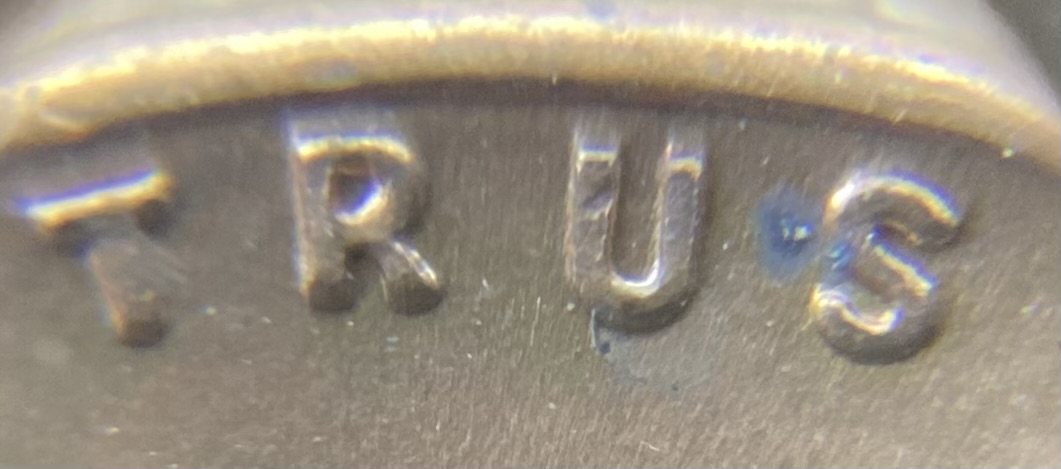 Essentially the same phenomenon as the OP coin. |
|
New Member
United States
11 Posts |
I appreciate everyone's time and opinions. I was frustrated and truly hoping it was something new and special. I never did out the coin on a gas pump but I sure though about it good and hard after finding out it's a only DDD.Now we can't even find said coin. How wonderful. |
|
Valued Member
United States
392 Posts |
Jsanny0916 - While I agree with others that what you saw on your coin was DDD, you clearly showed a passion for what you thought it was. Coin collecting is a journey. You can learn a tremendous amount about the minting process and the resultant coin deviations both valuable and not from a group of experts, like the ones on this forum. They are open to teaching new collectors the difference between errors, varieties and common minting discrepancies. Don't give up. Most collectors will find hundreds or thousands of coins that show those common discrepancies before they find a true variety. When you do, they will celebrate your success with you. It is somewhat like treasure hunting. You may find a lot of plain rocks while searching for one nugget of gold. Don't give up. |
| |
Replies: 25 / Views: 2,664 |





 First Page


 Posted 06/07/2025 01:08 am


