| Author |
 Replies: 21 / Views: 1,586 Replies: 21 / Views: 1,586 |
|
Pillar of the Community
United States
6960 Posts |
Hopefully I am not exasperating our coin photo experts with all these questions on lenses.
Most of the online reading material seems to indicate that the longer working distance lenses allow macrophotography of live subjects like insects without disturbing them. Obviously coins do not startle easily. Does a longer working distance lens (90-110mm) provide for other advantages vs. a 40-50mm lens? For example, reflections of the camera on proof coins, ability to control lighting angles, shadows cast by the camera, light box compatibility, and so forth. It just seems like the shorter working distance lenses are more affordable. However, as I would only intend to purchase one coin photo lens, perhaps longer working distance is better?
|
|
|
|
Pillar of the Community
 United States
4051 Posts |
Yes, longer is better for many of the reasons you mention.
|
|
New Member
Canada
7 Posts |
Longer distances are preferable because they let you work farther away from the coin. When you're closer, you block more of the coin and have less control over its lighting, particularly top-down lighting.
|
|
Moderator
United States
197785 Posts |
 to the Community, CoinPhotoStudio! |
|
Pillar of the Community
 United States
6960 Posts |
I appreciate the insight. =)
I am not used to dealing in millimeters, so it took me a moment to figure out the equivalent distance in inches. 50mm is 2", and 100mm is 4". I can see that jamming a light into a 2" gap would be pretty difficult without reflections, glare, and other problems.
For a 100mm lens, how far is the bottom of the lens from the coin surface? The videos I watch make it look like way more than 4".
|
|
Pillar of the Community
 United States
5725 Posts |
A focal length of 50mm or 100mm refers to an inherent property of the lens that roughly correlates with degree of magnification. What you're interested in is focus distance, which is the distance between the lens and the coin. With my 105mm lens, the distance from the front of the lens to the coin is about 10 to 14 inches, depending on the size of the coin.
|
|
Pillar of the Community
United States
6960 Posts |
Ok, that's what I was trying to understand. From physics, I remembered focal length to be the distance from the lens center to the focal point. But it has been a long time since I had physics mechanics. Then macrophotography articles that I read were describing a 50mm lens held two inches from the subject. Confusing. Thanks for helping to get me straightened out.
What is the guideline for distance to the subject? I assume it has to do with the focal length of the lens, the width of the subject, and possibly other factors.
|
|
Pillar of the Community
United States
5725 Posts |
You could obviously focus on a coin several feet away, but then the coin would be a tiny part of the image. You generally want to fill the sensor as much as possible with the coin, limited by the minimum distance you can keep the coin in focus. I don't know of a formula to calculate this for a specific lens, but the lens manufacturer will usually specify the minimum focus distance (from which you would need to subtract the length of the lens). Or you could test it yourself, finding the shortest distance that can keep a coin in focus.
|
|
New Member
Canada
7 Posts |
My Nikon 105's minimum focus distance is 12 1/4", measured from the focus point to the camera's film plane. This gives me roughly 6" from the front of the lens to the coin face. At this focus distance, I have around 1/16" Depth of Field. This holds for coins up to about 1" in diameter. Larger coins mean pulling back farther, which also increases the DoF. For medals 2" in diameter, I'm 16" off the face of the coin. I've shot 5" round medallions, and I'm 28" off the face of the coin. 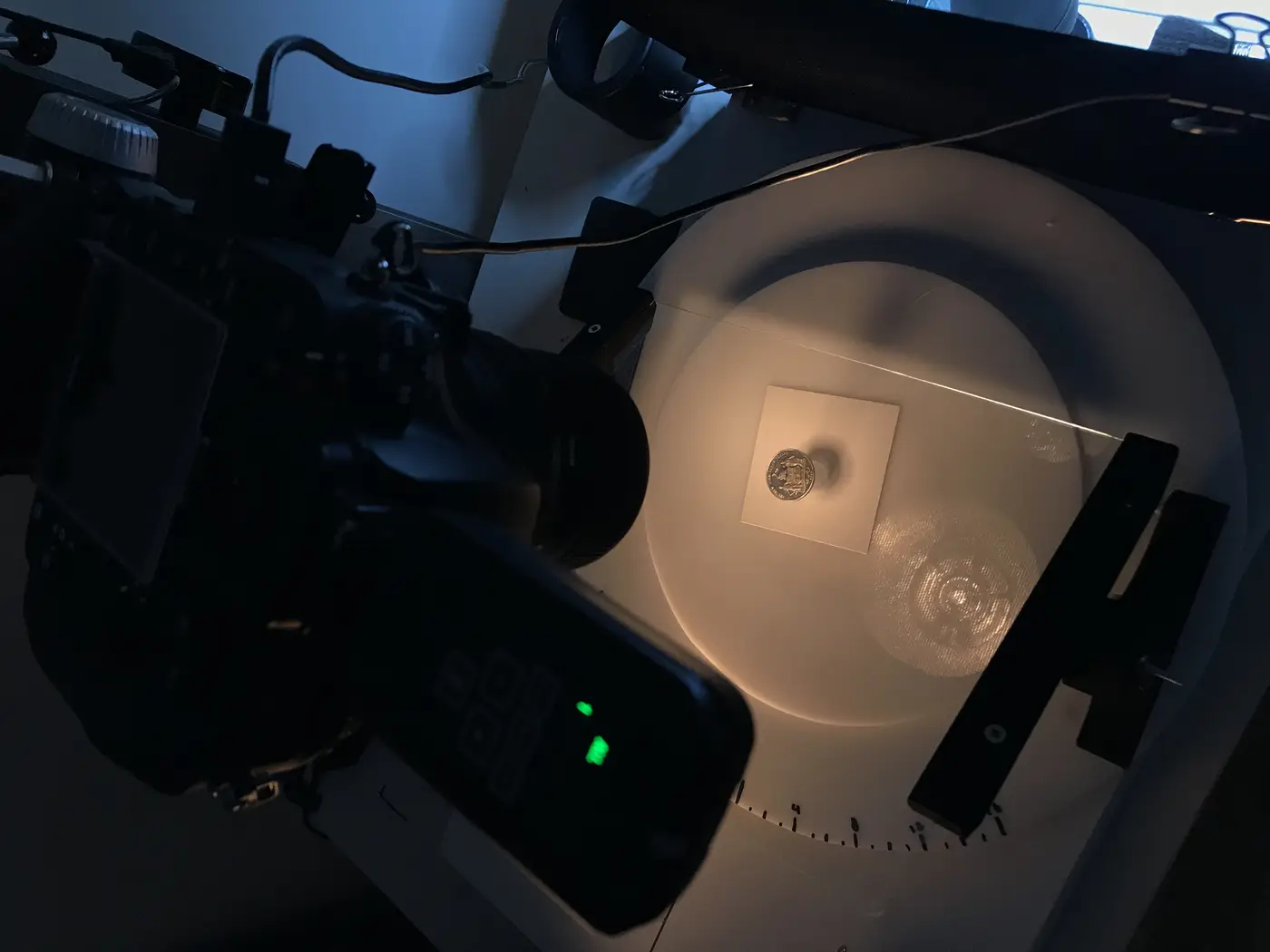 Edited by CoinPhotoStudio
01/15/2026 5:21 pm
|
|
Valued Member
Canada
321 Posts |
You want to get farther away from the coin to get a proper light setup (light is 90% of the work when working with coins) a coin is small and you usually only want it as the subject, so having a broader Field of view a 40 or 50mm would bring is pointless... also as a bonus, a 90 or 105mm F2.8 macro are very versatile and can make a superb portrait lens as well!
For a similar reason I think an APS-C camera does a better job than a Full-Frame since the crop factors make your have a longer focal range (a 90mm with a x0.5 sensor crop will give you 135mm equivalent on a FF, so the camera can be farther away from the subject), assuming you use a FF lens) Plus, some of the older macro lens are incredibly sharp in the middle but lack a little of sharpness in the corner, an APS-C use only the middle of the frame, making it equally sharp all across the frame.
I started with an APS-C, upgraded to a FF and for coins, Id definitely go back to an APS-C or better, a FF with an APS-C mode ; I went from a 157.5mm equivalent to the real 105mm and the difference truly made my work harder with less liberty for the light setup.
Purely my opinion, but DOF isn't a big factor in the equation since in more troubling subject, you can always use focus stacking (quite easy to do with a manual lens on a proper copystand) to make the whole subject in focus
''Buy the very best, stretch to buy it. It means if you can't afford to buy it, buy it anyway."
-Steven Duckor
Edited by Dollar 1935
01/15/2026 5:36 pm
|
|
Pillar of the Community
United States
6960 Posts |
Quote:
My Nikon 105's minimum focus distance is 12 1/4", measured from the focus point to the camera's film plane. This gives me roughly 6" from the front of the lens to the coin face. At this focus distance, I have around 1/16" Depth of Field. This holds for coins up to about 1" in diameter. Larger coins mean pulling back farther, which also increases the DoF. For medals 2" in diameter, I'm 16" off the face of the coin. I've shot 5" round medallions, and I'm 28" off the face of the coin. Thanks for including numbers. =) If a 2" coin is in focus with sharp details at 16", doesn't that also mean that a 0.5" coin would also be in focus at 16"? The smaller coin just wouldn't fill the whole frame. But the details would still be captured well, correct? The resulting image would just need to be cropped. |
|
Pillar of the Community
United States
6960 Posts |
Quote:
You generally want to fill the sensor as much as possible with the coin, limited by the minimum distance you can keep the coin in focus. I don't know of a formula to calculate this for a specific lens, but the lens manufacturer will usually specify the minimum focus distance (from which you would need to subtract the length of the lens). That makes practical sense. If you are shooting something tiny like a Mercury dime, doesn't that result in a tremendous resolution of the surface? I did eventually find the mathematical explanation to the focal distance question, called the Lensmaker's Equation. Basically, the inner and outer convexity of the lens determine the focal length and the field of focus, along with the index of refraction of the lens material. |
|
Pillar of the Community
United States
6960 Posts |
Quote:
You want to get farther away from the coin to get a proper light setup (light is 90% of the work when working with coins) a coin is small and you usually only want it as the subject, so having a broader Field of view a 40 or 50mm would bring is pointless... People have commented a lot on how lighting is crucial to coin photography. What lighting do you use, and why did you select that lighting? Some of it is obvious—such as people recommending goose neck lamps or axial light boxes—but aspects like color temperature and diffusion aren't as obvious (at least to me). |
|
Pillar of the Community
United States
5725 Posts |
Quote: If you are shooting something tiny like a Mercury dime, doesn't that result in a tremendous resolution of the surface? If you can fill the frame with the coin, then yes, the resolution will be excellent. But if the minimum focus distance results in the coin being in only part of the frame, you lose resolution when you crop the image. |
|
New Member
Canada
7 Posts |
Quote:
Thanks for including numbers. =)
If a 2" coin is in focus with sharp details at 16", doesn't that also mean that a 0.5" coin would also be in focus at 16"? The smaller coin just wouldn't fill the whole frame. But the details would still be captured well, correct? The resulting image would just need to be cropped. Yes, the smaller coin won't fill the whole frame, and needs cropping. However, if you have a smaller coin, you always want to put as many pixels on the product as you can, so you should shoot it at your lens's minimum focus distance. In my case, every coin under 1" in diameter is shot at 12 1/4", my lens's minimum focus distance. Only when a larger coin doesn't fit in the frame at that distance will I move the lens back to capture all of it. Regardless of coin size, how well the details are captured depends on your camera's resolution, lens quality and capture techniques. Edited by CoinPhotoStudio
01/16/2026 07:02 am
|
|
Pillar of the Community
United States
6960 Posts |
Appreciate the insight, guys. I don't have a copy stand. One of the things that I'm trying to figure out is whether I can have a DIY copy stand with fixed distances from the coin pedestal, and just fine tune with manual focus and maybe a lab jack. i.e. a post hole for nickels and dimes (<1"), one for quarters and halves (~1"), one for Ike dollars and medals (~2"). Recognizing that a lab jack might be able to do some intermediate work between physical camera elevation (gross) and manual focus adjustment (fine). |
| |
Replies: 21 / Views: 1,586 |




 Posted 01/15/2026 09:23 am





