Here's an interesting 1922 threepence with a raised mark on the reverse.
Last time I posted pics, some thought the mark could be due to a die chip, file, or some other damage.

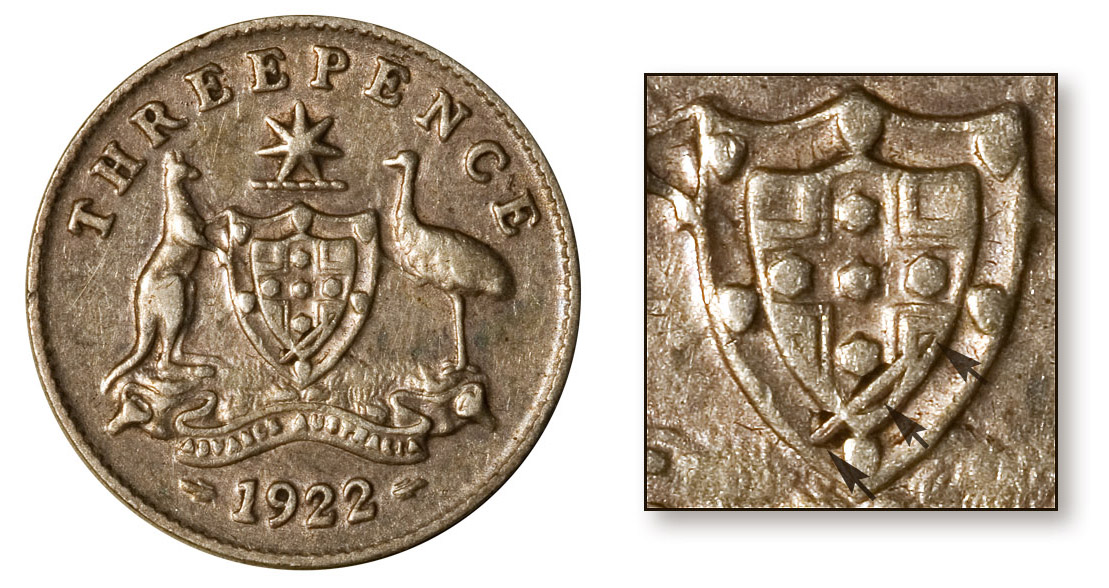
Today, I noticed something interesting about the raised mark. The main mark (dark arrows) crosses the shield in several places
higher than the normal design.
This means the mark was recessed into the inverse shield design on the die. However, at the periphery of this mark are areas
depressed below the coin's design (white arrows).
If struck this way, it means that around this depression in the die, there were areas
raised above the normal design.
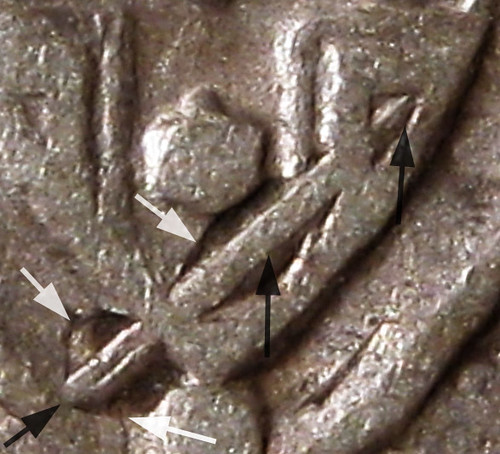
Which makes me wonder which circumstances best explain both the
raised mark and the
depressions struck into the coin? Here are 3 possible scenarios I considered:
• If the mark is a die chip, that would not make a
raised area on the die (white arrows).
• Deep file marks I've seen usually
remove metal, creating a sharp transition between the raised mark and the normal design.
• If an object were struck into a die, I would expect displaced metal around the object that pushes
upward, resulting in a recessed area struck into the coin.
Of these three options, I think a hard object striking the die best explains all the details on the coin. If that's a
plausible scenario, then I wonder if the marks is damage to a hardened die while on press, or mispunched into a soft steel die before it's hardened for use? Thoughts?
Yes--I'm probably thinking
too hard about this coin, but it's one of my more intriguing finds.

Thanks for reading!









 Posted 12/29/2009 4:48 pm


 I'll give my coin some time to "grow into" the 1922/1


