| Author |
 Replies: 36 / Views: 7,477 Replies: 36 / Views: 7,477 |
|
|
|
Bedrock of the Community
United States
20052 Posts |
Quote:
With all due respect Mr. Thad, patina and verdigris are NOT the same thing. Verdigris is not an oxidation process. The formation of a patina (or a tarnish if you prefer)is. Oxidation (patina)on bronze helps preserve the metal beneath it whereas verdigris, like rust on iron, corrodes it. Read the article on "bronze disease" the link for which was posted earlier in this thread by echizento, to clarify what this conversation was about. And please temper your overconfidence; you're not the only one who knows what he's talking about.
No problem, you're certainly entitled to your opinions. Since your new here, I'll give you a little bit of my background. I'm a chemist in the metalworking fluid industry (23 years) and I have extensively studied copper and it's reactions. In fact, I'm in the process of writing a book on the topic for numismatists. My goal in writing the book is to thoroughly explain copper coin verdigris in order to put an end to all the misinformation and half-truths perpetuated though folklore amongst collectors. I am stating science backed by hours of laboratory research. If you'd care to chemically explain exactly what you might think a "green patina" is, I'm all ears. However, assuming the surfaces were not artificially colored, I can assure you that green patina is nothing more than a metallic copper salt, i.e. verdigris. |
|
Moderator
 United States
23731 Posts |
Here are two examples from my collection that might help explain the difference between a green patina and Bronze Disease. 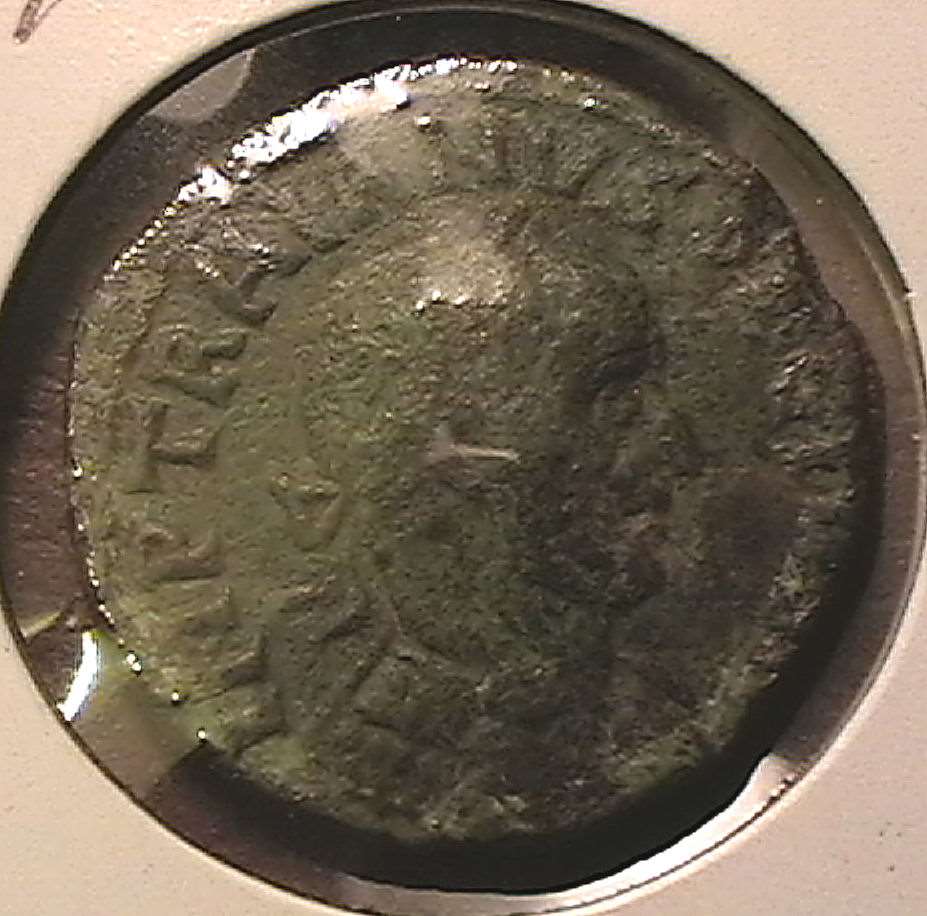 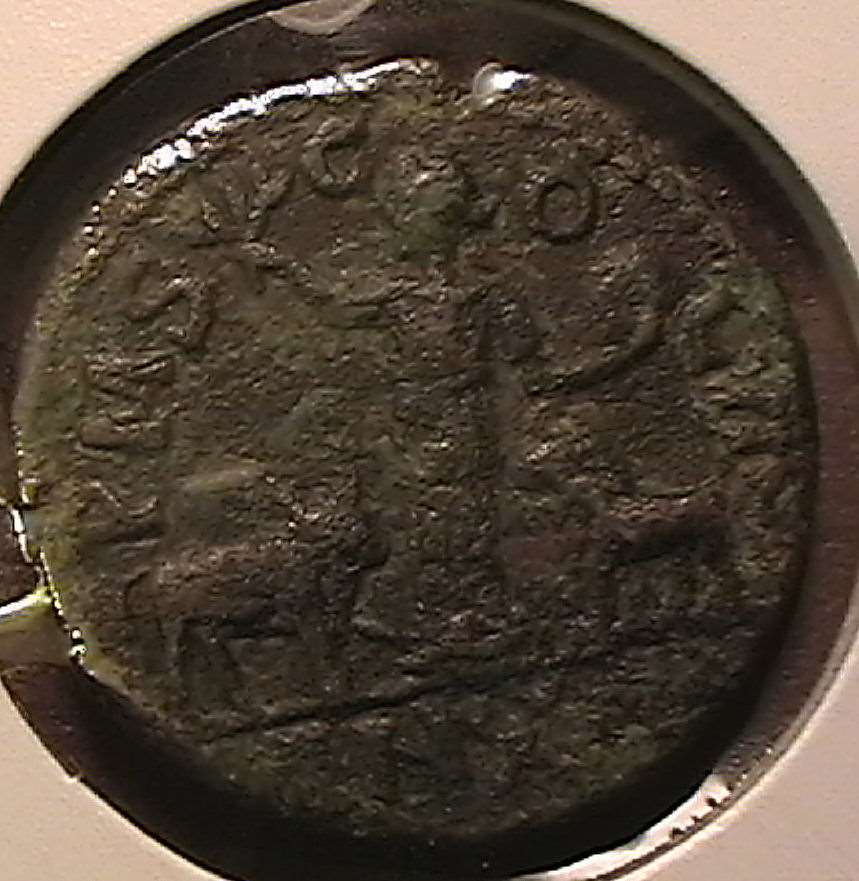 Coin A is a Roman Provincial coin of the Emperor Trajan Decius, on the obverse is a nice green patina and on the reverse is a green and black patina. 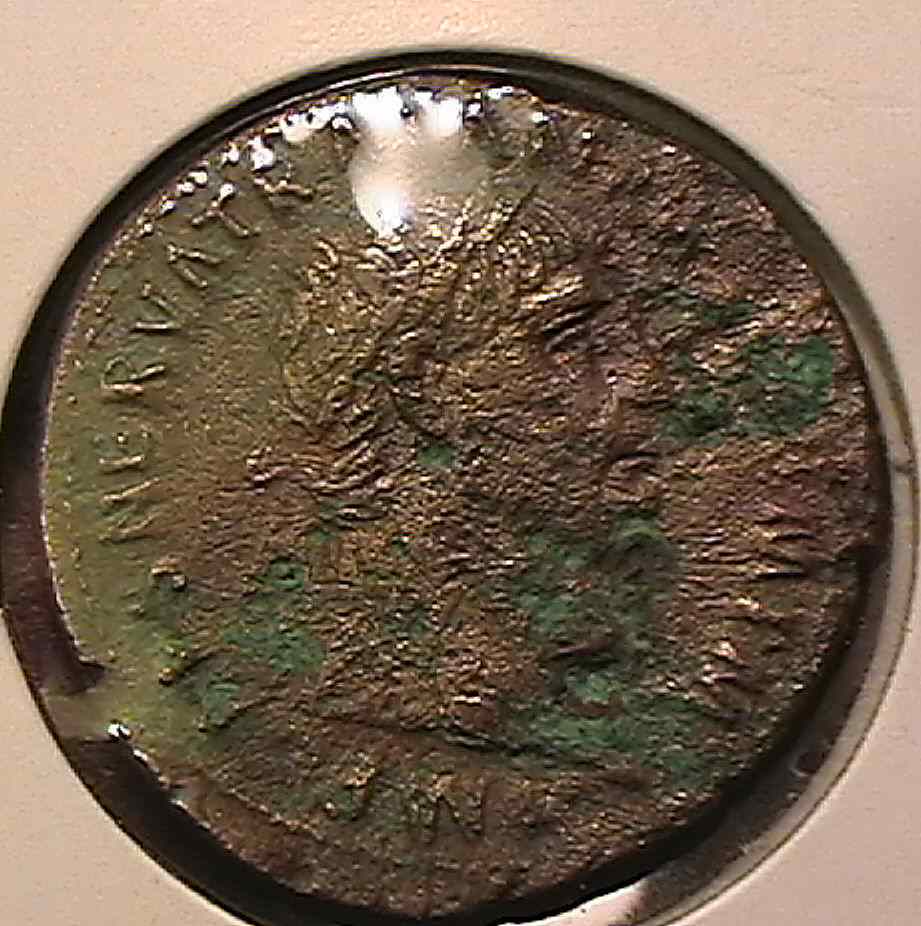 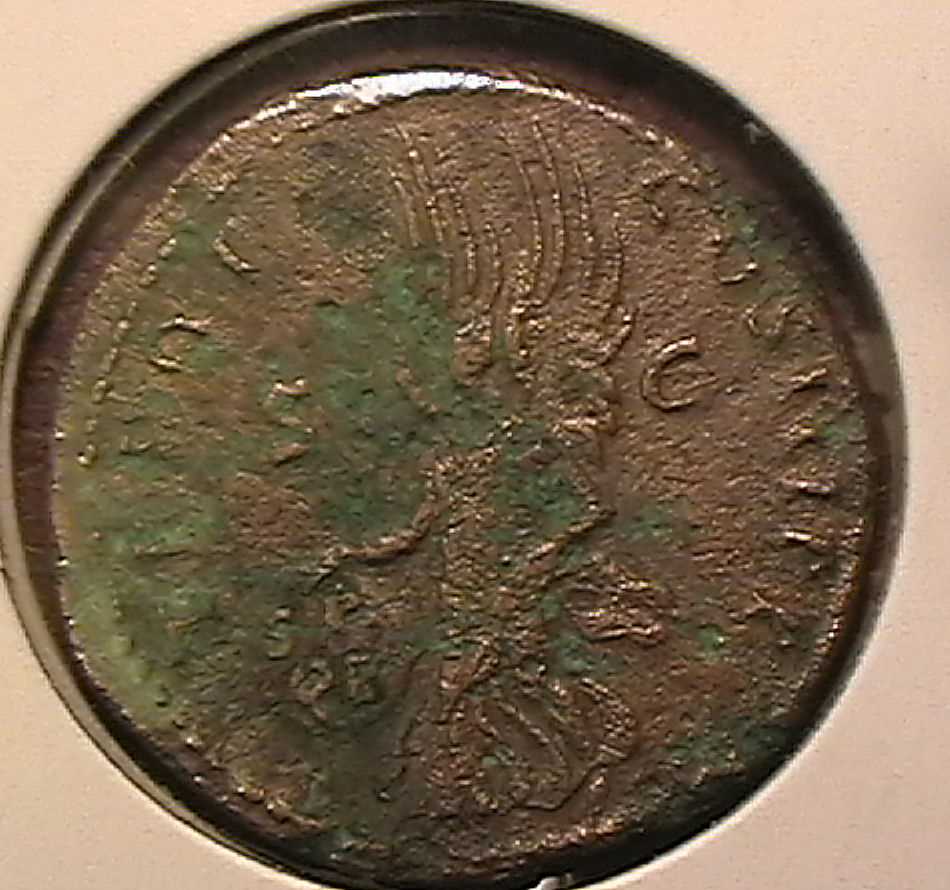 Coin B suffers from Bronze Disease, notice that the coin has no patina but shows the damage that has been caused by the Bronze Disease. I have managed to stop anymore damage from occurring, but I have to keep checking that it doesn't become active again. |
|
Bedrock of the Community
United States
20052 Posts |
You've shown me two coins that have verdigris on them. The ONLY difference is one shows light and the other shows heavy verdigris. Call it what you like, the "patina" is in fact light verdigris.
Edited by BadThad
09/08/2010 7:28 pm
|
|
Moderator
United States
23731 Posts |
Call it what you like, but one is destructive and the other is not. That's the point that I'm trying to make.
|
|
Bedrock of the Community
United States
20052 Posts |
All verdigris is destructive. Copper atoms have been pulled from the coin in order to form the verdigris. If you were to supply air to the first coin, the verdigris would continue to grow and it would eventually look like the bottom coin. There is no magic here, just science, science is fact and verdigris is verdigris no matter what anyone wants to call it.  Edited by BadThad
09/08/2010 7:50 pm
|
|
Valued Member
United States
313 Posts |
|
|
Bedrock of the Community
United States
20753 Posts |
Quote:
Posted Today 49 Min ago
All verdigris is destructive. Copper atoms have been pulled from the coin in order to form the verdigris. If you were to supply air to the first coin, the verdigris would continue to grow and it would eventually look like the bottom coin. There is no magic here, just science, science is fact and verdigris is verdigris no matter what anyone wants to call it.
Thad, your going to end up with ulcers. Maybe worse. Not sure if it was Wrigley's Gum but there used to be that saying "some call it a spear, some call it an arrow" Mr. Wrigley just didn't care since as long as you called it something at the store when you purchased it. Regardless of what anyone calls that green stuff on a coin, it is not good and that is what is important, not what you call it. A Rose by any other name is still a Rose isn't it? |
|
Bedrock of the Community
United States
20052 Posts |
Nah, I'm smiling while I'm typing! I guess I come across as the mean scientist, but I'm not really. Lincoln Cent Lover!VERDI-CARE™ INVENTOR https://verdi.care/
|
|
New Member
United States
10 Posts |
Ok...I'll defer to your expertise as a chemist who has studied this issue for 23 years and is about to write a book. However, in my own defense...I had read on the topic from internet sources prior to my chiming in on this forum topic and am only a novice chemist. That said, it seems like colloquial terms for these chemical processes are part of my confusion anyway. So consistent with your knowledge base BadThad, when a brass spittoon tarnishes...if left unchecked, that tarnish will eventually corrode the brass? Similarly, if the tarnish on my silver Trade dollars is not removed, eventually my Trade dollars will be corroded? Similarly, if the bronze statue of an ape carrying a woman off to the woods is not cleaned of its green patina it will corrode away and be destroyed? Please explain why I shouldn't be alarmed about oxidation of silver and tarnish on brass but concerned about verdigris on bronze and copper since these all seem to be interactions between cupric metal compounds and gaseous compounds. To my understanding, verdigris is a result of interaction between cupric metal compounds and solid compounds. So my understanding is that metal cannot acquire verdigris being exposed only to elements and compounds that are light enough to be present in air; rather, verdigris results from cupric metals exposed to heavier salt compounds that are not easily vaporized. But I'm always the interested student so please educate me if you will. |
|
Bedrock of the Community
Australia
21792 Posts |
Bad Thad: Someone once told me that one of the main components of verdigris was copper hydroxycarbonate. I have only schoolboy chemistry ability, but is that a double salt?
|
|
Bedrock of the Community
United States
20753 Posts |
Quote:
Ok...I'll defer to your expertise as a chemist who has studied this issue for 23 years and is about to write a book. However, in my own defense...I had read on the topic from internet sources prior to my chiming in on this forum topic and am only a novice chemist. Exactlly the problem today. People read something on the internet and think that is the absolute truth since it is on the internet. In my experience I would say the old saying of believe half of what you see and nothing of what you hear is justified with the internet. Not sure why but for some weird reason people actually spend the time posting stories that are completely rediculous hoping someone or everyone will read and think this is the truth. I too being a Chemist and Electrical Engineer love to read some of those things and then try them if for nothing but to see what someone thought was for real. In most instances a large majority of what you read on the internet is just NUTS. Try looking up cleaning coins in Google, for example. Virtually thousands of replys. Think any are real? |
|
New Member
United States
10 Posts |
Quote: People read something on the internet and think that is the absolute truth since it is on the internet.
Yes, JustCarl, I agree with your assertions about the problems of Wikipedia and the Internet at large, however, those capable of critical thinking while not necessarily expert in Chemistry and Engineering, are able to navigate the information available. Besides those credentials don't necessarily lead to an applied and informed opinion about any sub-specialty either unless the person possessing that C & E background also has some capacity for critical thought. I will assume you understand this point but if I am not being clear, consider the problem with the western practice of medicine. Doctors have "the expert" designation for their study of the facts and systems involved in human health but that in itself does not make them good practitioners of medicine.
I would rather that you would have responded to my last post to point out where my statement of the processes and source of tarnish/patina versus verdigris are incorrect, rather than pointing out the limitations of information available on the web as if I am unable to discern for myself what constitutes a reliable source of information.
While the Internet may be a lesser source for information about the physical sciences than for, say, history, disparaging the Internet because it doesn't consistently meet your intellectual standards about a particular topic and then pointing that out in the forum as if I wouldn't know the difference is both pedantic and a bit patronizing on your part.
I don't know that you meant it that way, but since I replied to BadThad's dismissive reply as the verdigris expert.I'm now deflecting additional replies from people who aren't contributing to the scientific basis for the verdigris versus patina discussion but rather are trying to reinforce BadThad's expertise and seemingly reinforce my point of view on the topic as limited at best.
Please contribute to the facts of the discussion rather than engaging methodological concerns in epistemology.
As it stands, no one from the "everything is verdigris" camp has addressed the assertion by equally qualified sources that bronze patinas protect bronze from deterioration. Please explain the difference in passivation between a patina and bronze disease both of which are being called verdigris. Why does verdigris protect bronze under certain conditions and destroy it under others?
|
|
Moderator
United States
23731 Posts |
We are all entitled to or theories and opinions, you base yours on science and I base mine on many years of experience with ancient coins plus the knowledge that I have gained from noted collectors and authors such as Matterley(sp)Sayles, Sear, and Van Meter to name but a few. I have seen the damage that active bronze disease can do. And the perseverative effect that a beautiful green patina can also have. They are two different effects and until it is proven to me beyond any doubt my opinion remains the same.
|
|
Pillar of the Community
United States
2669 Posts |
Quote:
I don't know that you meant it that way, but since I replied to BadThad's dismissive reply as the verdigris expert�I'm now deflecting additional replies from people who aren't contributing to the scientific basis for the verdigris versus patina discussion but rather are trying to reinforce BadThad's expertise and seemingly reinforce my point of view on the topic as limited at best. Nothing stays exactly on-topic.. there will be other comments and asides along the way. From what it sounded like, just carl was making a general observation, not pointing fingers at anyone in particular. I understand comments of this nature may be frustrating while you are waiting for a definitive answer, however, he did make a valid point. Comments that do not directly answer a question should also give you some means to get to know the people here while you're waiting. Everyone contributes in their own way - you are, of course, free to ignore those points of discussion you feel do not add any value to your main objective, but please do not disparage anyone while doing so. Thad explained verdigris in detail in a couple of posts but here is the only one I can find: https://goccf.com/t/61519#482624 - the entire thread might be worthwhile reading, but that one post outlines the elements involved for verdigris. I'm sure he'll also respond to the question. |
|
Bedrock of the Community
United States
20052 Posts |
Quote:
Ok...I'll defer to your expertise as a chemist who has studied this issue for 23 years and is about to write a book. However, in my own defense...I had read on the topic from internet sources prior to my chiming in on this forum topic and am only a novice chemist. That said, it seems like colloquial terms for these chemical processes are part of my confusion anyway. So consistent with your knowledge base BadThad, when a brass spittoon tarnishes...if left unchecked, that tarnish will eventually corrode the brass? The tarnish IS corrosion. A chemical has attacked the surface and produced the corrosion. Over time, the corrosive process will continue until all of the metal is consumed and you're left with a pile of dust. Quote:Similarly, if the tarnish on my silver Trade dollars is not removed, eventually my Trade dollars will be corroded? Similarly, if the bronze statue of an ape carrying a woman off to the woods is not cleaned of its green patina it will corrode away and be destroyed? Corrosion is complicated, but absolute. The process will continue indefinitely until all of the metal is consumed. The process can be greatly slowed, to the point where it is imperceptible. Your Trade dollars and statue are relatively safe if protected from temperature swings, air and by using physical or chemical means. I will also add that corrosion is not static. On a chemical level there are various reactions that are constantly occuring. Metal in itself is not really completely solid, it has many liquid-like properties. Within a metallic lattice there are micro-charges that drive reactions which create electrochemical cells. The minute charge differences are able to drive chemical equilibrium reactions to one side or the other. For example, the equilibrium reaction of copper + chloride ---> copper chloride. The smallest charge will reverse the process to create fresh chloride ions which will "re-react" with copper to create more copper chloride. All of this has a tendency to build up the layer, this is further complicated with exposure to air and changes in temperature. Quote:
Please explain why I shouldn't be alarmed about oxidation of silver and tarnish on brass but concerned about verdigris on bronze and copper since these all seem to be interactions between cupric metal compounds and gaseous compounds. Actually, oxidation provides some protection to a metallic surface. All metals, within micro-seconds of being made, will form a metallic oxidation layer on the surface. Since the metallic surface has reacted with oxygen, it is not "seeking" to combine with other elements. The reactivity of the surface is greatly diminished, however, when a very strong, corrosive element like chloride ion, for example, is introduced to the surface, it will "overwhelm" the oxygen bond and form a copper chloride. This is why we have verdigris in the first place.  So, you should be concerned with corrosion {tarnish} but you shouldn't be concerned with oxidation as much.....of course, this all depends on the metal as the oxidation of aluminum will turn your object into a pile of white dust eventually. Quote:
To my understanding, verdigris is a result of interaction between cupric metal compounds and solid compounds. So my understanding is that metal cannot acquire verdigris being exposed only to elements and compounds that are light enough to be present in air; rather, verdigris results from cupric metals exposed to heavier salt compounds that are not easily vaporized. But I'm always the interested student so please educate me if you will. Sure, I love talking about this stuff. No, verdigris forms due to a reaction between metallic copper and an anion. The source of the anion can be liquid, gas OR solid. Something as ubiquitous as hydrogen sulfide gas can be the source of sulfate ions once it reacts oxygen and a micro-layer of water on the surface (forms sulfuric acid). This is one of many, many examples. |
| |
Replies: 36 / Views: 7,477 |






 First Page


 Posted 09/08/2010 7:21 pm


