| Author |
 Replies: 160 / Views: 13,719 Replies: 160 / Views: 13,719 |
|
|
|
Pillar of the Community
3660 Posts |
Oh, there is more to it than meets the eye buddy.
Later Gene.
|
|
Pillar of the Community
United States
3076 Posts |
Actually I can not leave it here, I missed all of your post's...
the 1878 series is concidered a near date IMHO, yet your lines drawn such astounding, thought of what it really should be accepted...as... there is no near or far date listed or 1878 so your question of its placement is very valid...as to, this is the first year of minting. so how should others be compared to it for date placement? as it matters to the whole of the theory.. and as pictures often are at an angle so the concieved persception of these lines for date and Mint Mark placement also have been examined.......Mind you its not to shoot the system down, but rather to percieved the coin as it is and the angle of the photo.. which is why Russ thought to collect photo's of coins straight on so locations could be exacted... well I'm just thinking out loud...
|
|
Pillar of the Community
United States
3076 Posts |
|
|
Pillar of the Community
3660 Posts |
Gene, I know that most folks just start at the point of the neck (look at the green lines here)....and go down to the denticles..... that is why (I think) there is such disparity between individuals when determining near, normal and far dates..... If everyone started at a point further up the neck, and drew a line (white lines) through the point of the neck to the denticles, I think that folks could be singing the same tune (in key)...... A longer line (not one starting at the point of the neck) is necessary for consistency (it would be for me anyway). 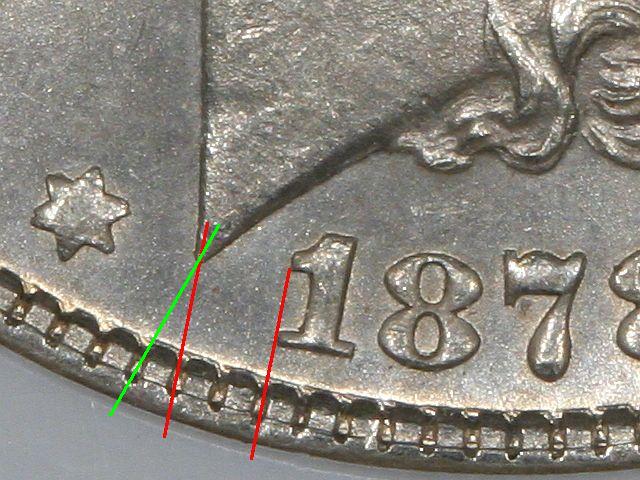 |
|
Pillar of the Community
United States
5700 Posts |
Welcome Back to this side ZEE, In your diagram above I always use the line that continues down from the neck, in this case the red left line, which would lead me to the closest indent between denticles and use the 1st whole denticle on the right of that mark to begin my count........
|
|
Moderator
 United States
23522 Posts |
Quote:
Gene, I know that most folks just start at the point of the neck (look at the green lines here)....and go down to the denticles..... that is why (I think) there is such disparity between individuals when determining near, normal and far dates..... If everyone started at a point further up the neck, and drew a line (white lines) through the point of the neck to the denticles, I think that folks could be singing the same tune (in key)...... A longer line (not one starting at the point of the neck) is necessary for consistency (it would be for me anyway). It's easier to visualize if you imagine the neck as an arrow - the denticle space the arrow points at is the one you count from. Just for the record, this and other basic VAM concepts are discussed in the "What is a VAM" sticky thread at the top of this forum. We've....revised it a bit. http://www.coincommunity.com/us_mor...is-a-vam.asp |
|
Pillar of the Community
3660 Posts |
Quote:
I always use the line that continues down from the neck, in this case the red left line, which would lead me to the closest indent between denticles and use the 1st whole denticle on the right of that mark to begin my count........ I understand what you are saying Mike.... what I don't understand is the accuracy of the human eye/brain function that can narrow down the distinction in such tight parameters..... is the red line really closer to that indent than the green line is to its indent? Would everyone agree? Within the confines of the various hub varieties, is this arrowhead to indent alignment always the same? Some overlays of the various obverse hubs might be enlightening. Quote:
It's easier to visualize if you imagine the neck as an arrow - the denticle space the arrow points at is the one you count from. An arrow consists of more than just the arrow head...... there is also a thing called the shaft, and the shaft is what determines (to the greatest extent) the vector in which the arrow will travel. Align your red line to the black shaft and the yellow arrowhead, and I'll align my green line in the same fashion.... who will have the better looking (and most accurate) arrow? I am sure that somehow, I am wrong about this too, as there must be some rules or ways of looking at things that I just am not capable of understanding. 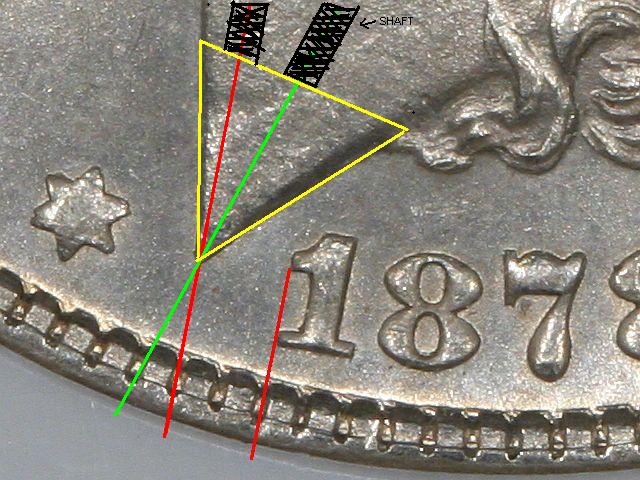 |
|
Pillar of the Community
United States
1315 Posts |
Would a pair of dividers work or a compass work? 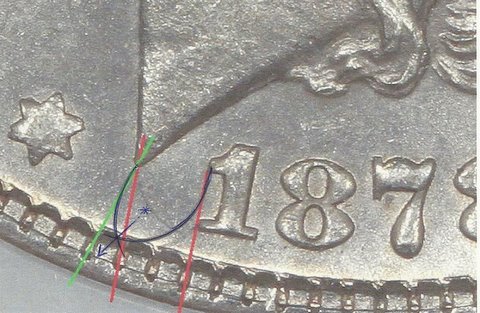 |
|
Pillar of the Community
United States
5700 Posts |
I personally found after looking at PLENTY of Morgans, it becomes easier to find the starting point..IMO
Zee, I have found this to be TRUE for ALL varieties of Morgans.While the 78's are always near, the locating of the starting point process, is the same.
|
|
Pillar of the Community
3660 Posts |
Maybe Doucet..... I guess I was just being my normal contrary self..... I could not understand why things have suddenly changed to something that is so illogical....(to me anyway). Here is the way things used to be: 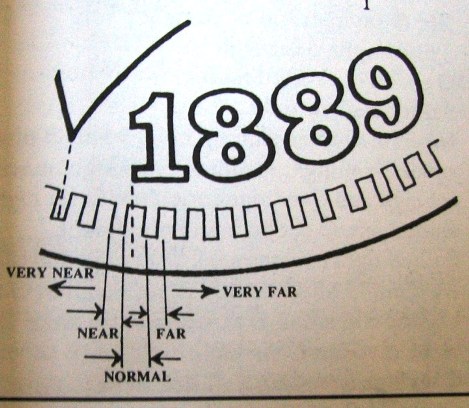 Extend the dotted line up through the neck and it seems fairly well centered in the neck (like an arrowhead is centered on its shaft): 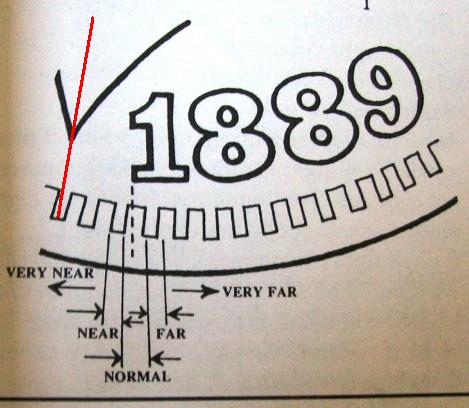 Here is the new rule with line shown extended through neck on an 1878 coin.... notice that the line is not centered through the neck, but is situated at a location that seems haphazardly placed left of center (a trick arrow).... The placement of point A (NECK) of a straight line as it necessarily passes through point B (POINT OF NECK) will affect its destination at point C (DENTICLES)..... I can't explain it any better. 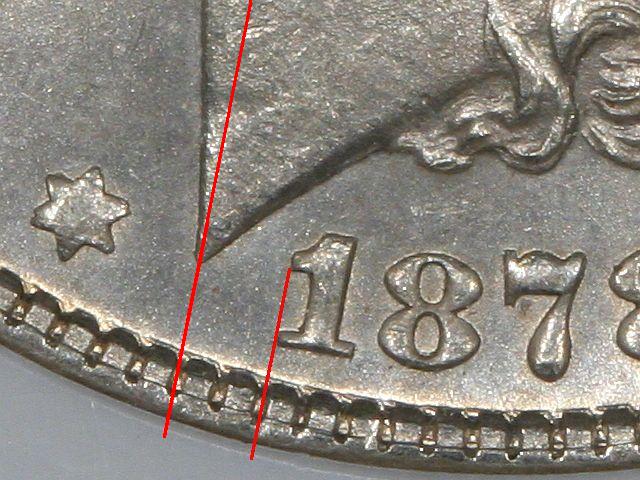 If the old rule were used, the green line would be logical.... such a simple thing, it only stands to reason that it would have to change into something obscure. 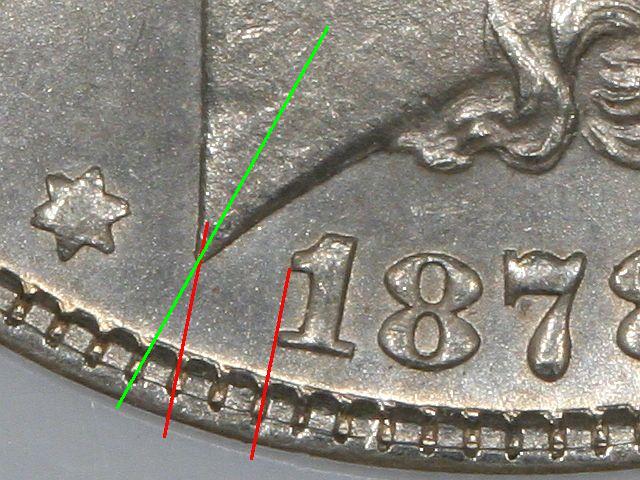 If accuracy and consistency are not considerations, then everything is left up to the eyeball call of each individual, and there is no such reality as near, normal or far dates..... only individual judgment calls based on visual perceptions. |
|
Pillar of the Community
3660 Posts |
Okay Mike, although I really believe that my soul brother Gene is the only one who actually understands what I am saying here, is this a near, normal, far or what date? I don't own a Morgan, so I hope that twohawks doesn't mind me using his here: 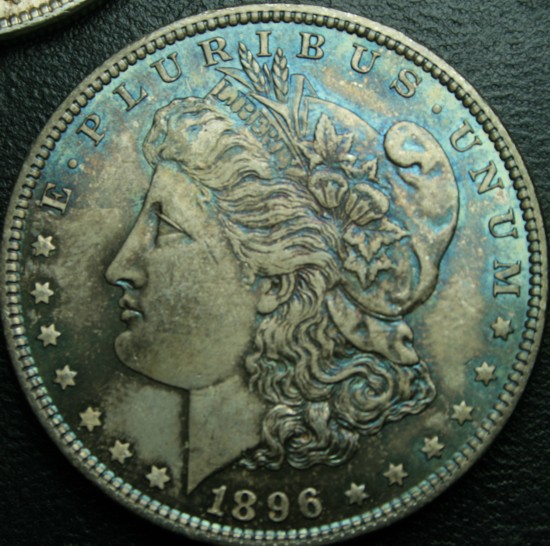 Still like the red line? 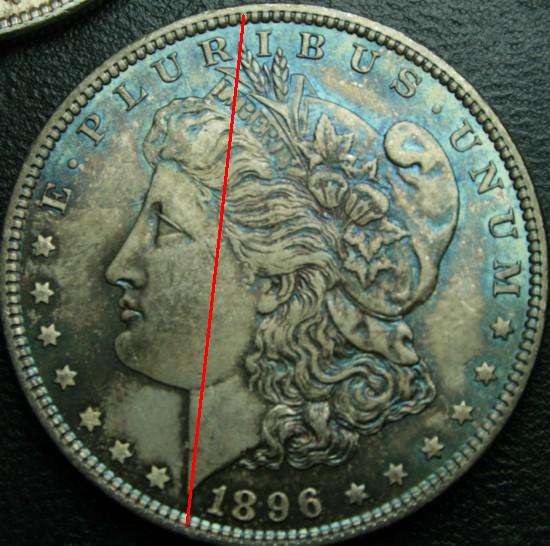 How about this one? 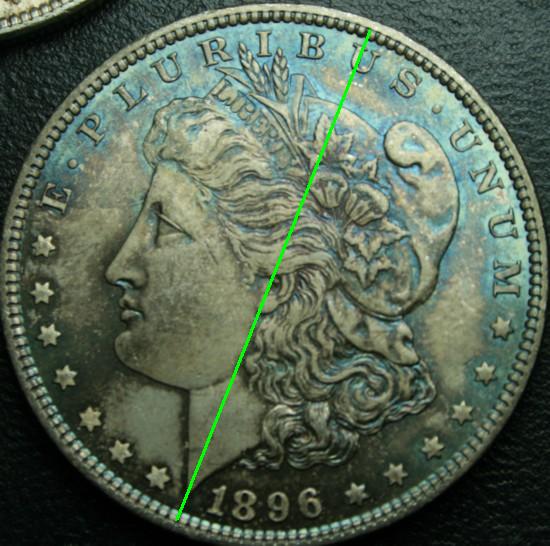 Understand now? |
|
Pillar of the Community
United States
5700 Posts |
The coin exhibits a near date, just more than 2 denticles away from the truncation of the necks point. I see your point with the green line? They are both actually correct.
|
|
Pillar of the Community
United States
3076 Posts |
yup a "normal date" as by the basic rules would imply....As Zee has pointed out"using the same principles for the 1878 series, shows how these rules do not work for the 78 series........yet its never been explicitly expressed that these rules are for 1879 and above...HUMMMM?
are there other years where these rules fall short?
|
|
Pillar of the Community
3660 Posts |
Maybe Russ' 1896 was a poor choice of coins..... The point I am trying to make here is two fold....
1).The point of the neck is in different relationships to the denticle spacing on different hubs, so the perception of which denticle is closest to the neck (or which indent the point of the neck is pointing at) will vary..... (nothing consistent about that without a longer reference line).
2).There must be a reference line through the coin (more than just a short line segment from the point of the neck to the denticles), or this near, normal, far thing will remain just as subjective as grading.
Edited by zeewool
02/08/2011 11:46 pm
|
|
Valued Member
United States
186 Posts |
Just throwing in here.... I use just the denticles... the edges of the dentical are close to parallel to each other... then just use those lines to find the difference to the date.
|
| |
Replies: 160 / Views: 13,719 |








 First Page
 Previous Page


 Posted 02/08/2011 01:18 am


