| Author |
 Replies: 160 / Views: 13,706 Replies: 160 / Views: 13,706 |
|
|
|
Pillar of the Community
United States
1204 Posts |
thanks , I didnt know about this topic.
|
|
Pillar of the Community
United States
1315 Posts |
I should said the TOP 100 or HOT 50 in my post above to keep morgans to morgans, but I get your point. thanks
|
|
Pillar of the Community
United States
5700 Posts |
I am not sure what you mean about the "big guns" and them not locating the coins not on any lists, could you please explain......What ever do you mean!!
|
|
Valued Member
United States
175 Posts |
Am I correct in assuming that for the 1921-P Morgan the Obverse has nothing to do with what makes it the VAM that it is? I bought a 1921-P that says on the slab it is a 1921 VAM41,but I'm kind of confused on this one. It listed as a 41B, then in the description of it they say " 41B IV 24-D1a ( Tripled left stars, Pitted Lower Reverse, Die File Lines Lower Reverse) (189) I-3-R6. Reverse D1a- Additional raised dots from rusted die around One with heavy File Lines all over Lower Reverse. They also use #2-4A. I can't match it up to any of the 1921-P's on vamworld or on SuperDaves 1921 VAM 41B page. I am still trying to figure out how to post pictures, I can e-mail them however if anyone would like to help me. I assume I just don't know enough yet. Thank You all, Lee.  Edited by rlcbj59
02/14/2011 2:03 pm
|
|
Pillar of the Community
 United States
709 Posts |
Quote:Am I correct in assuming that for the 1921-P Morgan the Obverse has nothing to do with what makes it the VAM that it is? Answer: No. VAMs can be identified by the obverse, or reverse or by both obverse and reverse. It depends on what is listable and what die markers are there (if any). Quote:
I bought a 1921-P that says on the slab it is a 1921 VAM41,but I'm kind of confused on this one. It listed as a 41B, then in the description of it they say " 41B IV 24-D1a ( Tripled left stars, Pitted Lower Reverse, Die File Lines Lower Reverse) (189) I-3-R6. Reverse D1a- Additional raised dots from rusted die around One with heavy File Lines all over Lower Reverse. VAM 41-A is differentiated by having a pitted reverse. VAM 41-B is differentiated by having pitted lower reverse and die file lines on the lower Reverse. Quote:
then in the description of it they say " 41B IV 24-D1a ( Tripled left stars, Pitted Lower Reverse, Die File Lines Lower Reverse) (189) I-3-R6. Reverse D1a- Additional raised dots from rusted die around One with heavy File Lines all over Lower Reverse. Who is 'they'? The description you list is for VAM 41-B. Now, Let's quantify your slab. What third party grading company slabbed it? Quote:
41B IV 24-D1a ( Tripled left stars, Pitted Lower Reverse, Die File Lines Lower Reverse) (189) I-3-R6. Are you having difficulty understanding the nomenclature? Edited by Ozland
02/14/2011 4:52 pm
|
|
Pillar of the Community
United States
709 Posts |
What exactly doesn't match up? Does your coin have a pitted reverse? This would narrow this discussion down quite a bit if it does. I realize you are having problems posting pictures, but if you could answer these two questions, hopefully we can fully answer your question.
|
|
Valued Member
United States
175 Posts |
The coin was graded by ANACS & yes I am having trouble with some of the nomenclature. I know that the I-3 means there are significant die changes, the r-6 is the rarity rating but I don't understand what the (189) means or the IV? I think the D1a is the Reverse Die however I'm not sure what the 24 is, I think it means a VAM # or is that the Obverse Die? There are file marks on the bottom reverse & it is pitted around the tail feathers as well as the Arrow Fletch & wreath. There is a also pitting around the O N in one. There is an impression between the E & D from the ONE DOLLAR as well as the W in we the T in States as well as the Eagles Breast. On the Obverse there is a very distinct impression from the bottom of the loop in 9 to the Serif ( hope I got it right) on the 1. I hope this narrows it down. I'm going to the book & see what I can do, Thanks OZ. Edited by rlcbj59
02/15/2011 04:06 am
|
|
Pillar of the Community
United States
709 Posts |
Quote:
41B IV 24-D1a ( Tripled left stars, Pitted Lower Reverse, Die File Lines Lower Reverse) (189) I-3-R6. 41 refers to the VAM number. VAM numbers followed by a letter indicates the presence of some feature on either the obverse or reverse that Leroy Van Allen / George Mallis felt was worthy of a special note. I-IV. These are designations for identifying the obverse design types. Type I and II were used only in 1878. Type III obverses were used after types I and II in 1878 and then were used exclusively through 1904. Type IV was a re-engraved design used only in 1921. A-D--Designations for identifying reverse design types. Type A reverses, known as 8 tail feather reverses were used only a short time in the spring of 1878. Type B is the 7 tail feather parallel arrow feathers, flat breast, reverse of 1878. These are found predominantly in 1878, although a few are known for 1879-S and 1880-CC. Type C reverses were first used in 1878 and continued to be the design type found on all Morgan dollars through 1904. Type D is the re-engraved design type only found in 1921. There are two of these Type D designs. Type D1 and Type D2. (189)--This refers to the reed count. The edge of the coins are reeded. So if you see (157) it means the reed count is one hundred fifty-seven. (190) means one hundred ninety on the reed count. I-3--This is the interest factor that Leroy Van Allen / George Mallis assigned to the coin. The higher the number, the higher interest they felt the coin merited. A low interest rating merely refers to the coin as mostly being nondescript. R-6. This is a rarity rating assigned by Leroy Van Allen / George Mallis. R-6 is considered Very Rare. The considered view is that there are likely several hundred specimens. Edited by Ozland
02/15/2011 12:56 pm
|
|
Pillar of the Community
United States
3076 Posts |
your coin is the 41B,,,after looking at your pictures, it has "pitting and die file lines" which differentiates it from the 41A,,,your coin most likely attributed before the revisions....I'll post the pics later when I get home tonight...
|
|
Valued Member
United States
175 Posts |
Ah that puts it in perspective. I'm going to have to start at the beginning of the book again, most of that was covered right in the front. I just received my Red Book so that should help me to understand what I'm looking at & for. What other books would ya'll suggest? I'm looking at a 160X/200X Pocket Microscope for $7.96, is that more than what I need or should I purchase it? You guys really are helpful to the beginner. Thanks Aladin & OZ  Edited by rlcbj59
02/15/2011 5:04 pm
|
|
Pillar of the Community
United States
3076 Posts |
Here are your pictures....the pitting... 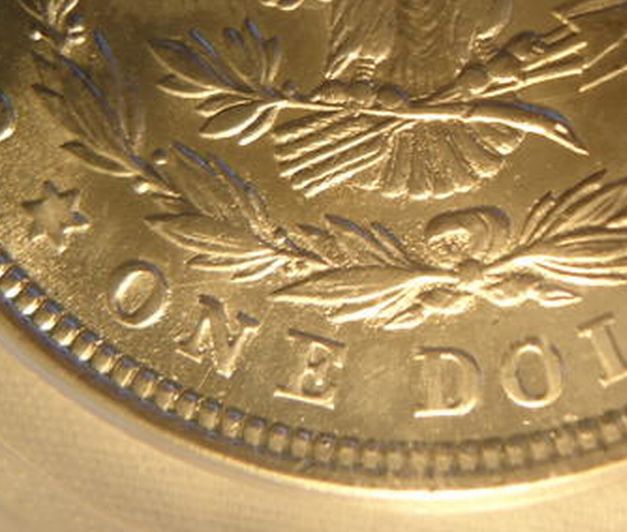 "note the specific: file lines from the "R" in dollar moving left back to the wreath... 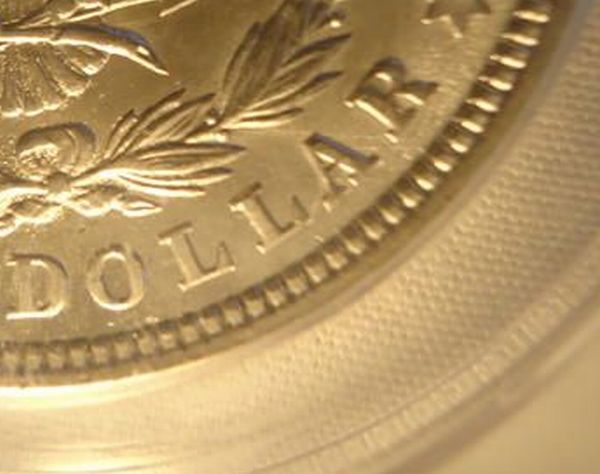 now your original slab, showing the VAM 41 attribution 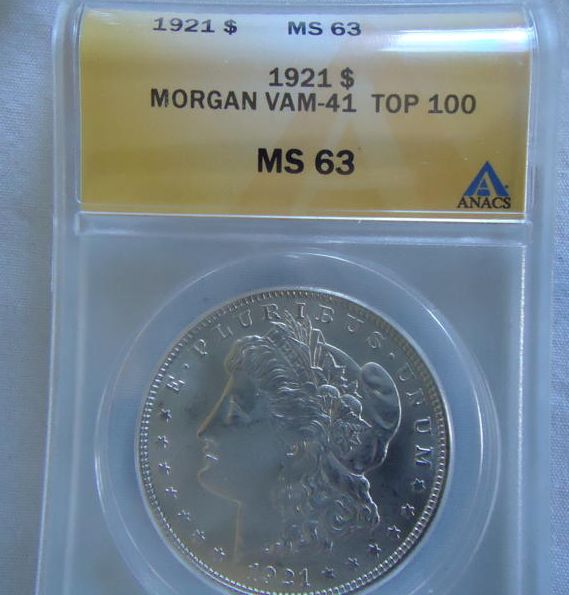 One must remember, as the years go by the bigger picture is seen... as time goes by there are revisions, as many vams as first found are but a snap shot of the dies life,, as time goes by and more vams are found to be of same dies progression and marriages, or possible multiple mariages within the series...Oz could explain it better... |
|
Pillar of the Community
3660 Posts |
Yes, and as time goes by, there are more vams given status as new marriages, that really are not..... superficial die cracks can disappear and new cracks can form in other places on the same die.
Yes, and as time goes by, there are more marriages gone unnoticed because they cannot be distinguished from a similar die pair..... die classification has definite limitations versus positive die identification...... for any given year, how many actual die pairings is vam-1 or VNA?
|
|
Pillar of the Community
United States
3076 Posts |
had to resize the file lines...sorry Actually the number of VAM 1 or VNA's don't mean a thing....as with any denomination or collectible coin its not the number of "NORMAL" coin's it's the number of abnormalities which make it collectible... there are as you know...there are die variety's and there are "MINT errors...different animals but .both are collectible by those who love to collect such things.... |
|
Pillar of the Community
United States
5700 Posts |
To stay on topic lets take the VAM 84A, B1 Reverse it is clashed with among other clashes the letter E transferred under the tail feathers and the VAM # is 84A. Well as stated above, as time goes by the clashed letter E slowly disappears and the coin, once checked again with out the transferred clashed letter E, is NOW a VAM 84, because the differences between the two are the clashes and the broken Die ( cracked ) under the 4th right star and travels towards the date into the denticles, and with out a very good eye and an experienced person attributing, it is possible the die break might not be seen and the coin would be attributed as a VAM 84, was an 84A, but time and every strike after the original dies clashed, the evidence slowly disappears........ |
|
Pillar of the Community
3660 Posts |
Quote:Actually the number of VAM 1 or VNA's don't mean a thing.... Yes, that much is true sadly..... that is just one of the many drawbacks of vamming...... Nobody knows for sure just what they are looking at because they are unable to distinguish one die pair from another in a good many cases..... They may think that they know with all certainty, but reality does not allow it. Quote:
.as with any denomination or collectible coin its not the number of "NORMAL" coin's it's the number of abnormalities which make it collectible... I really could not disagree more with that..... folks who collect by variety are in a very small minority..... Coin collectors in general collect by type, date, and mint mark, without any consideration for variety at all..... (and that is a fact).... 1893-S.... 1889-CC.... who cares what variety they are? Those are some pretty nondescript coins..... One Morgan of each year and each mint mark is the standard. How many vammers are there for every 10,000 coin collectors? One? Maybe? The same is true for other types of coins.... Most folks collect CBH by year, not by variety, despite the fact that CBH are actually distinguished by die pairs rather than mere similarities like vams are. How many vams are there? There probably is a definite number, although it changes slightly from day to day, usually increasing..... how many die pairings were there? Nobody will ever know, and it most likely does not even remotely resemble the number of vams already designated. Bob is clean shaven, call him VAM 3.... Bob grows a mustache, now he is VAM 6.... Bob grows a beard, he is now VAM 6A..... Bob shaves his moustache and beard, but cuts himself in the process, he is now VAM 13..... Bob's wound heals, he is now VAM 10A because he has a scar from cutting himself.... Bob has a twin brother, although they are different people, his brother is VAM 10 while Bob remains VAM 10A......Some of these different vams are really the same die pair...... Some VAM 10s are really different die pairs.... None of this matters though, because "the number of VAM 1 or VNA's don't mean a thing...." |
| |
Replies: 160 / Views: 13,706 |







 First Page
 Previous Page


 Posted 02/13/2011 1:40 pm





